







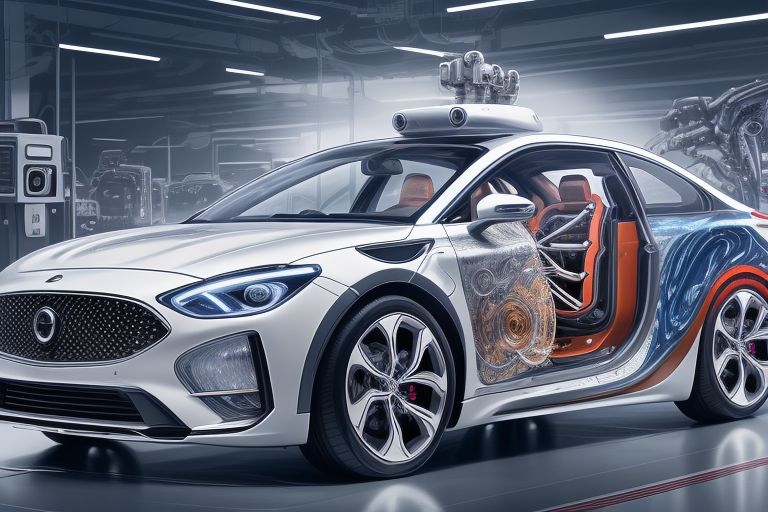
The automobile industry is currently experiencing a radical shift, propelled by the progress of artificial intelligence (AI) and automation. These innovative technologies are fundamentally altering the paradigm of vehicle design, production, and operation, offering a plethora of opportunities to enhance safety, efficiency, and the overall user experience.
AI’s Ascendancy in Vehicle Operation
The automotive sector is witnessing a pivotal shift towards AI-driven vehicles, which are poised to revolutionize the driving experience. While traditional mechanical systems are being increasingly supplanted by sophisticated, AI-powered technologies, the transition from human-operated to autonomous vehicles marks a significant societal transformation. Initially, the concept of fully autonomous vehicles may encounter resistance from the public, as historical precedents have shown that revolutionary technologies often face skepticism prior to achieving mass adoption.
AI’s prevalence is most evident in the proliferation of Advanced Driver-Assistance Systems (ADAS), which serve to amplify vehicle safety by minimizing human error. These systems are founded on a synthesis of AI and machine learning, capable of performing functions like lane maintenance, adaptive cruise control, and emergency braking. As AI evolves, it is anticipated that these systems will grow increasingly reliable, paving the way for vehicles that demand minimal human input.
The Imperative of Responsible AI Governance
The increasing integration of AI in vehicle systems necessitates careful governance to ensure responsible deployment. The balance between the advantages of automation and potential risks is delicate. Paramount considerations encompass the safety of autonomous vehicles, ethical concerns pertaining to data bias, and the transparency of AI decision-making, especially under critical circumstances. To foster trust among consumers and regulatory bodies, it is essential that AI systems are robust, comprehensible, and devoid of bias.
Moreover, the integration of AI into vehicles raises complex questions regarding accountability. In the event of an autonomous vehicle accident, the attribution of liability can be intricate. This has precipitated debates surrounding the necessity for clear-cut regulatory frameworks that address the legal and ethical ramifications of autonomous driving.
The Trials of Data Management and Integration
A notable challenge in the adoption of AI within the automotive industry is the management of the vast quantities of data produced by connected and autonomous vehicles. The data deluge, derived from sensors, cameras, and onboard technologies, necessitates robust storage and analysis systems. The data volume continues to escalate, which in turn amplifies the associated costs of cloud storage and data management.
Furthermore, integrating AI with the legacy systems of older vehicles poses a substantial hurdle. Many vehicles currently in circulation were not conceived with AI compatibility, making retrofitting them with advanced technologies a complex and costly endeavor. Despite these hurdles, there are substantial opportunities in domains like predictive maintenance, where AI can anticipate potential issues and avert breakdowns, thereby enhancing vehicle reliability and reducing maintenance costs.
The Synergistic Alliance of Startups and Industry Titans
The breakneck pace of innovation in AI and automation has spawned numerous collaborations between nimble startups and established automotive behemoths. Startups contribute their cutting-edge technologies and agility, while traditional manufacturers provide the necessary infrastructure and market penetration to scale these solutions effectively. These collaborative efforts have spawned AI-infused products that optimize vehicle design, safety, and consumer experiences.
Generative AI, for instance, holds the promise of dramatically reducing design cycles by automating the creation of intricate vehicle components and systems. Predictive maintenance represents another promising frontier, where AI can scrutinize vehicle data to foresee potential malfunctions, thereby enabling preventive repairs and minimizing downtime.
The Evolution of AI in Vehicle Safety and Autonomy
Looking to the future, AI’s contributions to vehicle safety and autonomous driving are poised to amplify. Emerging trends such as multimodal AI, integrating data from various sensors to refine vehicle perception, are set to disrupt the industry. Additionally, self-learning systems capable of adapting to real-time driving conditions are likely to proliferate, empowering vehicles to navigate unforeseen situations with greater accuracy.
Swarm intelligence, a concept that involves multiple vehicles communicating to optimize navigation and enhance traffic flow, also holds significant promise. This collaborative driving model has the potential to boost safety, alleviate congestion, and improve fuel economy. Nonetheless, the widespread integration of such technologies hinges on advances in vehicle-to-vehicle communication and cybersecurity to safeguard against potential vulnerabilities.
AI’s Global Market Implications
The embrace of AI in the automotive sector is not homogeneous across the world. While some regions, like the Middle East, are fostering the growth of autonomous vehicle technologies through conducive regulations and testing environments, others, such as South and Southeast Asia, grapple with infrastructural challenges and regulatory discrepancies despite governmental backing for AI and machine learning.
In Europe, where infrastructure is more developed, there is a greater willingness to embrace AI technologies, particularly concerning autonomous vehicles. Nonetheless, the regulatory framework must keep pace with technological advancements to ensure ethical and safe implementation. The disparate regulatory landscapes across regions underscore the criticality of adopting adaptable, region-specific strategies to promote the responsible growth of AI and automation within the automotive sector.
AI’s Influence on Manufacturing and Mobility Innovations
AI’s impact extends beyond autonomous driving to the realms of automotive manufacturing. Technologies such as AI-powered diagnostics, predictive maintenance, and real-time monitoring of production processes are streamlining operations and bolstering efficiency. For instance, embedded AI agents in manufacturing machinery are breaking down silos and enhancing inter-device communication, leading to more fluid production cycles and expedited response times.
Consumer-focused automotive applications of AI include smarter fleet management systems, advanced diagnostics, and the integration of IoT devices. These innovations are not only improving vehicle performance but also elevating the customer experience by providing real-time insights into vehicle health and performance.
Takeaway
AI and automation are set to redefine the automotive industry, bringing forth a new epoch of innovation and productivity. While hurdles persist, particularly in data management, regulatory compliance, and ethical governance, the prospects for advancement are vast. Collaborative efforts between startups, traditional manufacturers, and policymakers will be pivotal to ensure that the deployment of AI and automation in vehicles prioritizes consumer benefits and societal progress.