







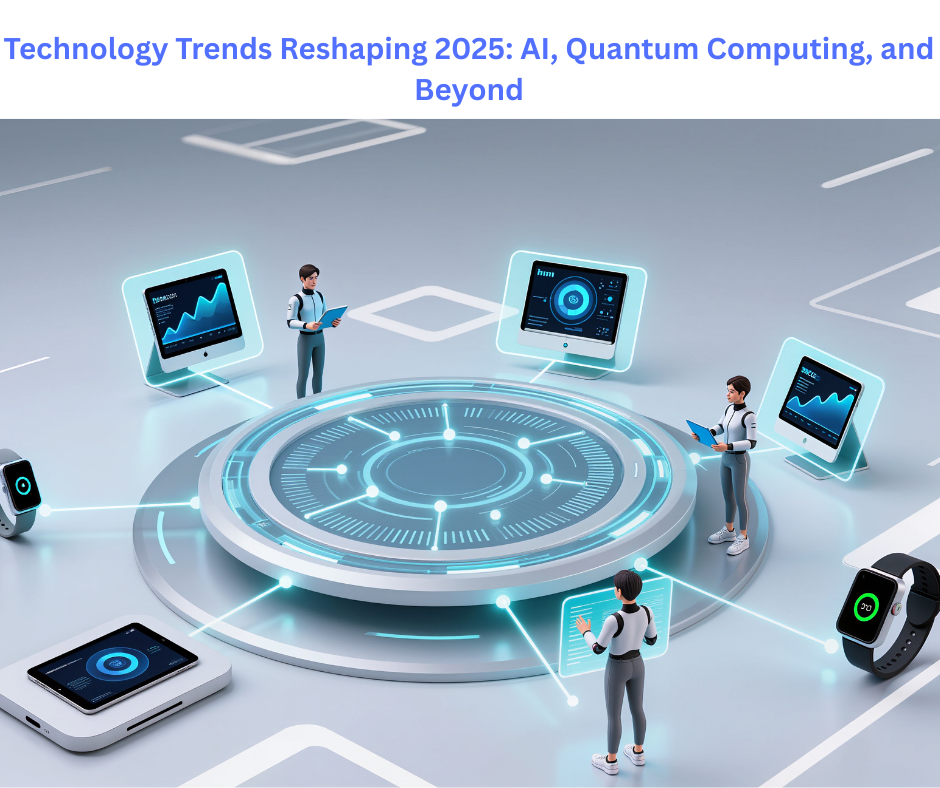
In 2025, the technology landscape is undergoing unparalleled change in a number of areas. The rate of innovation keeps speeding up, from autonomous AI agents transforming business operations to quantum computers moving from research labs to commercial applications. This thorough analysis looks at the most important technology developments that are reshaping sectors and creating new commercial and research opportunities.
The Rise of Autonomous AI Agents
Artificial intelligence is now much more advanced than simple chatbots. In 2025, autonomous AI agents that can operate without human input are becoming essential to business operations, marking a significant change in how companies use AI technology.
These advanced agents perform continuous data analysis, automate multi-step business processes, and communicate directly with other software systems. Compared to earlier AI tool generations that needed ongoing human supervision and involvement, this represents a substantial advancement. These agents’ autonomy allows them to manage intricate workflows, make choices based on real-time data, and adjust to changing circumstances without requiring manual reconfiguration.
Copilots and generative AI are concurrently speeding up coding, decision-making, and content production across industries. Driven by developments in massive language models, agentic AI has become a key enabler in a number of industries, radically altering the way work is done. These systems are being implemented by organizations as essential parts of their operational architecture, not only to increase efficiency.
Notable examples include the incorporation of AI into digital twins, cyber-physical systems, and edge computing. By removing latency problems and facilitating automation at the data generating stage, these apps enable real-time insights and quicker reaction times. Applications ranging from smart city infrastructure to industry automation are finding that this distributed approach to AI implementation is crucial.
Semiconductor Industry: Powering the AI Revolution
The semiconductor industry is going through an unprecedented period of growth in terms of both size and strategic significance. The sector is experiencing rapid innovation and significant investment due to the demand for AI chips and high-performance processors.
In order to support generative AI workloads, specialized AI accelerators and graphics processing units have become essential. The market is reacting with impressive growth forecasts: sales of generative AI chips are predicted to reach $150 billion in 2025 alone. Companies are accelerating their development schedules as a result of this growing demand, which is changing the competitive landscape.
The production of advanced chips is developing at a breakneck speed. Higher transistor density and increased power efficiency are made possible by the development of node technology, which is a major milestone in shrinking. More integration and performance improvements that were previously unattainable are now available thanks to advanced packaging techniques like TSMC’s CoWoS (Chip-on-Wafer-on-Substrate) technology. In order to meet the computing requirements of next-generation AI applications, these manufacturing advancements are essential.
The market for memory is changing, especially in the area of High-Bandwidth Memory (HBM). Because it provides the data throughput required for training and operating big AI models, this specialized memory technology has become crucial for AI accelerators. Due to the unquenchable desire for quicker, more effective memory solutions, the HBM industry is predicted to propel overall memory revenues up by an astounding rate in 2025.
The development of neuromorphic circuits, which imitate organic neural systems to provide incredibly effective AI processing, is arguably the most fascinating. A radically different approach to computing is represented by these specialized processors, which may allow for the development of new kinds of applications with significantly reduced power requirements.
Quantum Computing: From Laboratory to Marketplace
In 2025, quantum computing has reached a turning point, moving from strictly scholarly study to early commercial influence. This change is the result of years of consistent work to overcome the basic obstacles that have long prevented quantum computing from being used outside of research facilities.
Significant gains in qubit performance, including improved coherence times and reduced error rates, have been made recently. More useful quantum systems are being made possible by the integration of specialized hardware and software, and hybrid quantum-AI systems are creating new opportunities by fusing the advantages of both processing paradigms.
Quantum computing’s application fields are growing quickly and getting more tangible. Quantum simulations, which can predict chemical interactions with previously unheard-of accuracy, are helping in drug discovery. Quantum computing is being used in climate modeling applications to process complicated atmospheric and oceanic data at previously unattainable scales. While post-quantum cryptography initiatives are planning for a future where conventional encryption techniques may be susceptible, materials science researchers are harnessing quantum systems to create novel materials with particular features.
These applications are no longer just theoretical. Pharmaceutical businesses, climate research institutes, and materials manufacturers are investing in quantum computing capabilities, which is driving real-world pilots across industries. The technology is demonstrating its worth by resolving optimization issues and simulations that are too complex for traditional computers.
Governments and business executives are increasing investments and workforce development programs in recognition of the strategic significance of quantum technology. With countries seeing quantum capacity as crucial to their future technical and economic competitiveness, the battle to take the lead in quantum computing is getting fiercer.
Next-Generation Connectivity and Extended Reality
The networking infrastructure that facilitates digital transformation is changing quickly. The capabilities and reach of 5G and next-generation wireless networks are growing, radically altering the possibilities for mobile communication.
5G is making real-time, high-bandwidth applications possible on a large scale, with rates as high as 20 gigabits per second. Both the deployment of augmented and virtual reality systems and the Internet of Things are greatly benefiting from this increased connectedness. Most importantly, 5G is enabling autonomous cars by supplying the high-reliability, low-latency connectivity required for safe operation.
Systems for virtual reality and augmented reality are evolving on their own, with advancements in wearability, resolution, and interaction propelling acceptance in a variety of industries. Although gaming is still a significant business, the technology is rapidly being used in healthcare, education, and industrial training. Long usage sessions are now feasible for the first time thanks to the enhanced fidelity and comfort of contemporary XR devices.
These days, immersive job training programs that lower costs and increase safety are powered by extended reality technologies. While remote work and cooperation are changing due to the merging of digital and physical environments, virtual campuses are increasing access to education. The way people engage with information and with one another over long distances has been fundamentally expanded by these technologies.
Sustainable Technology Infrastructure
AI and advanced computing’s massive energy requirements are posing new problems and spurring innovation in energy infrastructure. The technology sector is searching for sustainable solutions as a result of the enormous amounts of electricity needed to run data centers at scale and train massive AI models.
There is a resurgence of interest in nuclear power as a remedy for these energy problems. In order to supply clean, dependable electricity for data centers and high-performance computing facilities, next-generation reactors are being built.
Innovations in batteries and renewable energy technologies, aside from nuclear energy, are growing quickly. In order to meet both short-term environmental aims and long-term climate change objectives, carbon capture systems are being implemented to offset emissions. The technology industry is realizing more and more that sustainable operations are crucial for long-term viability from both an environmental and strategic standpoint.
Biotechnology: AI Meets Life Sciences
In 2025, biotechnology and artificial intelligence are coming together to produce amazing discoveries. AI algorithms that can forecast editing results and improve targeting tactics are improving gene-editing tools like CRISPR. The period from pathogen identification to effective vaccine candidates is being accelerated by new platforms for vaccine development. Finding interesting medicinal molecules is becoming much faster and less expensive thanks to AI-enhanced drug discovery.
With AI algorithms evaluating genetic data to suggest customized treatment plans, personalized medicine is becoming more and more feasible. These same technologies are being used in agriculture to create resilient crops that can sustain or increase yields while withstanding climate difficulties.
AI-powered digital health solutions and synthetic biology are developing completely new diagnostic and therapeutic categories. Emerging bio-based manufacturing techniques have the potential to replace conventional chemical processes with more environmentally friendly biological ones. These developments signify a profound extension of the possibilities in biological engineering and healthcare.
Looking Ahead
The technical innovations of 2025 are linked patterns that support and magnify one another rather than discrete breakthroughs. The need for sophisticated semiconductors, which enable more potent AI systems, is fueled by AI. While AI optimizes quantum systems, quantum computing promises to speed up AI development. While demanding sophisticated connectivity and computing capacity, extended reality develops new interfaces for intricate technologies.
When taken as a whole, these developments are speeding up digital transformation in every industry area. They are enabling innovative business models, expanding the boundaries of research, and radically changing operating paradigms. The state of technology in 2025 reflects not only little but significant advancements but also a number of turning points that will influence the course of innovation for years to come.
As these technologies develop and converge, their influence will go much beyond the technology industry itself, affecting every facet of how we work, communicate, learn, and address society’s major problems. 2025’s breakthroughs are setting the stage for a future that will be more digital, linked, and able to solve issues that were previously thought to be unsolvable.
Quotients is a platform for industry, innovators, and investors to build a competetive edge in this age of disruption. We work with our partners to meet this challenge of metamorphic shift that is taking place in the world of technology and businesses by focusing on key organisational quotients. Reach out to us at open-innovator@quotients.com