







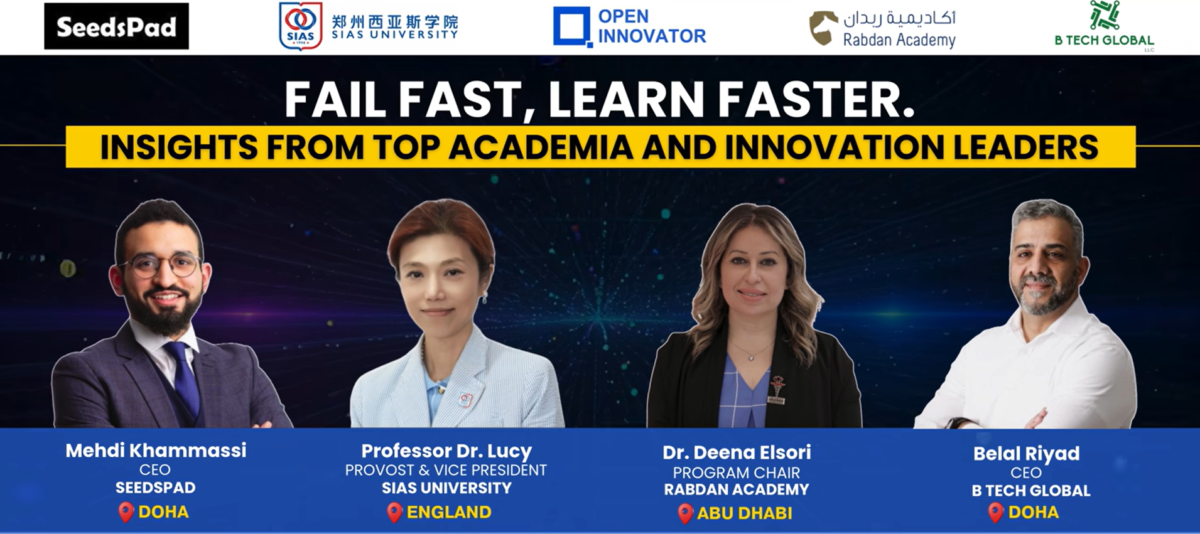
At our recent Open Innovator Session, we dove into topic ‘F𝗮𝗶𝗹 F𝗮𝘀𝘁 𝗮𝗻𝗱 L𝗲𝗮𝗿𝗻 F𝗮𝘀𝘁𝗲𝗿’. A distinguished panel of innovation experts gathered to explore the transformative power of failure in driving business success.
The discussion featured Mehdi Khammassi, an experienced entrepreneur specializing in rapid iteration strategies; Professor Dr Yang (Lucy) Lu, an academic leader in innovation education; Dr. Deena Elsori, a researcher focused on entrepreneurial psychology and confidence building; and Belal Riyad, a startup practitioner with extensive experience in customer-centric product development. The session was moderated by Naman K, who facilitated insights on building collaborative innovation communities.
Key Discussion Points
The Failure Reality Check
The panel opened with a striking statistic: 90% of startups fail not because they have bad ideas, but because they learn too slowly from their mistakes. This fundamental insight shaped the entire conversation, with participants arguing that traditional approaches to avoiding failure actually slow down the innovation process.
Redefining Success and Failure
The experts challenged conventional thinking by positioning failure as the actual process of success rather than its opposite. Khammassi emphasized that “it’s not us who fail; it’s our hypothesis,” helping entrepreneurs separate their personal identity from business outcomes. This psychological shift enables faster decision-making and reduces the emotional barriers to necessary pivots.
Building Confidence Through Action
Dr. Elsori provided a counterintuitive insight about confidence, stating that “confidence is a result of overcoming failure, not a prerequisite.” This perspective encourages entrepreneurs to take action despite uncertainty, building resilience through direct experience rather than waiting for complete confidence before moving forward.
Customer-Centric Learning
Belal Riyad stressed the importance of understanding customer pain points and using real feedback to guide product development. He advocated for focusing on small features and minimal viable products to learn faster, rather than building extensive solutions based on assumptions. This approach ensures that innovation efforts address actual market needs.
Academic Innovation
Professor Dr Lu discussed how educational institutions can foster fail-fast principles through structured experimentation. She emphasized creating learning environments where failure becomes a valuable educational tool rather than a source of discouragement.
Core Methodology Principles
The panel identified several key principles for implementing fail-fast approaches:
Speed of Learning: Organizations must prioritize how quickly they can extract lessons from failures rather than focusing solely on avoiding mistakes. Rapid iteration and hypothesis testing become more valuable than extensive planning.
Ego Management: Successful innovators learn to receive objective feedback without letting personal attachment to ideas prevent necessary changes. This emotional discipline enables more rational decision-making throughout the innovation process.
Customer Engagement: Direct interaction with target markets provides the most valuable insights for refining products and services. Customer feedback should drive iteration cycles rather than internal preferences or assumptions.
Risk Reframing: Rather than avoiding risks, successful innovators take calculated risks with rapid feedback mechanisms that minimize potential losses while maximizing learning opportunities.
Practical Applications
The experts provided concrete strategies for implementing these principles across different contexts. Startups can use minimal viable products to quickly test market assumptions before investing in full development. Academic institutions can create experimentation-friendly environments that encourage student innovation. Established companies can develop internal cultures that reward learning from failure rather than penalizing unsuccessful attempts.
Community and Collaboration
Host Naman K emphasized the collaborative nature of innovation, encouraging continued dialogue among innovators, entrepreneurs, and educators.
The session also had a presentation from Puneet Agarwal, Founder, AI LifeBOAT, who introduced his product to the panelists. The virtual event concluded with strong encouragement for community engagement and peer-to-peer learning as essential components of the fail-fast methodology.
Looking Forward
The panel’s insights suggest a fundamental shift in how organizations should approach innovation challenges. By embracing failure as a learning accelerator rather than an outcome to avoid, businesses can develop more effective products, build stronger teams, and create sustainable competitive advantages in rapidly changing markets. The unanimous agreement among these diverse experts indicates growing recognition that strategic failure management will become increasingly critical for innovation success.
Write us to at open-innovator@quotients.com to get more information on our upcoming sessions.