






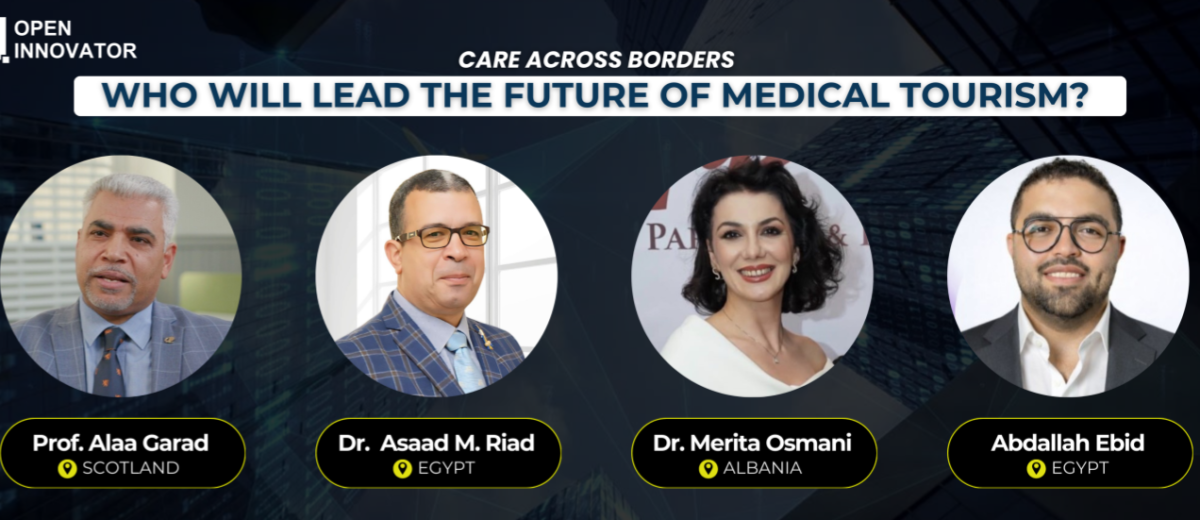
Open Innovator recently organized a virtual session, exploring the massive disruption within the global medical tourism sector and the strategic pivots required to lead the future of borderless healthcare.
Session Participants
- Naman Kothari: Moderator, Nasscom.
- Dr. Asad Riad: Medical excellence expert for Egypt and the MENA region.
- Professor Alaa Garad: Global hospital strategy authority, based in Scotland.
- Abdullah Ebid: Technology innovator and developer of AI-driven patient journey platforms.
- Dr. Merita Osmani: Healthcare visionary representing Albania’s emerging medical sector.
The Death of Geographic Monopoly
The traditional paradigm where healthcare quality was determined by a patient’s zip code has effectively collapsed. In 2026, we are witnessing a “silent migration” of over millions of people annually crossing international borders for care. This billion dollar industry is no longer a niche market; it is a strategic financial pivot for patients. While a complex heart bypass in the United States might cost upwards of $150,000, the same procedure in India—performed by surgeons trained at world-class institutions like Stanford—costs approximately $10,000. This massive cost delta allows patients to integrate high-end travel and family recovery into their medical budgets while still retaining significant savings.
From Medical Intervention to Holistic Health Tourism
The industry is evolving beyond simple surgical procedures into a broader “Health Tourism” umbrella. This shift encompasses six to seven distinct segments, including regenerative medicine, wellness, mental health, and spiritual healing. The journey is no longer viewed as a purely physical transaction but as an opportunity for cultural discovery and personal growth. Strategists noted that while digital consultations can replace some physical visits, the human element of travel—experiencing new territories and food—remains a vital component of the recovery and business ecosystem.
Trust: The Only Currency That Matters
While affordability was once the primary driver, the modern international patient now prioritizes certainty and reputation. In a market where multiple countries offer similar pricing, the deciding factor is trust. Experts emphasized that “trust is the currency, but technology is the bank.” This trust is built on invisible infrastructure: post-operative care, insurance interoperability, and the elimination of legal surprises, such as medication restrictions at transit airports. The focus has shifted from finding the cheapest price to identifying the “right” doctor who fits a specific condition, verified by AI-driven precision.
The Digital Navigator and AI Precision
The future of the sector likely belongs to digital platforms that act as “medical navigators” rather than simple marketplaces. Unlike booking a hotel or a flight, healthcare requires a deep, guided coordination of the entire patient relationship from start to finish. AI now allows for a “digital handshake” to occur long before a patient arrives at a facility. These platforms provide informed decision-making tools, allowing patients to compare treatment plans—often cross-referencing them with generative AI models—to ensure they are making the safest choice.
Infrastructure vs. Cultural Software
A critical distinction was made between “hardware” and “software” in healthcare. While building state-of-the-art hospitals and purchasing advanced machinery (the hardware) is relatively easy with sufficient capital, developing the “software”—ethics, transparency, and cultural sensitivity—is the true challenge. Leading destinations must invest in learning-driven environments where staff are trained in cultural nuances, such as faith-based medical preferences and linguistic diversity. Furthermore, there is a recognized risk of creating “two-tier” systems where international patients receive faster care than locals; a balanced national strategy is essential to ensure that medical tourism supports, rather than burdens, the local healthcare infrastructure.
Conclusion
The future of medical tourism in 2026 is being defined by a move away from fragmented services toward integrated, learning-driven patient experiences. Success will not be measured by the number of hospital beds, but by the strength of the digital and ethical “software” that fosters global trust. As new hubs like Egypt, Albania, and Scotland rise to challenge traditional leaders, the winners will be those who treat healthcare not just as a medical procedure, but as a borderless, culturally sensitive journey.
Open Innovator serves as a platform dedicated to mapping global industry shifts and providing “information capital” before it reaches the mainstream. Please write us at open-innovator@quotients.com for more information.