






Open Innovator hosted Agentic AI Knowledge Session convened an assembly of distinguished thought leaders, innovators, and industry professionals to delve into the transformative prospects of agentic AI in revamping business practices, fostering innovation, and bolstering collaboration.
The virtual event held on March 21st , moderated by Naman Kothari, underscored the distinctive traits of agentic AI—its proactive and dynamic nature contrasting with the traditional, reactive AI models. The session encompassed engaging panel discussions, startup presentations, and profound insights on how small and medium enterprises (SMEs) can exploit agentic AI to enhance productivity, efficiency, and decision-making capabilities.
Prominent Speakers and Discussion Points:
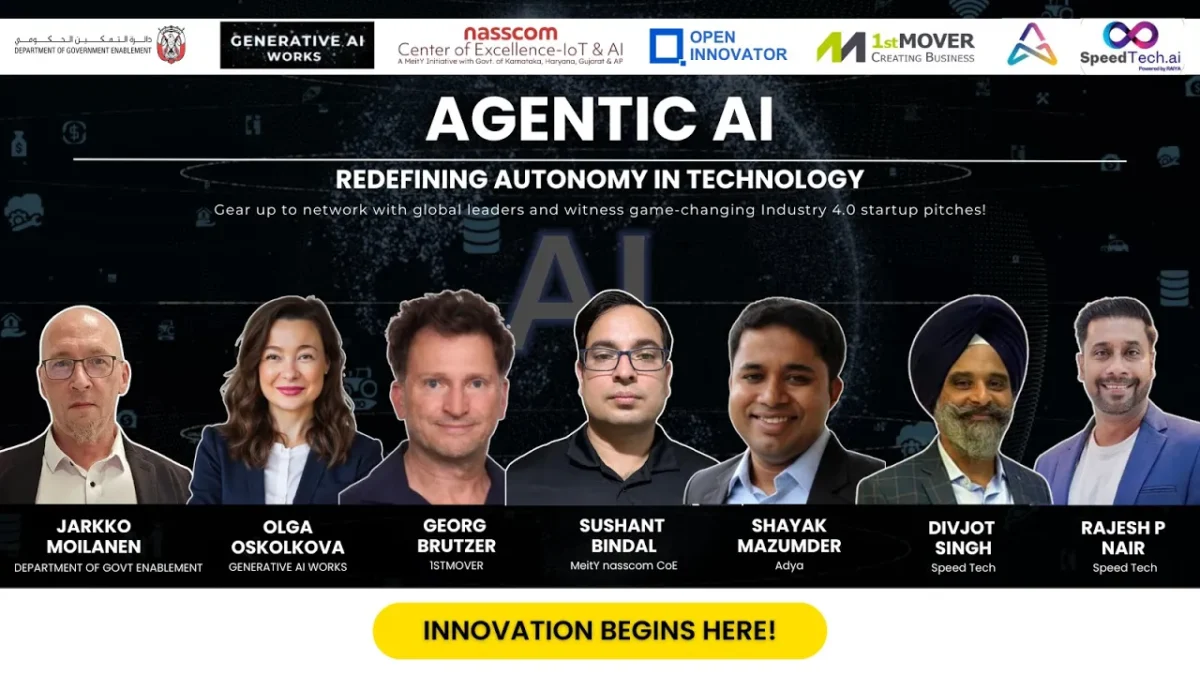
- Sushant Bindal, Innovation Partnerships Head at MeitY-Nasscom CoE, steered conversations about nurturing innovation within Indian businesses.
- Dr. Jarkko Moilanen, Platform Product Head for the Department of Government Enablement in Abu Dhabi, UAE, offered insights into AI’s evolving role within governmental and public domains.
- Olga Oskolkova, Founder of Generative AI Works, and Georg Brutzer, Agentic AI Strategy Consultant, delved into the long-term implications of agentic AI for commerce and governance frameworks.
- Shayak Mazumder, CEO of Adya, presented their technology platform, which is instrumental in advancing ONDC adoption in India and simplifying AI integration.
- Divjot Singh and Rajesh P. Nair, the masterminds behind Speed Tech, showcased their intelligent enterprise assistant aimed at optimizing operations and enhancing decision-making processes.
Overview of the Future of AI in Business
Naman Kothari initiated the session by distinguishing between conventional AI and agentic AI, likening the latter to a proactive participant in a classroom setting. This distinction laid the foundation for an exploration of how AI can transcend automation to facilitate real-time decision-making and collaboration across various industries.
Agentic AI’s Impact on SMEs
A pivotal theme was the substantial benefits that agentic AI can offer to SMEs. Georg Brutzer underscored that SMEs are at disparate levels of digital maturity, necessitating tailored AI approaches. More digitized firms can integrate AI via SaaS platforms, while less digitized ones should prioritize controlled generative AI projects to cultivate trust and understanding. Olga Oskolkova reinforced the importance of strategic AI adoption to prevent resource waste and missed opportunities.
Building Confidence in AI: Education and Strategy
A prevailing challenge highlighted was the need to establish trust in AI within organizational structures. Sushant Bindal advocated for starting with bite-sized AI projects that yield evident ROI, particularly in sectors like manufacturing and logistics where AI can enhance processes without causing disruptions.
Olga Oskolkova placed emphasis on AI literacy, suggesting businesses prioritize employee education on AI’s capabilities, limitations, and ethical ramifications. This approach fosters an environment conducive to learning and helps navigate beyond the hype to derive actual value from AI adoption.
Governance and Ethical Considerations
The increasing integration of AI into business processes has brought to the fore the necessity for robust governance frameworks and ethical considerations. Dr. Jarkko Moilanen spoke on the evolving nature of AI and the imperative for businesses to adapt governance models as AI systems become more autonomous. Balancing machine autonomy with human oversight remains vital for AI to serve as a complementary tool rather than a human replacement.
AI as a Catalyst for Startup and Enterprise Synergy
AI’s role in fostering collaboration between startups and large corporations was another key discussion point. Sushant Bindal pointed out that AI agents can function as matchmakers, identifying supply chain gaps and business needs to facilitate beneficial partnerships. These collaborations can spur innovation and ensure mutual growth for startups and established enterprises.
SaaS Companies and AI’s Evolution
The session touched on the challenges and opportunities SaaS companies face as AI advances. Olga Oskolkova discussed how AI’s transition from basic automation to complex agentic systems would affect business models, suggesting a shift from traditional subscription-based to token-based pricing models tied to output and effectiveness.
Moreover, as AI takes on more sophisticated tasks, businesses must reevaluate their approach to adoption and integration, maintaining human engagement while leveraging AI’s potential.
Startup Showcases: Adya AI and Speed Tech
The session included captivating startup pitches from two innovative companies:
– Adya AI, presented by Shayak Mazumder, showcased their platform’s ability to create custom AI agents using a user-friendly drag-and-drop interface, streamlining data integration and app development. This underscored the potential for agentic AI to boost productivity, innovation, and accessibility.
– Divjot Singh and Rajesh P. Nair introduced Speed Tech’s intelligent enterprise assistant, designed to optimize operations and decision-making. Their product, Rya, demonstrated AI’s ability to enhance customer service and minimize operational costs by addressing challenges such as long wait times and document processing errors.
Concluding Remarks and Key Takeaways
The session concluded with an emphasis on collaboration, innovation, and continuous learning as essential for harnessing agentic AI’s potential. The session encouraged the audience to embrace the evolving AI landscape and recognize the vast potential for business transformation. The speakers collectively highlighted the importance of education, strategy, and collaboration in navigating AI integration successfully. The event left participants with a clear understanding of the profound impact of AI and a call to stay informed, explore emerging opportunities, and drive innovation within the realm of AI.