Categories
DTQ

Report: From AI Execution to AI Ownership – Building Teams That Delivers Value

Categories
DTQ

Report: From AI Execution to AI Ownership – Building Teams That Delivers Value

BEYOND THE COGNITIVE COPILOT: TECH LEADERS WARN OF AN ‘ILLUSION OF PROGRESS’ IN ENTERPRISE AI ADOPTION

DTQ convened a high‑impact masterclass to interrogate the state of enterprise AI adoption. The session, led by Abhishek Kulkarni (technology risk and InfoTech leader), challenged prevailing narratives of “success” in corporate AI programs. The purpose was to expose systemic blind spots and equip leaders with a governance‑driven roadmap for 2026.

As corporate investments in artificial intelligence accelerate, a critical systemic flaw is emerging within the enterprise landscape: organizations are mastering the art of AI execution, but completely failing at AI ownership.

During the virtual masterclass addressing the path to future-ready enterprise leadership, Abhishek Kulkarni, a prominent technology risk and InfoTech leader, challenged the current corporate obsession with rapid tool deployment. The central argument? While enterprises have successfully moved past basic capability doubts, they are stalling out at the Minimum Viable Product (MVP) stage because no one is taking structural accountability for the final business outcomes.

The Strategic Shift: From Running Engines to Steering Vessels

The tech risk expert highlighted that the era of treating AI as a mere sandbox experiment is officially over. Today’s boardrooms are no longer asking if a workflow can be automated—they are demanding to know who stands accountable when an automated workflow goes rogue.

The industry evolution is captured by a stark division between past execution milestones and current ownership obligations:

Technical Execution Focus (The Engine)Enterprise Ownership Mandate (The Steering Wheel)
Can AI automate this workflow?Who are the definitive human end-users?
How fast can we launch an MVP?What measurable business value is being created?
Which platform or copilot should we buy?Who signs off on data decisions and model ethics?
How do we maximize productivity metrics?How do we secure long-term enterprise equity?

“Execution is the fuel, the speed, and the engine,” the speaker noted during the session. “But without defined accountability and outcome measurement, execution is just an aggressive, directionless expenditure of effort.”

Case Study: The Ghost in the Onboarding Machine

To anchor this problem in real-world stakes, a case study involving a recently deployed generative AI onboarding system was presented. On paper, the project was a resounding success—it significantly cut down customer transaction processing times and optimized data ingestion pipelines.

However, a structural compliance audit revealed an organizational vacuum:

  • The Infrastructure: The technology development team claimed complete ownership of the underlying code and models.
  • The Perimeter: The risk and cyber security teams took ownership of the deployment guardrails.
  • The Consequences: When asked who structurally owned the actual business outputs and operational decisions made by the AI, the room went entirely silent.

This siloed approach exposes a dangerous corporate reality: technical teams are managing the tools, but no business entity is managing the outcomes.

Exposing the “Illusion of Progress”

The core takeaway of the briefing was the concept of the Illusion of Progress. High corporate activity, constant pilot program announcements, and widespread copilot usage often create a false sense of security. In reality, this technical velocity represents only the visible tip of an operational iceberg, concealing deep structural liabilities beneath the surface.

The Three Critical Fault Lines:

  • The IT Ticket Fallacy: When an enterprise model behaves erratically, organizations treat it as a technical glitch by default, routing it to IT support. True ownership must belong to the functional business leader (e.g., the Head of Customer Onboarding) who relies on that system.
  • The “Build vs. Buy” Escalation Void: Modern enterprises rarely build models from scratch; they fine-tune pre-existing third-party architectures. When a fine-tuned model exhibits unpredictable biases, corporations frequently lack any pre-defined legal or operational escalation framework to resolve the breakdown.
  • Fragmented Corporate Silos: Responsibility is currently fractured. Tech teams own the deployment, product teams own the features, and support teams manage the fallout. Without a unified framework, holistic management of business value remains impossible.

The 2026 Action Plan for Leadership

To successfully convert AI execution into sustainable enterprise asset value, the briefing concluded with three mandatory directives for technology and operational leaders:

  1. Mandate Business-Side Product Owners: Stop assigning AI tools exclusively to IT. Every tool in production must have a designated business champion who is legally and operationally accountable for its outputs.
  2. Shift KPIs to Value Pools: Evaluate AI teams based on structural business outcomes (such as risk mitigation, customer retention, or cost reduction) rather than tool adoption metrics or engineering speed.
  3. Establish Cross-Functional Governance: Replace fragmented team silos with a unified decision governance framework that spans tech, security, legal, and operational leadership across the entire life cycle of the automated asset.

Conclusion

DTQ’s masterclass reframed AI adoption as a governance and accountability challenge. The warning was clear: without ownership, enterprises risk mistaking motion for progress. The path forward demands structural accountability, outcome‑driven KPIs, and unified governance to transform AI from a technical experiment into a sustainable enterprise asset.

Data Trust Quotients (DTQ) as a strategic ecosystem architect, bridges gaps between industry, startups, and investors. DTQ blends data privacy, governance, and cutting-edge AI to accelerate transformative breakthroughs in different domains.

Categories
DTQ Data Trust Quotients

Report: The Last Mile of AI- Why Governance and Trust Are the New ROI in 2026

Categories
DTQ Data Trust Quotients

Report: The Last Mile of AI- Why Governance and Trust Are the New ROI in 2026

The Evolution of the AI Narrative

In the initial gold rush of Generative AI, the global conversation was dominated by three pillars: speed, experimentation, and raw capability. Organizations raced to integrate Large Language Models (LLMs) into their workflows, driven by a “fear of missing out” and the allure of unprecedented productivity gains. However, as we move through 2026, the narrative has fundamentally shifted. The industry has reached a critical inflection point where the novelty of AI has worn off, replaced by a sobering realization of the complexities involved in actual production.

Ashwini Giri, a renowned Architect of Data Trust and Responsible AI, recently led a masterclass titled at DTQ “The Last Mile of AI.” The core question he posed to a room of executives and engineers was simple yet profound: How do we build and deploy AI systems that people can actually trust?

The “last mile” of AI deployment—the transition from a successful laboratory prototype to a reliable, live enterprise system—is where most real-world challenges surface. It is the bridge between a conceptual “cool tool” and a mission-critical business asset. In this virtual masterclass, Giri explored why the path to production is paved with governance, why trust has become the ultimate market differentiator, and how organizations must pivot to survive the transition from AI hype to AI responsibility.

Why Trust Matters: The New Corporate Frontier

We are currently operating under intense AI adoption pressure. Boardrooms, executive committees, and venture capitalists are no longer asking if AI should be integrated, but how fast it can happen. This pressure is driven by the hunt for Return on Investment (ROI). Yet, beneath the surface of this enthusiasm lies a deep-seated fear: the erosion of customer trust.

In the digital economy, trust is not an abstract virtue; it is a tangible asset. It is the differentiator that separates ordinary firms from “blue-chip” organizations. A blue-chip company isn’t defined just by its revenue, but by its reliability and the degree to which it safeguards customer data.

Data integrity serves as the bedrock of this trust. If an AI system hallucinates, leaks sensitive information, or makes biased decisions, the damage to the brand is often irreparable. As Giri notes, organizations are beginning to realize that while models are replaceable, the trust of a customer base, once lost, is nearly impossible to regain.

The Production Paradox: Why AI Projects Fail

To illustrate the gap between expectation and reality, Giri conducted an icebreaker poll asking: “Why do AI projects fail in production?” While many participants initially pointed toward technical hurdles like lack of compute power or poor model accuracy, the definitive answer was weak data quality and governance.

This is the production paradox: we spend millions on sophisticated algorithms, yet the systems fail because of the data they consume. Models are essentially mirrors; they reflect the quality of the input data. Without governance, there is no traceability, no accountability, and no ethical guardrail. Technical limitations are rarely the deal-breaker in 2026; rather, it is the lack of robust processes and oversight that causes projects to collapse at the finish line.

The Current Reality: A Landscape of Jittery Leaders

Despite the billions invested, the statistics regarding AI success remain startling. According to recent McKinsey reports, approximately 80% of AI programs fail to deliver their intended results.

These failures are not just academic; they carry a massive financial burden. Abandoned projects result in losses totaling millions of dollars, leaving ROI expectations unmet and shareholders frustrated. This has created what Giri describes as a “Trust Deficit.” Currently, only 30–35% of business leaders fully trust their data lineage. They lack clarity on:

  • Data Origin: Where did this information come from?
  • Data Flow: How has this data been transformed as it moved through our systems?
  • Integrity: Can we rely on this output to make a multi-million dollar decision?

This uncertainty has left leadership feeling tentative and “jittery.” When a leader cannot explain why an AI arrived at a specific conclusion, they are understandably hesitant to deploy it in high-stakes environments.

The Organizational Response: New Guardians of the Machine

To combat this deficit, a new corporate structure is emerging. We are seeing the rise of specialized leadership roles: the Chief AI Officer (CAIO) and the Chief Trust Officer (CTrO).

These roles are not merely bureaucratic additions; they are the guardians of the “last mile.” Their purpose is to:

  1. Establish Governance Frameworks: Implementing the “rules of the road” for how AI is developed and deployed.
  2. Safeguard Datasets: Ensuring that the fuel for the AI engine is clean, ethical, and legally compliant.
  3. Provide Board-Level Assurance: Translating technical AI metrics into business confidence.
  4. Enable Traceability: Creating systems where every AI-driven decision can be traced back to its source system.

Transparency is becoming a standard feature rather than an afterthought. For example, modern iterations of tools like Microsoft Copilot now prioritize showing the sources for generated responses. This “show your work” approach is essential for building confidence. When a user can see the citation, the AI moves from being a “black box” to a transparent partner.

Key Takeaways: Mastering the Last Mile

The masterclass concluded with several foundational insights that every modern organization must internalize:

  • Trust is the Differentiator: In a world where everyone has access to the same LLMs, the company that can prove its AI is safe and reliable will win the market.
  • The Bottleneck is Human, Not Technical: Data quality and governance are the real hurdles. Solving the math is easy; solving the data lineage is hard.
  • Failure is Visible: Unlike back-office software failures of the past, AI failure is often public and reputationally devastating.
  • Traceability is Mandatory: Board assurance cannot be based on “vibes” or general optimism; it must be based on a documented trail of data.

The “last mile” challenge is ultimately a shift in focus. It is not about how fast you can launch, but about how well you can govern.

Strategic Implications: A Roadmap for the Future

For organizations looking to bridge the gap between experimentation and safe deployment, Giri outlines a strategic roadmap focused on four key pillars:

1. Invest Heavily in Governance

Organizations must build frameworks that prioritize lineage and accountability. This means investing in tools that catalog data, track model versions, and monitor for bias in real-time. Governance should not be viewed as a “brake” on innovation, but as the seatbelt that allows the car to go faster safely.

2. Elevate the Roles of Trust

The Chief AI and Chief Trust Officers must have a seat at the table. They should be empowered to veto projects that do not meet ethical or data-quality standards. Their success should be measured by the organization’s resilience against AI-related risks.

3. Prioritize Data Integrity over Model Complexity

A simple model trained on pristine, high-quality data will almost always outperform a complex model trained on “garbage” data. The focus must shift from chasing the latest parameter counts to perfecting the internal data supply chain.

4. Cultivate a Cultural Shift

The organization must move from “AI Hype”—where the goal is simply to use AI—to “AI Responsibility.” This involves training employees not just on how to use prompts, but on how to critically evaluate AI outputs and understand the ethical implications of the technology.

5. Redefine Success Metrics

ROI remains important, but it is no longer the only metric. Organizations must include Trust Metrics and Governance Compliance in their KPIs. Success should be defined by how many stakeholders feel confident in the system, how transparent the decision-making process is, and how well the organization adheres to emerging global AI regulations.

Conclusion: Doing AI Right

The “last mile” of AI is arguably the most difficult part of the journey. It requires a transition from the creative, “break things” energy of a startup to the disciplined, “protect the asset” mindset of a mature enterprise. As Ashwini Giri emphasized, the goal isn’t just to do AI—it’s to do AI right. By prioritizing governance and trust today, organizations aren’t just protecting themselves from failure; they are building the foundation for the next decade of digital leadership. In 2026 and beyond, the fastest way to the finish line is a safe, governed, and transparent path.

Data Trust Quotients (DTQ) as a strategic ecosystem architect, bridges gaps between industry, startups, and investors. DTQ blends data privacy, governance, and cutting-edge AI to accelerate transformative breakthroughs in different domains.

Categories
DTQ Events

Report: From Accuracy to Accountability- What Should We Really Measure in AI Systems

Categories
DTQ Events

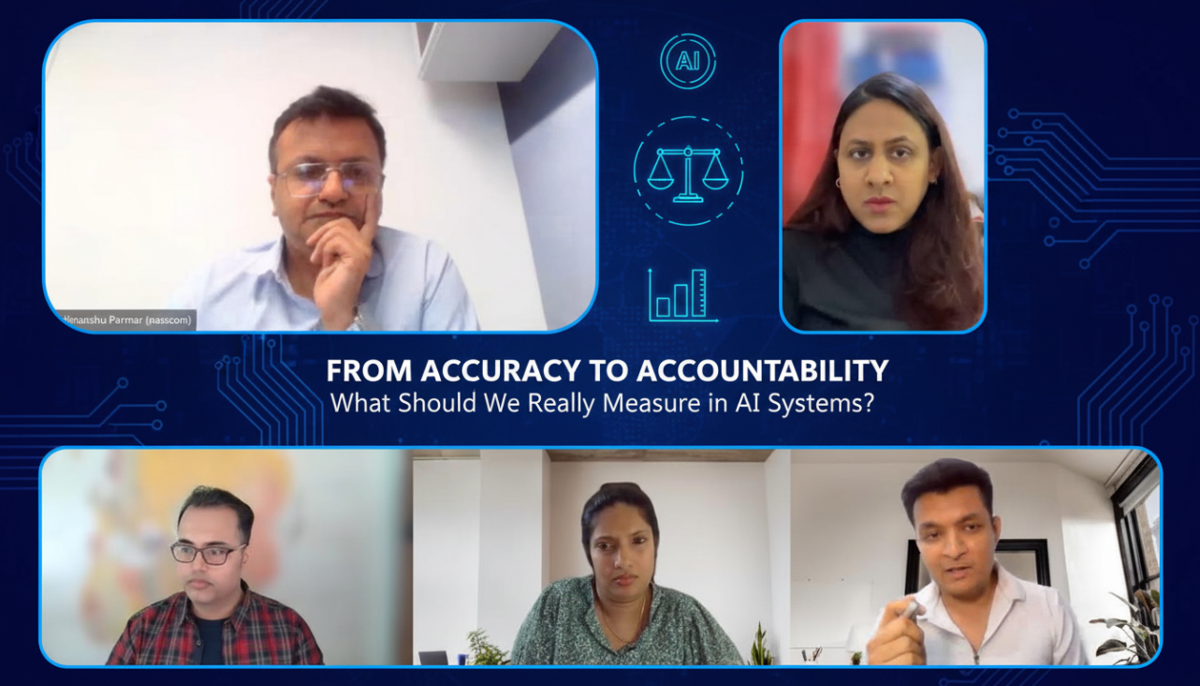
Report: From Accuracy to Accountability- What Should We Really Measure in AI Systems

The rapid acceleration of artificial intelligence adoption has brought with it a fundamental shift in how we evaluate technological success. Traditionally, AI systems have been judged primarily on performance metrics such as accuracy, precision, and speed. However, as these systems move from controlled environments into real-world applications—impacting healthcare, governance, finance, and everyday decision-making—the limitations of these metrics have become increasingly evident.

The Data Trust Quotients (DTQ) recently convened a thought‑provoking discussion titled “From Accuracy to Accountability: What Should We Really Measure in AI Systems?” The dialogue tackled a critical shift in how we evaluate AI: is accuracy alone sufficient, or should accountability, trust, and human impact take precedence. The virtual session explored the growing realization that high-performing models can still fail in practice if they lack proper governance, transparency, and ethical grounding. As organizations race toward rapid deployment, the need to redefine evaluation frameworks for AI systems has never been more urgent.

Speakers

  • Naman Kothari – NASSCOM COE (Moderator)
  • Anniliza Crasta – Director, Information Security, Juniper Networks
  • Sneha Pillai – Data Protection Lawyer, Bosch Middle East
  • Abhishek Tripathi – Head of Cybersecurity & IT Operations
  • Himanshu Parmar – Senior Manager, AI, NASSCOM COE

Key Insights from the Discussion

1. The AI Adoption Paradox

The session opened by highlighting a striking imbalance in the current AI ecosystem. On one hand, there is unprecedented enthusiasm and investment, with billions of dollars flowing into AI development and a majority of enterprises actively integrating generative AI into their operations. On the other hand, there is a significant lack of preparedness when it comes to managing the risks associated with these systems. Organizations are under immense pressure to deploy AI quickly in order to remain competitive, yet only a small fraction feel confident in their ability to implement proper safeguards. This creates a paradox where speed is prioritized over safety, leading to fragile systems that may not withstand real-world complexities.

2. Accuracy as a Misleading Benchmark

A key theme throughout the discussion was the idea that accuracy, while important, can often be a misleading indicator of success. Examples were shared where models achieved near-perfect accuracy in testing environments but failed dramatically once deployed. These failures were not due to flaws in the mathematical models themselves but rather due to unaddressed external factors such as biased data, changing environments, and lack of human oversight. This highlights a critical gap between theoretical performance and practical reliability. In real-world scenarios, systems must operate under uncertainty, adapt to new conditions, and interact with human users—factors that accuracy metrics alone cannot capture.

3. The Shift from Accuracy to Trust

As AI systems take on more complex and sensitive roles, there is a growing recognition that trust is becoming the ultimate measure of success. Trust encompasses multiple dimensions, including fairness, transparency, reliability, and security. Organizations are beginning to move away from purely technical metrics toward a more holistic evaluation framework that considers how systems behave over time and how they are perceived by users. This shift reflects a broader understanding that AI systems must not only perform well but also inspire confidence among stakeholders.

4. Hidden Risks Across the AI Lifecycle

One of the most significant insights from the discussion was the identification of risks that are often overlooked during the development and deployment of AI systems. These risks are not confined to a single stage but span the entire lifecycle:

  • Data-related risks: Biases embedded in datasets, errors in labeling, and poor data quality can significantly impact outcomes.
  • Design assumptions: Many systems are built on implicit assumptions that are neither documented nor tested, leading to unexpected behavior.
  • Context drift: The environment in which a model operates can change over time, reducing its effectiveness.
  • Post-deployment gaps: Once a system is deployed, accountability often becomes unclear, and continuous monitoring is neglected.

These blind spots can lead to failures even when initial performance metrics appear satisfactory.

5. The Complexity of Global Regulations

The discussion also highlighted the challenges posed by the lack of a unified global standard for AI governance and data privacy. Different regions have developed their own regulatory frameworks, each with unique requirements and expectations. This creates a complex landscape for organizations operating across multiple jurisdictions. Systems that are compliant in one region may not meet the standards of another, requiring constant adaptation. The evolving nature of these regulations further complicates the situation, making compliance an ongoing process rather than a one-time achievement.

6. Security as an Integral Design Element

Another important takeaway was the need to rethink how security is approached in AI systems. Instead of treating security as a final checkpoint before deployment, it must be integrated into every stage of development. This involves designing systems with security considerations from the outset, ensuring that vulnerabilities are addressed early rather than patched later. Such an approach not only reduces risks but also aligns with the fast-paced nature of AI development, where late-stage changes can be costly and disruptive.

7. Real-World Deployment Challenges

When AI systems are deployed in real-world environments, a range of operational challenges emerges. These include over-permissioned systems that have access to more data than necessary, lack of domain-specific constraints, and insufficient control mechanisms. In some cases, AI agents may perform tasks beyond their intended scope, leading to unintended consequences. These issues underscore the importance of clearly defining the boundaries within which AI systems operate and ensuring that they are aligned with their intended purpose.

8. The Emergence of Shadow AI

The increasing accessibility of AI tools has led to the rise of “shadow AI,” where individuals within organizations use AI systems independently without proper oversight. While often driven by a desire to innovate or improve efficiency, this practice introduces significant risks. Sensitive data may be exposed, and untested systems may be integrated into workflows without adequate safeguards. Addressing this challenge requires both technical solutions and a cultural shift toward responsible AI usage.

9. The Challenge of AI Hallucinations

AI hallucinations—instances where systems generate incorrect or fabricated information—remain a persistent issue. Despite advancements in model design, these errors cannot be entirely eliminated. Instead, organizations must focus on mitigating their impact through validation mechanisms and oversight processes. This reinforces the need for layered accountability, where multiple checks are in place to ensure reliability.

10. Data as Both an Asset and a Challenge

While data is often described as the fuel of AI, the discussion revealed that managing data effectively is one of the most challenging aspects of AI development. Collecting high-quality data requires significant effort and resources, and legal restrictions can complicate cross-border data transfers. Even after data is collected and processed, it may not always meet the requirements for training effective models. This highlights the need for careful planning and validation at every stage of the data lifecycle.

11. The Importance of a Structured Data Strategy

A recurring theme was the lack of a comprehensive data strategy in many organizations. Without a clear framework for managing data, organizations risk inefficiencies and vulnerabilities. A robust data strategy should include classification, access control, and lifecycle management, ensuring that data is treated as a critical asset. Such an approach not only enhances security but also supports the development of more reliable AI systems.

12. Governance as the Backbone of AI System

Governance plays a crucial role in ensuring that AI systems operate within defined boundaries. It involves establishing policies, setting standards, and monitoring compliance throughout the lifecycle. Unlike operational management, governance focuses on creating the structures that guide decision-making. Effective governance ensures consistency, reduces risks, and supports the responsible use of AI.

13. Measuring Human Impact

One of the most important yet often overlooked aspects of AI evaluation is its impact on users. AI systems can influence behavior, decision-making, and societal outcomes in ways that are not immediately apparent. Evaluating these effects requires a long-term perspective and continuous monitoring. By considering human impact, organizations can ensure that their systems contribute positively to society.

14. Building Trust Through Design

Moving from compliance to trust requires a proactive approach to system design. Features such as transparency, user control, and data minimization can enhance trust and improve user experience. Trust is not built through policies alone but through consistent and predictable system behavior. By prioritizing user-centric design, organizations can create systems that are both effective and trustworthy.

15. The Need for Interdisciplinary Collaboration

The discussion emphasized the importance of collaboration between technical, legal, and business teams. As AI systems become more complex, no single discipline can address all the challenges involved. Bridging the gap between these domains is essential for developing systems that are both innovative and responsible.

Conclusion

The session underscores a critical shift in how AI systems should be evaluated. While accuracy remains an important metric, it is no longer sufficient on its own. The future of AI lies in building systems that are accountable, transparent, and aligned with human values. This requires a comprehensive approach that considers the entire lifecycle of AI systems, from data collection and model design to deployment and long-term impact. By expanding the scope of measurement to include trust, governance, and human impact, organizations can move toward a more responsible and sustainable AI ecosystem.

Categories
DTQ Events

Report: Transitioning to Agentic Cyber Defense

Categories
DTQ Events

Report: Transitioning to Agentic Cyber Defense

Introduction

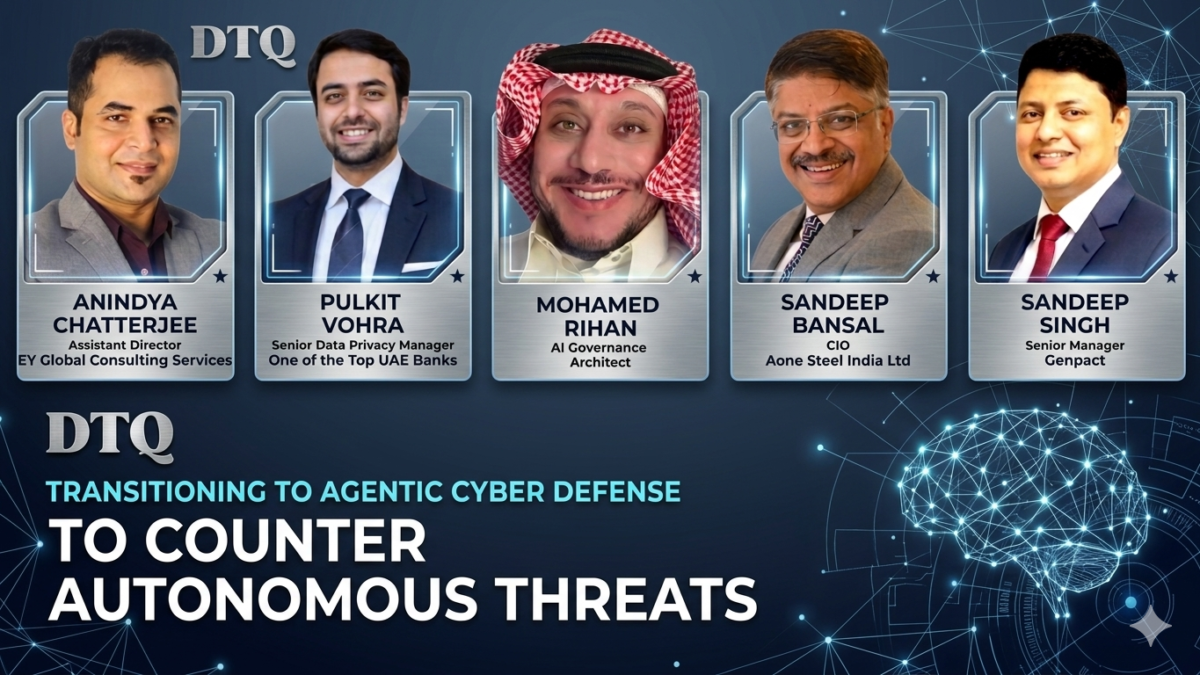
DTQ recently convened a specialized session, “Transitioning to Agentic Cyber Defense to Counter Autonomous Threats,” to explore the evolution of defensive strategies in an era of self-evolving adversarial tactics. The online discussion framed “agentic defense” not merely as an upgrade in tooling, but as a strategic pivot from reactive, signature-based controls toward autonomous systems capable of reasoning and adapting within defined risk parameters.

The Speakers

The panel featured a cross-disciplinary group of leaders representing the financial, industrial, and consulting sectors:

  • Anindya Chatterjee — Assistant Director, EY Global Consulting Services
  • Pulkit Vohra — Senior Data Privacy Manager, Top UAE Financial Institution
  • Mohamed A. S. — AI Governance Architect
  • Sandeep Bansal — CIO, Aone Steel India Ltd
  • Sandeep Singh — Senior Manager, Genpact

Key Insights

The Changing Threat Landscape

  • Lowered Barriers to Entry: AI and automation allow low-skill actors to execute high-sophistication attacks. Phishing and credential harvesting are becoming indistinguishable from human activity.
  • Compressed Response Windows: The primary vulnerability is no longer just the “bad decision,” but the “unquestioned execution” of rapid, automated attacks.
  • Cognitive Overload: Traditional SOC workflows are structurally incapable of managing the current volume of alerts; governed automation is now a survival requirement.

Principles of Agentic Defense

  • Bounded Autonomy: Systems must operate within “guardrails.” High-confidence, low-risk actions can be fully automated, while high-impact shifts require human-in-the-loop (HITL) authorization.
  • Radical Transparency: Every autonomous action must be explainable and auditable, detailing the rationale and data inputs for regulatory and forensic purposes.
  • Collateral-Aware Logic: Systems must calculate the potential business impact (e.g., service downtime) before executing a defensive maneuver, with built-in “safe rollback” capabilities.

Governance and Accountability

  • Human-Centric Liability: Regardless of the level of autonomy, accountability remains with human stakeholders. Responsibilities must be clearly mapped across model owners and business leaders.
  • Policy-as-Code: Governance should be machine-readable, allowing agentic systems to enforce legal and internal constraints at the same speed as the threats they counter.
  • Cross-Functional Oversight: Alignment between Security, Legal, and Privacy teams is essential to define the boundaries of “acceptable” autonomous behavior.

Privacy and Data Strategy

  • Privacy-Preserving Telemetry: Implementation of data minimization and pseudonymization ensures that detection needs do not compromise privacy obligations.
  • Engineering-Led Privacy: Privacy cannot be a checkbox; it must be baked into the architecture and model training phases to prevent data “scope creep.”

Operationalization Strategy

  • Phased Deployment: Start with “low-hanging fruit,” such as quarantining known malware or blocking confirmed fraud, before scaling to complex decision-making.
  • Continuous Simulation: Use red-teaming and “chaos experiments” to test how autonomous playbooks behave under extreme or unpredictable stress.
  • Legacy Integration: Agentic capabilities should augment—not replace—existing SIEM, EDR, and IAM investments to ensure telemetry continuity.

Technical & Sector Considerations

Technical Design

  • Model Lifecycle Management: Rigorous versioning and drift detection are required to prevent adversarial manipulation of the defense models themselves.
  • Fail-Safe Defaults: When confidence scores are low, systems must default to “Alert Only” modes rather than taking disruptive actions.

Sector-Specific Applications

  • Financial Services: Focus on real-time fraud prevention and identity risk scoring while maintaining high explainability for regulators.
  • Industrial/OT: Priority is placed on Operator-Assist recommendations. Given the risk of physical damage, direct autonomous actuation must be approached with extreme caution.
  • Managed Services (MSSPs): Providers can act as a force multiplier by centralizing model management and threat intelligence for multiple clients.

Practical Recommendations for Leaders

  1. Tier Your Automation: Classify defensive actions by risk level. Automate the “obvious” and assist the “complex.”
  2. Codify Your Rules: Move from written PDFs to machine-executable Policy-as-Code.
  3. Enrich Your Context: Invest in high-quality telemetry (Identity, Asset, and Business process mapping) to improve the “reasoning” of agentic tools.
  4. Monitor the Models: Treat your security AI as a high-value asset; implement drift monitoring and adversarial testing.
  5. Foster Collaboration: Establish a cross-functional forum where Legal and IT define the rules of engagement together.

Conclusion

Agentic cyber defense is no longer a futuristic concept—it is an operational necessity. To successfully transition, organizations must balance the speed of AI with the wisdom of human oversight. By adopting a phased, risk-aware approach grounded in Policy-as-Code and explainable AI, security leaders can build a resilient posture that scales with the threat while remaining firmly under human control.

DTQ serves as a platform dedicated to mapping global industry shifts and providing “information capital” before it reaches the mainstream. in cybersecurity space. Please write us at open-innovator@quotients.com for more information.

Categories
Data Trust Quotients Events

Report: The AI vs. AI Digital Arms Race

Categories
Data Trust Quotients Events

Report: The AI vs. AI Digital Arms Race

March 6, 2026

The global technological landscape has reached a pivotal tipping point where the narrative of Artificial Intelligence has shifted from “assistance” to “autonomy.” We have officially entered an era of a digital arms race—a state where AI systems are simultaneously being engineered to compromise global infrastructure and to defend it.

In a landmark knowledge session organized by DTQ, a panel of elite practitioners from the banking, telecommunications, and aviation sectors convened to dissect this “AI vs. AI” phenomenon. The consensus was clear: the battlefield has moved beyond human reaction times. The security of our future now depends on how we architect the machines that fight on our behalf.

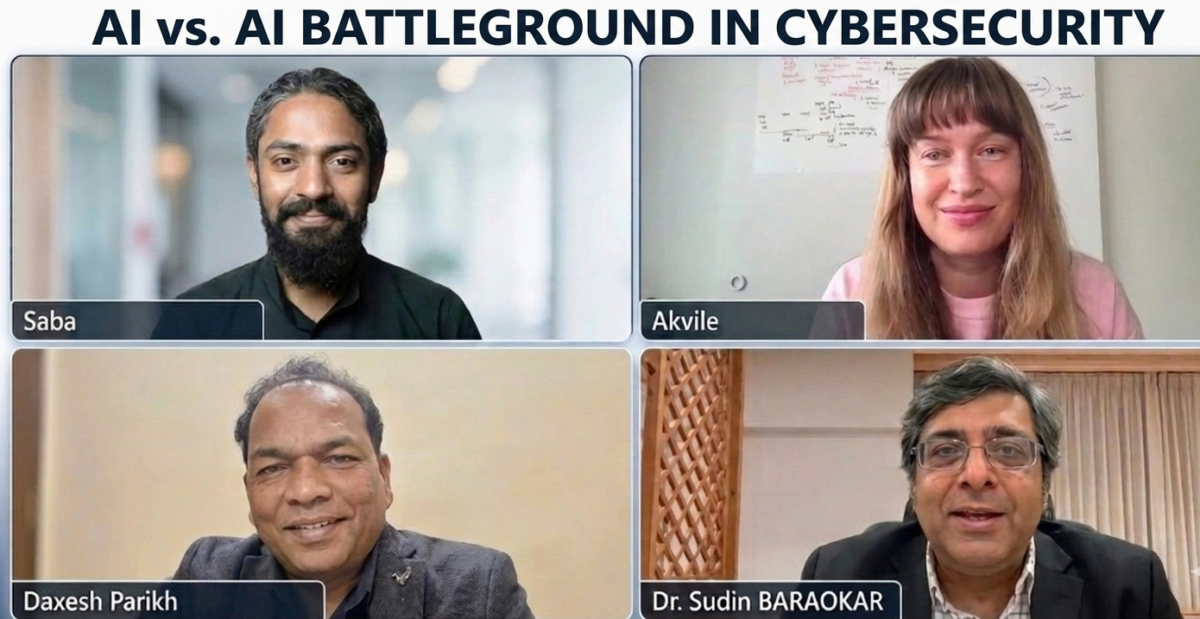
The session brought together three leading practitioners in AI-driven cybersecurity across banking, telecom, and aviation:

  • Dr. Sudin Baraokar – AI and quantum scientist, former Head of Innovation at SBI, architect of the Yono app (100M+ users), and builder of AI-native banking systems.
  • Daxesh Parikh – EVP at DoveLoft Limited, specializing in telecom-based authentication for government, banking, and fintech, working with major Indian banks on next-gen security beyond OTPs.
  • Sabarikumar KB – Group Manager & CSO at Airbus, with frontline SOC experience countering AI-generated attacks and expertise in aviation security architecture.

Moderator: Dr. Akvile, founder of System Akvile and CEO, participant in G20 AI governance discussions, with extensive work on AI in health and youth sectors

The Opening Salvo: From Tools to Combatants

The discussion opened with a provocative observation: technology is advancing at a velocity that has outpaced traditional oversight. Only a few years ago, AI was seen as a helpful tool for automation; today, it has become a primary combatant. Some systems are designed to create problems, while others are built to stop them, turning the digital landscape into a battle where one AI generates threats and another AI counters them—leaving humans as spectators to the unfolding drama.

This drama plays out through a sophisticated cycle: attackers deploy Large Language Models to craft flawless phishing campaigns, generate hyper-realistic deepfakes for social engineering, and automate brute-force hacking that can probe millions of vulnerabilities in seconds. In response, defensive AI is being woven into the fabric of networks, detecting anomalies and neutralizing threats at machine speed

Banking Infrastructure: Resiliency at 24,000 TPS

The primary concern for any digital economy is the stability of its financial heart. Dr. Sudin Baraokar, an AI and Quantum Scientist with a storied career at SBI, IBM, and GE, provided a masterclass on how banking infrastructure is evolving to survive an AI-native world.

The Scale of the Challenge

Dr. Sudin shared staggering benchmarks from his tenure as Head of Innovation at the State Bank of India (SBI). These figures provide the context for why traditional security is no longer sufficient:

  • Transaction Speed: Core banking systems are benchmarked at 24,000 transactions per second (TPS).
  • Daily Volume: Handling approximately 1.5 billion transactions daily.
  • Customer Reach: Protecting the data of 500 million customers across 700 million accounts.
  • The Yono Factor: The Yono digital lending app has now crossed 100 million users, representing a massive surface area for potential attacks.

The Shift to Artificial Superintelligence (ASI)

Dr. Sudin emphasized that the advent of AI and Gen AI allows banks to “talk to their data” in ways previously unimagined. The shift is moving away from static rules and manual libraries toward Security Model Management.

“Previously, we used to have a whole lot of templates and rules, but now it’s all model-driven,” he explained. This allows for a three-level approach to security:

  1. Level 1 (Business Rules & Intent): Establishing the foundational logic of what a transaction should look like.
  2. Level 2 (Reasoning): Using AI to analyze the context and intent behind system behavior.
  3. Level 3 (Decisioning): Enabling the system to take autonomous action to block a threat.

The Human Factor: The Persistent Weakest Link

Moderator Dr. Akvile, Founder and CEO of System Akvile, brought a grounding perspective to the high-tech discussion. Despite the billions of dollars invested in AI shields, she pointed out that the most frequent point of failure is still the human being sitting at the keyboard.

The “Grandmother” Scam and Deepfakes

Dr. Akvile highlighted a growing trend in European banking: the largest investments are no longer just in software, but in human education. She shared anecdotes of “grandmothers” in Germany giving away banking details to AI-generated voices claiming to be their granddaughters.

“Banks are doing a lot to protect from cyberattacks, but the biggest issue is still the person handling the account,” she remarked. Whether it is using “Password123” or sharing sensitive data on fraudulent web pages, human fallibility provides a backdoor that even the most advanced AI struggles to close.

The Value of Information

Working with young people in the health sector, Dr. Akvile expressed concern over the “value of information.” In an age of deepfakes and AI influencers, the public’s ability to distinguish reality from manipulation is eroding. This creates a secondary security risk: the manipulation of public opinion to trigger bank runs or healthcare panics.

The Telecom Backbone: Beyond the OTP

Daxesh Parikh, Executive Vice President at Dovelofts Limited, pivoted the conversation toward the “nervous system” of the digital world: Telecommunications. He argued that data theft is synonymous with “business paralysis.”

The RBI Mandate of 2026

In a significant update for the Indian BFSI sector, Parikh discussed the April 1, 2026, RBI mandate. The regulator is demanding a robust alternative to the One-Time Password (OTP) to prevent fraud and reduce friction.

“Fraudsters can weaponize SS7 and SIP protocols to intercept OTPs,” Parikh warned. The industry is moving toward Predictive Real-Time Authentication using the “crypto engine” already present in every SIM card.

The “Crypto Engine” Solution

By leveraging the unique cryptographic identity held by telecom operators, banks can verify a user’s identity without ever sending a text message. This “silent” authentication is already being used by Barclays Bank in Europe and is expected to become the global standard by 2030.

Frontline Defense: The Struggling SOC

Saba, Group Manager and CSO at Airbus, provided a reality check from the Security Operations Center (SOC). She confirmed that traditional detection tools are “struggling” because they were built to recognize historical patterns.

The Experimentation Advantage

Attackers now have the “experimentation advantage.” Instead of sending one phishing email, they can use AI to generate 100,000 variations, testing each one against common filters until they find a “perfect” version that looks like a genuine internal HR update.

The SOC Shift

To counter this, Saba outlined a necessary evolution for security teams:

  • Behavior Over Signatures: Stop looking for what a file “is” and start looking at what it “does.”
  • Correlation Over Isolated Events: Using AI to connect a harmless-looking login with an unusual data export.
  • Analytical Thinking: Analysts must move from being “tool operators” to “investigators.”

Security by Design in an AI-Native World

The panel agreed that “Security by Design” has fundamentally changed. It is no longer enough to secure the infrastructure (the “car”); you must secure the intelligence (the “driver”).

The Three Pillars of Model Security

Dr. Sudin and Saba identified three critical areas where AI-native systems must be protected:

  1. Training Data Security: Preventing “data poisoning” where an attacker injects malicious data into the AI’s learning set.
  2. Model Behavior: Implementing filters to prevent “prompt injection,” where a user tricks an AI into bypassing its own safety rules.
  3. Lifecycle Monitoring: AI systems “drift” over time. Continuous monitoring is required to ensure the AI doesn’t develop harmful biases or vulnerabilities as it learns from new data.

Compliance: The Floor, Not the Ceiling

A common mistake made by organizations is treating compliance (GDPR, ISO, India’s DPDP) as the goal. Saba argued that compliance is merely the floor—the absolute minimum baseline.

“Compliance moves at the speed of governance, but threats move at the speed of code,” she noted. An organization can be 100% compliant and still be 100% vulnerable. The goal must shift from “being compliant” to “being resilient.”

The 2036 Vision: Agentic and Autonomic Security

Looking toward the next decade, Dr. Sudin outlined a future of Agentic Security. In this world, security fabrics will function like a neural network—automated, autonomic (self-managing), and self-audited.

He compared this transformation to the current $5 trillion investment in AI hardware, such as NVIDIA’s Blackwell chips, which feature 200 billion transistors. “We need to accelerate our journeys across business, data, and technology just as fast as the hardware is accelerating,” he urged.

Conclusion: Fortune Favors the Prepared

The DTQ session concluded with a final round of advice for the next generation of entrepreneurs and leaders:

  • Dr. Sudin: “Don’t depend on particular LLMs. Build your own organizational Small Language Models (SLMs) to own your IP and security.”
  • Daxesh Parikh: “Fortune favors the brave. Take calculated risks, align with AI-routing platforms early, and don’t wait indefinitely for the ‘perfect’ time.”
  • Saba: “Do the basics first. HTTPS, MFA, and API security are the foundations. AI is the roof. You cannot build the roof before the foundation.”
  • Dr. Akvile: “Preserve humanity. As we use more AI, we must ensure we don’t lose our empathy and authenticity.”

Final Takeaways

  1. AI vs. AI is Reality: Organizations must fight automation with intelligence.
  2. The OTP is Dying: Prepare for hardware-based, cryptographic identity.
  3. Model-Driven GRC: Governance must be integrated into the AI’s reasoning layer from Day Zero.
  4. Education is Essential: The human link must be strengthened through constant awareness.

The “AI vs. AI” digital arms race is not a drama we can afford to watch from the sidelines. It is a fundamental shift in the human-machine relationship, and the winners will be those who build their defenses as intelligently as their offenses.

This DTQ Session provided essential insights on the AI vs. AI battleground in cybersecurity. Expert panel: Dr. Sudin Baraokar (AI/Quantum Scientist, former SBI Head of Innovation), Daxesh Parikh (DoveLoft Limited), and Saba (Airbus CSO). Moderated by Dr. Akvile. Write to us at open-innovator@quotients.com for participating and more information about our upcoming sessions.

Categories
Events Data Trust Quotients

From Data Privacy to Data Trust: The Evolution of Data Governance

Categories
Events Data Trust Quotients

From Data Privacy to Data Trust: The Evolution of Data Governance

Data Trust Quotient (DTQ) organized a critical knowledge session on February 20, 2026, addressing the fundamental shift from data privacy to data trust as AI systems scale across industries. The session explored a new category of risk: not just data theft, but quiet data manipulation that can make even the smartest AI make dangerously wrong decisions.

Expert Panel

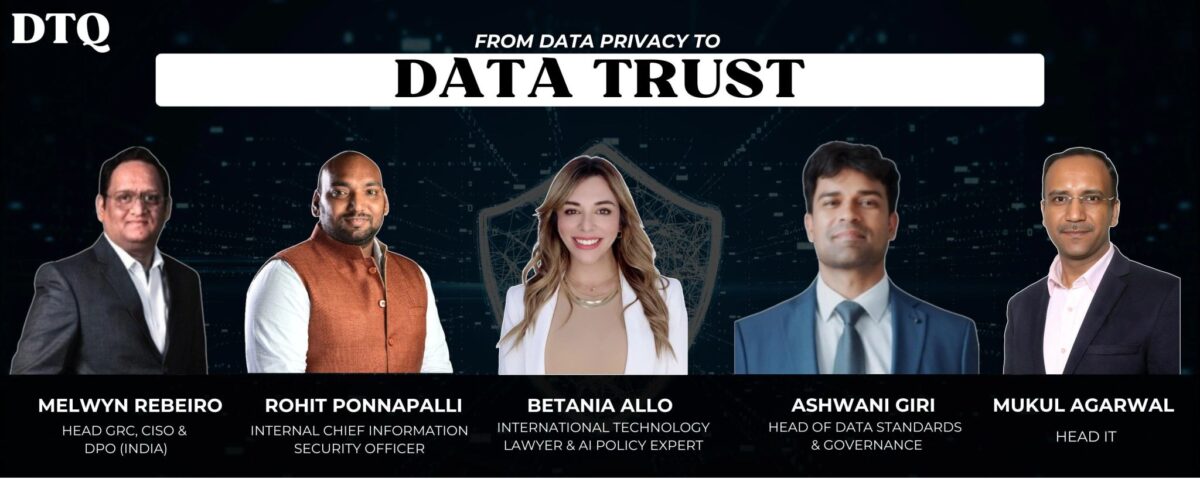
The session convened four practitioners from highly regulated industries where data integrity is mission-critical:

Melwyn Rebeiro – CISO at Julius Baer, bringing extensive experience in security, risk, and compliance from ultra-regulated financial services environments, wearing both the Chief Information Security Officer and Data Protection Officer hats.

Rohit Ponnapalli – Internal CISO at Cloud4C Services, specializing in cloud security, enterprise protection, and cybersecurity for government smart city projects where real-time data integrity directly influences public infrastructure operations.

Ashwani Giri – Head of Data Standards and Governance at Zurich, working with enterprise privacy frameworks and regulators.

Mukul Agarwal – Head of IT with deep experience in IT strategy, systems, and digital transformation in the banking and financial services sector, bringing the skepticism and traceability mindset essential to financial industry operations.

Moderated by Betania Allo, international technology lawyer and AI policy expert based in Riyadh, working at the intersection of AI governance, cybersecurity, and cross-border regulatory strategy. Hosted by Data Trust (DTQ), a global platform bringing professionals together to share practices, address challenges, and co-create solutions for building stronger trust across industries.

The Shift: From Confidentiality to Verifiable Integrity

Regulators Are Changing Their Expectations

Ashwani opened by confirming the shift is happening at ground level as AI adoption increases. Organizations are preparing security documentation, having internal discussions, trying to understand what changes are required. Confidentiality was the past—now much more mature with clear understanding. The present focus: initiating discussions around veracity and verifiable data.

The Medical Prescription Analogy: Earlier, the idea was ensuring only the right people (patient and doctor) had access. Now the expectation is that nobody is altering the prescription in the background. With AI, the expectation is that data is not poisoned or drifting, that hallucinations and poisoning are prevented.

Regulators as Trust Enablers: Regulators enable trust in the social ecosystem. As AI adoption drives changes, they’re moving from simply asking access-related questions (IAM) to expecting cryptographic proof of truth, verifiable audit trails, immutable integrity checks, and mechanisms providing confidence that claimed data is actually true.

The Verification Challenge: Organizations are framing that they have bases covered, but when regulators try to verify, many cannot demonstrate it. Except for the most mature organizations with proper budgets and resourcing, most face this challenge—trying to understand changes before implementing them.

The Timeline: Similar to information security 15 years ago when organizations struggled with their own approaches, AI security faces similar challenges now. But this evolution will be much faster—5-10 years to reach maturity rather than decades.

AI Readiness Without Data Provenance Is Flying Without a Black Box

When asked if organizations can truly claim AI readiness without tracking who changed data and when, Ashwani was direct: AI readiness is definitely not there in many organizations. Provenance is absolutely essential.

The Right Thing, No Matter How Hard: Organizations should do the right thing regardless of difficulty. Provenance work is already happening in bits and pieces but not in structured format. Requirements include policies in place, dedicated teams (not stopgap arrangements), and full commitment—not pulling people just to support tasks.

The Stark Reality: AI readiness without rigorous data governance is like flying a commercial plane without a black box, without proof of provenance or source of truth. It will land nowhere.

Automation Requirements: Regulators expect automated readiness testing and red teaming (validation testing of processes) to ensure controls are designed properly and working without glitches. If automation is less than 80%, it’s a problem.

The Non-Negotiable Future: Regulators are signaling this now but will become more aggressive. Provenance will be non-negotiable. Without it, enterprises are building highly efficient black boxes.

Industry Readiness: Varied Responses to the Challenge

BFSI Leads, Others Follow at Their Own Pace

Different sectors respond differently. Banking, Financial Services, Insurance (BFSI) and healthcare—highly critical sectors—are early adopters responding well. Other industries respond at their own pace, some lagging behind, but everyone understands the importance.

The Leadership Ladder: Understanding and awareness exist. Behaviors are being introduced. Once understanding, awareness, behaviors, and ownership align, leadership emerges. AI leadership is still far away, but early adopters (especially BFSI) are doing well and having internal discussions to create right synergies.

No Choice But to Comply: Organizations understand this requirement is coming. They have no choice but to comply eventually.

The Vault Problem: Securing Contents, Not Just Containers

Mukul brought the financial services perspective with a critical observation: Skepticism is the word in BFSI. The industry doesn’t trust anything at face value unless traceability exists.

What Security Has Done Wrong: Traditional IT security secured the vault—fortifying infrastructure, ensuring nothing comes in, checking what goes out, logging and mitigating. But they haven’t verified what’s inside the vault.

The Critical Gap: Did someone with the absolute right key enter the vault and modify contents? Could be malicious intent or oversight. This is where data corruption matters.

Real-World Financial Risk: What if someone changed the interest rate for a customer’s loan for a specified period, reducing their outgo, causing damage of X amount to the financial institution, then reset it later? The change happened, reverted, damage was done, nobody noticed. This problem area lacks fair mitigation.

Insider Risk: The Blind Spot in Mature Security

Rohit emphasized this isn’t just about regulatory requirements—it’s about trust. Organizations have controls in place, but are they using those controls to monitor behavior changes or data changes?

The Maturity Imbalance: Security has organized as a fortress to prevent intrusion. Organizations are mature enough to prevent hackers from getting in. But there are fewer controls to tackle insider risk management—where data changes, data integrity, data accuracy, and data theft issues originate.

The Spending Gap: Leaving BFSI aside, other industries don’t spend much on tools. Organizations should start looking at insider threat and gaining trust from operations adapted to day-to-day life.

Zero Trust for Data: Beyond Access Control

Trust Nobody, Verify Everybody

Melwyn brought the perspective from Julius Baer’s highly regulated environment. Regulators are adopting zero trust—not trusting anybody, just verifying everybody. Whether insider or outsider, the boundary has completely changed.

The Regulatory Focus: Most regulators in India are focusing on having organizations adopt zero trust technology—trust nobody but always verify so legitimate users are the only ones accessing data.

The Evidence Requirement: If someone tries to tamper with data, at least you have logs or verifiable evidence that data has been tampered with and appropriate action can be taken.

From Access Zero Trust to Data Zero Trust

The zero trust mindset must extend directly to the data layer itself—continuously validating that information has not been altered.

The Shift Beyond Access: It’s not only about access control in zero trust, but also about the data itself. Always verify rather than trust the data. The source of data, integrity of data, and provenance of data must be verified in an irrefutable manner without tampering or malicious intent.

Why Data Is Everything: If there’s no data, there are no jobs for anyone in the room. Data is the critical aspect of decision-making and must be protected at all times.

The AI Attack Surface: Traditional cybersecurity techniques exist—encryption, hashing, salting. But with AI advent, various attacks are happening against data: injection, poisoning, and others.

The Survival Requirement: Focus must shift from zero trust access to zero trust data. Without it, organizations cannot make critical and crucial decisions and will not survive in a competitive, AI and ML-driven world.

Multi-Dimensional Accountability

Who Owns Risk When Data Is Quietly Manipulated?

In India, the trend shows most organizations still have CISOs taking care of data because they’re considered best positioned to understand both security and privacy requirements that the DPO job demands.

Different Layers of Ownership:

  • Data Owner: The reference point for data
  • CISO: Provides guardrails to guard data safety against malicious attacks
  • DPO: Concerned only with data privacy, ensuring it’s not impacted or hampered
  • Governance: Legal and compliance teams ensuring every control is covered

Shared Responsibility: Each member has their own job in the organizational chart and must do their part in protecting data. But ultimately, the board has overall responsibility and accountability to ensure whatever guardrails or safety measures allocated to data protection are in place and nothing is missing.

When Data Alteration Creates Public Safety Risks

Rohit brought critical perspective from smart city and government projects where personally identifiable information (PII) and sensitive personal data are paramount—not just for cybersecurity but for counterterrorism.

The Bio-Weapon Example: If data about blood group distribution leaked—showing a city has the highest number of O-positive blood groups—a bio-weapon could be created targeting only that blood group, causing mass casualties and impacting national reputation.

Real-Time Utility Monitoring: Smart cities don’t just hold privacy data; they monitor real-time use of public services by citizens. Traffic analysis, water management during seasonal changes, public Wi-Fi usage—all create critical data that, if tampered with, could cause chaos in city operations.

The Efficiency Question: Models exist to monitor data alteration and access, but are they efficient? Considering the scale of operations, monitoring capabilities, budget limitations, and whether they treat public safety with the same seriousness as corporate security—efficiency remains a question mark.

The Tool Gap: Industry-Specific Maturity

When it comes to infrastructure security or user security, good controls exist across industries with mature maintenance. But data access management is a question mark depending on industry.

BFSI Advantage: The Reserve Bank of India mandates database access management tools. They have controls because they have solutions. They can develop use cases, rules, and alerts for abnormalities, modifications, deletions, additions, direct database access.

The Budget Challenge: Outside BFSI, getting board approval for database access management tools requires a very strong use case or customer escalation. Without these tools, organizations rely on DB soft logs requiring manual review—cumbersome for humans to identify abnormalities and more like postmortem analysis.

Real-Time vs. Postmortem: Manual review might take six days to discover data modification. By then, damage is done. With DAM tools in place, organizations can get alerts and act in real-time with preventive and corrective controls.

Industry-Specific Reality: Controls are there but depend on how important security, integrity, and trust are to the board—determining what tools can be secured for data integrity monitoring.

Traditional Security Models Are Insufficient

Rohit identified a critical trend: Traditional data access had a system and a user or user-developed application. Controls were simple. Now there’s a third element: AI—self-adaptive, self-learning, and capable of directly accessing data.

Going Back to the Drawing Board: Everyone is returning to proper boards where they can define and design controls. The whole industry—technical people, operations teams—are validating whether traditional security controls are sufficient to handle AI operations.

The Use Case Problem: Concerns arise because controls must change for every use case. One AI tool might have eight use cases, each requiring different controls, different monitoring, different security on who’s accessing, what output is given, what data is accessed, privilege levels, potential injection attacks, and command exploitation.

Output Modification Threat: It’s not just about data modification. What if output is modified? Hackers don’t need to get into databases to modify data if they can modify output directly. This concern is getting significant attention.

The Level Question: Organizations must determine at what level they’re discussing data integrity—making it a complex, layered challenge.

Key Questions Defining Data Trust

Is Data Trust Just Rebranding Privacy?

Ashwani’s answer: Data trust is the next level of data privacy. Privacy focused on keeping data safe. The question now: Is the data you’ve kept trustable? Is somebody altering or changing it? Is it the right data collected in the first place?

End-to-End Protection: Ensuring you’re collecting data that’s right and fit for purpose, protecting it with all possible controls until consumption, and having the right pipeline protecting from end to end with proper lineage.

Traceability Requirement: You should be able to identify where trust is broken. If somebody altered data, you must be able to trace it.

The Future Parameter: Data trust is next-step beyond traditional data privacy controls—paramount for successful AI-driven organizations in the fully AI-driven era ahead.

The DPO Triad: As Rohit suggested to a DPO colleague—information security has three attributes (confidentiality, integrity, availability). For DPOs, it should be privacy, security, and trust defining overall governance.

Three Years Forward: Trusted vs. Just Compliant

Melwyn’s perspective: Trust is extremely important—going one level ahead of compliance. Compliance and trust are interchanging based on time differences.

Why Both Matter: Everyone wants to be compliant because penalties are high and heavy. Everyone wants to be trusted because without being a trusted brand or company, you’re out of business—competitors are already ahead.

The Reversal: Compliance is not driving trust. Trust is driving compliance. It’s a non-negotiable, hand-in-glove situation.

The Drinkable Water Example: Mukul provided a perfect analogy: Someone asks for water. Giving a glass of water is compliance. But was that water drinkable? That’s trust. Would you trust the person who gave drinkable water, or just take water from someone who was merely compliant?

No Shortcut to Trust: Ashwani emphasized trust cannot be bought with budget instantly. It takes time, requiring continuous good work to earn it. Trust is a real differentiator earned only by fixing things at ground level. There’s no shortcut to trust.

Compliance as Checkbox vs. Backbone

Rohit highlighted that compliance is a satisfaction factor for customers. When you want to prove you have good security controls, compliance comes into picture.

The Dangerous Trend: Compliance is becoming a checkbox, which should not be taken lightly. Compliance should be the backbone on which you build more security controls. Some organizations treat it as a checkbox saying they’re compliant, but effectiveness and efficiency remain questionable.

Priority Actions for the Next 24 Months

People, Process, Technology—In That Order

Ashwani’s Framework: Organizations must ensure right standards, policies, procedures, and mandates are in place. Identify the right people for the work and agree on RACI matrix (who’s responsible, accountable, consulted, informed) defining roles clearly.

Ground framework first. Other things are technology-related. Fixing the people part—the human factor—is always most important. Once you fix the human vector, everything else comes with much more ease.

Mindset and Culture Change

Melwyn’s Priority: The mindset must change when discussing privacy, data security, and integrity. Culture has to be there. Without the right mindset, culture, ethos, and ethics to govern, even the best controls, equipment, or security will not work.

The right mindset is the key to success.

Access Monitoring and Traceability

Rohit’s Focus: Culture is a never-ending job through awareness sessions and phishing simulations—always 10-20% violating despite efforts. But purely for trust, organizations have enough controls knowing who has access to systems.

Three Critical Questions: Focus on controls understanding who has access to systems or data, who is modifying data, and what is being modified. Answer these three questions and trust can be easily built.

Explainable AI with Human in the Loop

Mukul’s Guidance: Many organizations live in the hype of deploying AI and trusting their data with AI. There must be a human in the loop, and AI must be explainable.

Explainable AI with human in the loop is the keyword when trusting data with AI models. At least jobs are safe with this explanation—people are still needed to validate.

Conclusion: Trust Cannot Be Bought, Only Earned

The session revealed unanimous agreement: The future belongs to organizations with the most trusted data, not just the most data or the most advanced AI.

Trust is the cornerstone of AI-driven ecosystems. Provenance is non-negotiable. Zero trust must extend from access control to the data layer itself. Accountability is multi-dimensional across boards, executive leadership, technology teams, and legal compliance.

As India accelerates its AI ambitions (hosting the AI Summit during this session), embedding verifiable integrity at scale becomes essential—not only for foundational institutional credibility across sectors but for defining long-term leadership.

Key principles emerged: Do the right thing no matter how hard. Fix the human factor first. Treat compliance as backbone, not checkbox. Remember there’s no shortcut to trust—it must be earned through continuous good work fixing things at ground level.

The shift from data privacy to data trust represents the next evolution in data governance—moving from protecting data from unauthorized access to ensuring data remains true, accurate, and verifiable throughout its lifecycle in AI-driven systems.


This Data Trust Knowledge Session provided essential frameworks for organizations navigating the evolution from data privacy to data trust. Expert panel: Melwyn Rebeiro (Julius Baer), Rohit Ponnapalli (Cloud4C Services), Ashwani Giri (Zurich), and Mukul Agarwal (BFSI sector). Moderated by Betania Allo.


Categories
Data Trust Quotients DTQ Visibility Quotient

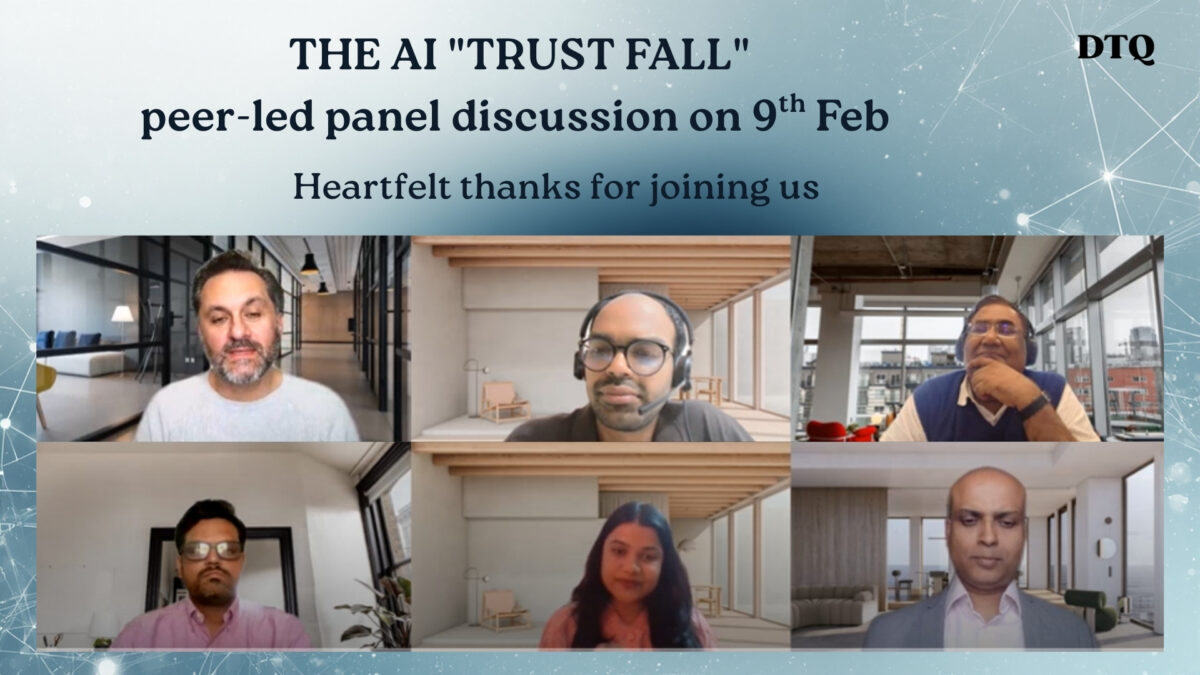
The AI Trust Fall: Building Confidence in an Era of Hallucination

Categories
Data Trust Quotients DTQ Visibility Quotient

The AI Trust Fall: Building Confidence in an Era of Hallucination

Data Trust Knowledge Session | February 9, 2026

Open Innovator organized a critical knowledge session on AI trust as systems transition from experimental tools to enterprise infrastructure. With tech giants leading trillion-dollar-plus investments in AI, the focus has shifted from model performance to governance, real-world decision-making, and managing a new category of risk: internal intelligence that can hallucinate facts, bypass traditional logic, and sound completely convincing. The session explored how to design systems, governance, and human oversight so that trust is earned, verified, and continuously managed across cybersecurity, telecom infrastructure, healthcare, and enterprise platforms.

Expert Panel

Vijay Banda – Chief Strategy Officer pioneering cognitive security, where monitors must monitor other monitors and validation layers become essential for AI-generated outputs.

Rajat Singh – Executive Vice President bringing telecommunications and 5G expertise where microsecond precision is non-negotiable and errors cascade globally.

Rahul Venkat – Senior Staff Scientist in AI and healthcare, architecting safety nets that leverage AI intelligence without compromising clinical accuracy.

Varij Saurabh – VP and Director of Products for Enterprise Search, with 15-20 years building platforms where probabilistic systems must deliver reliable business foundations.

Moderated by Rudy Shoushany, AI governance expert and founder of BCCM Management and TxDoc. Hosted by Data Trust, a community focused on data privacy, protection, and responsible AI governance.

Cognitive Security: The New Paradigm

Vijay declared that traditional security from 2020 is dead. The era of cognitive security has arrived like having a copilot monitor the pilot’s behavior, not just the plane’s systems. Security used to be deterministic with known anomalies; now it’s probabilistic and unpredictable. You can’t patch a hallucination like you patch a server.

Critical Requirements:

  • Validation layers for all AI-generated content, cross-checked by another agent using golden sources of truth
  • Human oversight checking if outputs are garbage in/garbage out, or worse-confidential data leakage
  • Zero trust of data-never assume AI outputs are correct without verification
  • Training AI systems on correct parameters, acceptable outputs, and inherent biases

The shift: These aren’t insider threats anymore, but probabilistic scenarios where data from AI engines gets used by employees without proper validation.

Telecom Precision: Layered Architecture for Zero Error

Rajat explained why the AI trust question has become urgent. Early social media was a separate dimension from real life. Now AI-generated content directly affects real lives-deepfakes, synthesized datasets submitted to governments, and critical infrastructure decisions.

The Telecom Solution: Upstream vs. Downstream

Systems are divided into two zones:

Upstream (Safe Zone): AI can freely find correlations, test hypotheses, and experiment without affecting live networks.

Downstream (Guarded Zone): Where changes affect physical networks. Only deterministic systems allowed-rule engines, policy makers, closed-loop automation, and mandatory human-in-the-loop.

Core Principle: Observation ≠ Decision ≠ Action. This separation embedded in architecture creates the first step toward near-zero error.

Additional safeguards include digital twins, policy engines, and keeping cognitive systems separate from deterministic ones. The key insight: zero error means zero learning. Managed errors within boundaries drive innovation.

Why Telecom Networks Rarely Crash: Layered architecture with what seems like too many layers but is actually the right amount, preventing cascading failures.

Healthcare: Knowledge Graphs and Moving Goalposts

Rahul acknowledged hallucination exists but noted we’re not yet at a stage of extreme worry. The issue: as AI answers more questions correctly, doctors will eventually start trusting it blindly like they trust traditional software. That’s when problems will emerge.

Healthcare Is Different from Code

You can’t test AI solutions on your body to see if they work. The costs of errors are catastrophically higher than software bugs. Doctors haven’t started extensively using AI for patient care because they don’t have 100% trust—yet.

The Knowledge Graph Moat

The competitive advantage isn’t ChatGPT or the AI model itself—it’s the curated knowledge graph that companies and institutions build as their foundation for accurate answers.

Technical Safeguards:

  • Validation layers
  • LLM-as-judge (another LLM checking if the first is lying)
  • Multiple generation testing (hallucinations produce different explanations each time)
  • Self-consistency checks
  • Mechanistic interpretability (examining network layers)

The Continuous Challenge: The moment you publish a defense technique, AI finds a way to beat it. Like cybersecurity, this is a continuous process, not a one-time solution.

AI Beyond Human Capabilities

Rahul challenged the assumption that all ground truth must come from humans. DeepMind can invent drugs at speeds impossible for humans. AI-guided ultrasounds performed by untrained midwives in rural areas can provide gestational age assessments as accurately as trained professionals, bringing healthcare to underserved communities.

The pragmatic question for clinical-grade AI: Do benefits outweigh risks? Evaluation must go beyond gross statistics to ensure systems work on every subgroup, especially the most marginalized communities.

Enterprise Platforms: Living with Probabilistic Systems

Varij’s philosophy after 15-20 years building AI systems: You have to learn to live with the weakness. Accept that AI is probabilistic, not deterministic. Once you accept this reality, you automatically start thinking about problems where AI can still outperform humans.

The Accuracy Argument

When customers complained about system accuracy, the response was simple: If humans are 80% accurate and the AI system is 95% accurate, you’re still better off with AI.

Look for Scale Opportunities

Choose use cases where scale matters. If you can do 10 cases daily and AI enables 1,000 cases daily with better accuracy, the business value is transformative.

Reframe Problems to Create New Value

Example: Competitors used ethnographers with clipboards spending a week analyzing 6 hours of video for $100,000 reports. The AI solution used thousands of cameras processing video in real-time, integrated with transaction systems, showing complete shopping funnels for physical stores—value impossible with previous systems.

The Product Manager’s Transformed Role

Traditional PM workflow–write user stories, define expectations, create acceptance criteria, hand to testers–is breaking down.

The New Reality:

Model evaluations (evals) have moved from testers to product managers. PMs must now write 50-100 test cases as evaluations, knowing exactly what deserves 100% marks, before testing can begin.

Three Critical Pillars for Reliable Foundations:

1. Data Quality Pipelines – Monitor how data moves into systems, through embeddings, and retrieval processes. Without quality data in a timely manner, AI cannot provide reliable insights.

2. Prompt Engineering – Simply asking systems to use only verified links, not hallucinate, and depend on high-quality sources increases performance 10-15%. Grounding responses in provided data and requiring traceability are essential.

3. Observability and Traceability – If mistakes happen, you must trace where they started and how they reached endpoints. Companies are building LLM observation platforms that score outputs in real-time on completeness, accuracy, precision, and recall.

The shift from deterministic to probabilistic means defining what’s good enough for customers while balancing accuracy, timeliness, cost, and performance parameters.

Non-Negotiable Guardrails

Single Source of Truth – Enterprises must maintain authentic sources of truth with verification mechanisms before AI-generated data reaches employees. Critical elements include verification layers, single source of truth, and data lineage tracking to differentiate artificiality from fact.

NIST AI RMF + ISO 42001 – Start with NIST AI Risk Management Framework to tactically map risks and identify which need prioritizing. Then implement governance using ISO 42001 as the compliance backbone.

Architecture First, Not Model First – Success depends on layered architectures with clear trust boundaries, not on having the smartest AI model.

Success Factors for the Next 3-5 Years

The next decade won’t be won by making AI perfectly truthful. Success belongs to organizations with better system engineers who understand failure, leaders who design trust boundaries, and teams who treat AI as a junior genius rather than an oracle.

What Telecom Deploys: Not intelligence, but responsibility. AI’s role is to amplify human judgment, not replace it. Understanding this prevents operational chaos and enables practical implementation.

AI Will Always Generalize: It will always overfit narratives. Everyone uses ChatGPT or similar tools for context before important sessions—this will continue. Success depends on knowing exactly where AI must not be trusted and making wrong answers as harmless as possible.

The AGI Question and Investment Reality

Panel perspectives on AGI varied from already here in certain forms, to not caring because AI is just a tool, to being far from achieving Nobel Prize-winning scientist level intelligence despite handling mediocre middle-level tasks.

From an investment perspective, AGI timing matters critically for companies like OpenAI. With trillions in commitments to data centers and infrastructure, if AGI isn’t claimed by 2026-2027, a significant market correction is likely when demand fails to match massive supply buildout.

Key Takeaways

1. Cognitive Security Has Replaced Traditional Security – Validation layers, zero trust of AI data, and semantic telemetry are mandatory.

2. Separate Observation from Decision from Action – Layered architecture prevents errors from cascading into mission-critical systems.

3. Knowledge Graphs Are the Real Moat – In healthcare and critical domains, competitive advantage comes from curated knowledge, not the LLM.

4. Accept Probabilistic Reality – Design around AI being 95% accurate vs. humans at 80%, choosing use cases where AI’s scale advantages transform value.

5. PMs Now Own Evaluations – The testing function has moved to product managers who must define what’s good enough in a probabilistic world.

6. Human-in-the-Loop Is Non-Negotiable – Structured intervention at critical decision points, not just oversight.

7. Single Source of Truth – Authentic data sources with verification mechanisms before AI outputs reach employees.

8. Continuous Process, Not One-Time Fix – Like cybersecurity, AI trust requires ongoing vigilance as defenses and attacks evolve.

9. Responsibility Over Intelligence – Deploy systems designed for responsibility and amplifying human judgment, not autonomous decision-making.

10. Better System Engineers Win – Success belongs to those who understand where AI must not be trusted and design boundaries accordingly.

Conclusion

The session revealed a unified perspective: The question isn’t whether AI can be trusted absolutely, but how we architect systems where trust is earned through verification, maintained through continuous monitoring, and bounded by clear human authority.

From cognitive security frameworks to layered telecom architectures, from healthcare knowledge graphs to PM evaluation ownership, the message is consistent: Design for the reality that AI will make mistakes, then ensure those mistakes are caught before they cascade into catastrophic failures.

The AI trust fall isn’t about blindly falling backward hoping AI catches you. It’s about building safety nets first—validation layers, zero trust of data, single sources of truth, human-in-the-loop checkpoints, and organizational structures where responsibility always rests with humans who understand both the power and limitations of their AI tools.

Organizations that thrive won’t have the most advanced AI—they’ll have mastered responsible deployment, treating AI as the junior genius it is, not the oracle we might wish it to be.


This Data Trust Knowledge Session provided essential frameworks for building AI trust in mission-critical environments. Expert panel: Vijay Banda, Rajat Singh, Rahul Venkat, and Varij Saurabh. Moderated by Rudy Shoushany.

Categories
DTQ Data Trust Quotients

Trust as the New Competitive Edge in AI

Categories
DTQ Data Trust Quotients

Trust as the New Competitive Edge in AI

Artificial Intelligence (AI) has evolved from a futuristic idea to a useful reality, impacting sectors including manufacturing, healthcare, and finance. These systems’ dependence on enormous datasets presents additional difficulties as they grow in size and capacity. The main concern is now whether AI can be trusted rather than whether it can be developed.

Trust is becoming more widely acknowledged as a key differentiator. Businesses are better positioned to draw clients, investors, and regulators when they exhibit safe, open, and moral data practices. Trust sets leaders apart from followers in a world where technological talents are quickly becoming commodities.

Trust serves as a type of capital in the digital economy. Organizations now compete on the legitimacy of their data governance and AI security procedures, just as they used to do on price or quality.

Security-by-Design as a Market Signal

Security-by-design is a crucial aspect of trust. Leading companies incorporate security safeguards at every stage of the AI lifecycle, from data collection and preprocessing to model training and deployment, rather than considering security as an afterthought.

This strategy demonstrates the maturity of the company. It lets stakeholders know that innovation is being pursued responsibly and is protected against abuse and violations. Security-by-design is becoming a need for market leadership in industries like banking, where data breaches can cause serious reputational harm.

One obvious example is federated learning. It lowers risk while preserving analytical capacity by allowing institutions to train models without sharing raw client data. This is a competitive differentiation rather than just a technical protection.

Integrity as Differentiation

Another foundation of trust is data integrity. The dependability of AI models depends on the data they use. The results lose credibility if datasets are tampered with, distorted, or poisoned. Businesses have a clear advantage if they can show provenance and integrity using tools like blockchain, hashing, or audit trails. They may reassure stakeholders that tamper-proof data forms the basis of their AI conclusions. In the healthcare industry, where corrupted data can have a direct impact on patient outcomes, this assurance is especially important. Therefore, integrity is a strategic differentiation as well as a technological prerequisite.

Privacy-Preserving Artificial Intelligence

Privacy is now a competitive advantage rather than just a requirement for compliance. Organizations can provide insights without disclosing raw data thanks to strategies like federated learning, homomorphic encryption, and differential privacy. In industries where data sensitivity is crucial, this enables businesses to provide “insights without intrusion.”

When consumers are assured that their privacy is secure, they are more inclined to interact with AI systems. Additionally, privacy-preserving AI lowers exposure to regulations. Proactively implementing these strategies puts organizations in a better position to adhere to new regulations like the AI Act of the European Union or the Digital Personal Data Protection Act of India.

Transparency as Security

Black-box, opaque AI systems are very dangerous. Organizations find it difficult to gain the trust of investors, consumers, and regulators when they lack transparency. More and more people see transparency as a security measure. Explainable AI guarantees stakeholders, lowers vulnerabilities, and makes auditing easier. It turns accountability from a theoretical concept into a useful defense. Businesses set themselves apart by offering transparent audit trails and decision-making reasoning. “Our predictions are not only accurate but explainable,” they may say with credibility. In sectors where accountability cannot be compromised, this is a clear advantage.

Compliance Across Borders

AI systems frequently function across different regulatory regimes in different regions. The General Data Protection Regulation (GDPR) is enforced in Europe, the California Consumer Privacy Act (CCPA) is enforced in California, and the Digital Personal Data Protection Act (DPDP) was adopted in India. It’s difficult to navigate this patchwork of regulations. Organizations that exhibit cross-border compliance readiness, however, have a distinct advantage. They lower the risk associated with transnational partnerships by becoming preferred partners in global ecosystems. Businesses that can quickly adjust will stand out as dependable global players as data localization requirements and AI trade obstacles become more prevalent.

Resilience Against AI-Specific Threats

Threats like malware and phishing were the main focus of traditional cybersecurity. AI creates new risk categories, such as data leaks, adversarial attacks, and model poisoning.
Leadership is exhibited by organizations that take proactive measures to counter these risks. “Our AI systems are attack-aware and breach-resistant” is one way they might promote resilience as a feature of their product. Because hostile AI attacks could have disastrous results, this capacity is especially important in the defense, financial, and critical infrastructure sectors. Resilience is a competitive differentiator rather than just a technical characteristic.

Trust as a Growth Engine

When security-by-design, integrity, privacy, transparency, compliance, and resilience are coupled, trust becomes a growth engine rather than a defensive measure. Consumers favor trustworthy AI suppliers. Strong governance is rewarded by investors. Proactive businesses are preferred by regulators over reactive ones. Therefore, trust is more than just information security. In the AI era, it is about exhibiting resilience, transparency, and compliance in ways that characterize market leaders.

The Future of Trust Labels

Similar to “AI nutrition facts,” the idea of trust labels is a new trend. These marks attest to the methods utilized for data collection, security, and utilization. Consider an AI solution that comes with a dashboard that shows security audits, bias checks, and privacy safeguards. Such openness may become the norm. Early use of trust labels will set an organization apart. By making trust public, they will turn it from a covert backend function into a significant competitive advantage.

Human Oversight as a Trust Anchor

Trust is relational as well as technological. A lot of businesses are including human supervision into important AI decisions. Stakeholders are reassured by this that people are still responsible. It strengthens trust in results and avoids naive dependence on algorithms. Human oversight is emerging as a key component of trust in industries including healthcare, law, and finance. It emphasizes that AI is a tool, not a replacement for accountability.

Trust Defines Market Leaders

Data security and trust are now essential in the AI era. They serve as the cornerstone of a competitive edge. Businesses will draw clients, investors, and regulators if they exhibit safe, open, and moral AI practices. The market will be dominated by companies who view trust as a differentiator rather than a requirement for compliance. Businesses that turn trust into a growth engine will own the future. In the era of artificial intelligence, trust is power rather than just safety.

Reach out to us at open-innovator@quotients.com or drop us a line to delve into the transformative potential of groundbreaking technologies. We’d love to explore the possibilities with you.

Categories
DTQ Data Trust Quotients

Privacy, Security, and the New AI Frontier

Categories
DTQ Data Trust Quotients

Privacy, Security, and the New AI Frontier

Understanding AI Agents in Today’s World

Artificial Intelligence agents are software systems designed to act independently, make decisions, and interact with humans or other machines. They learn, adapt, and react to changing circumstances instead of merely following predetermined instructions like traditional algorithms do. Because of their independence, they are effective instruments in a variety of fields, including finance and healthcare. But it also raises serious questions about their security and handling of sensitive data. Understanding how AI agents affect security and privacy is now crucial for fostering trust and guaranteeing safe adoption as they grow more prevalent in homes and workplaces.

Large volumes of data are frequently necessary for AI agents to operate efficiently. Based on the data they process, they identify trends, forecast results, and offer suggestions. Personal information, financial records, or even proprietary business plans can be included in this data. They are helpful because of this, but there are risks as well. Malicious actors may be able to access the data stored in an agent if it is compromised. The difficulty is striking a balance between the advantages of AI agents and the obligation to safeguard the data they utilize. Their potential might easily become a liability in the absence of robust safeguards.

The emergence of AI agents also alters how businesses view technology. Network and device protection used to be the primary focus of security. It now has to include intelligent systems that represent people. These agents have the ability to manage physical equipment, make purchases, and access many platforms. Attackers may utilize them to do damage if they are not well secured. This change necessitates new approaches that include security and privacy into AI agents’ design from the start rather than adding them as an afterthought.

Security Challenges in the Age of AI

The unpredictability of AI agents is one of their main problems. Their behavior is not always predictable due to their capacity for learning and adaptation. Because of this, it is more difficult to create security systems that can foresee every eventuality. For instance, while attempting to increase efficiency, an agent trained to optimize corporate operations may inadvertently reveal private information. These dangers emphasize the necessity of ongoing oversight and stringent restrictions on what agents are permitted to accomplish. Security needs to change to address both known and unknown threats.

The increased attack surface is another issue. AI agents frequently establish connections with a variety of systems, including databases and cloud services. Every connection is a possible point of entry for hackers. The entire network of interactions may be jeopardized if one system is weak. Hackers may directly target agents, deceiving them into disclosing information or carrying out illegal activities. Because AI agents are interconnected, firewalls and other conventional security measures are insufficient. Organizations need to implement multi-layered defenses that track each encounter and confirm each agent action.

Access control and identity are also crucial. Strong identification frameworks are necessary for AI agents, just as humans need passwords and permits. Without them, it becomes challenging to determine which agent is carrying out which task or whether an agent has been taken over. Giving agents distinct identities promotes accountability and facilitates activity monitoring. When used in conjunction with audit trails, this method enables organizations to promptly identify questionable activity. In the agentic age, machines also have identities.

Privacy Concerns and Safeguards

A significant concern with AI agents is privacy. These systems frequently handle personal data, including shopping habits and medical records. Inadequate handling of this data may result in privacy rights being violated. An agent that makes treatment recommendations, for instance, might require access to private medical information. This information could be exploited or shared without permission if appropriate precautions aren’t in place. Ensuring that agents only gather and utilize the minimal amount of data required for their duties is essential to protecting privacy.

Building trust is mostly dependent on transparency. Users need to be aware of the data that agents are accessing, how they are using it, and whether they are sharing it with outside parties. People are more at ease with AI agents when there is clear communication. Additionally, it enables them to decide intelligently whether to permit particular behaviors. In addition to being required by law under rules like GDPR, transparency is a useful strategy to guarantee that users maintain control over their data.

Control and consent are equally crucial. People ought to be able to choose whether or not to share their data with AI agents. Additionally, they must to be able to modify parameters to restrict an agent’s access. A financial agent might, for instance, be permitted to examine expenditure trends but not access complete bank account information. Giving users control guarantees that agents work within the bounds established by the clients they serve and that privacy is protected. Every AI system needs to incorporate this privacy-by-design concept.

Balancing Innovation with Responsibility

Organizations face the difficulty of striking a balance between innovation and accountability. AI agents have a great deal of promise to enhance client experiences, decision-making, and efficiency. However, they might also produce hazards that outweigh their advantages if appropriate precautions aren’t taken. Businesses need to develop a perspective that views security and privacy as facilitators of trust rather than barriers. They may unleash innovation while retaining user credibility by creating agents that are safe and considerate of privacy.

One of the best practices is to incorporate security into the design process instead of leaving it as an afterthought. This entails incorporating safeguards into an agent’s architecture and taking possible hazards into account before deploying it. Layered protections, ongoing monitoring, and robust identity systems are crucial. Simultaneously, data minimization, anonymization, and openness must be prioritized in order to protect privacy. When taken as a whole, these steps lay the groundwork for AI agents to function in a responsible and safe manner.

Another important component is education. The dangers of AI agents and the precautions taken must be understood by both users and developers. A safer ecosystem can be achieved by educating users about their rights, instructing developers to integrate privacy-by-design, and training staff to spot suspicious activity. Raising awareness guarantees that everyone contributes to safeguarding security and privacy. In the end, people who utilize and oversee AI bots are just as important as the technology itself.

Building a Trustworthy Future

Trust is essential to the future of AI agents. Adoption will increase if users think that their data is secure and if agents behave appropriately. However, trust will crumble if privacy abuses or security breaches become widespread. Because of this, it is crucial that organizations, authorities, and developers collaborate to build frameworks and standards that guarantee safety. Governments and businesses working together can create regulations that safeguard people while fostering innovation.

An essential component of this future is governance. The design, deployment, and monitoring of agents must be outlined in explicit policies. Legal foundations are provided by laws like India’s DPDP Act and Europe’s GDPR, but enterprises need to do more than just comply. They must embrace moral values that put user rights and the welfare of society first. AI agents are a force for good rather than a source of danger because governance guarantees responsibility and guards against abuse.

In the end, AI agents signify a new technological era in which machines intervene on behalf of people in challenging situations. We must include security and privacy into every facet of its use and design if we are to succeed in this era. By doing this, we can maximize their potential and steer clear of their dangers. The way forward is obvious: responsibility and creativity must coexist. AI agents won’t be able to genuinely become dependable partners in our digital lives until then.

Reach out to us at open-innovator@quotients.com or drop us a line to delve into the transformative potential of groundbreaking technologies. We’d love to explore the possibilities with you

Categories
Evolving Use Cases

From Concept to Impact: Agentic AI and the Use Cases Shaping Tomorrow

Categories
Evolving Use Cases

From Concept to Impact: Agentic AI and the Use Cases Shaping Tomorrow

Agentic AI is transforming businesses by introducing intelligence and autonomy into routine systems. Agentic AI is perfect for complicated and dynamic contexts because it can reason, plan, and adapt on its own, unlike traditional tools that wait for instructions. Its new applications in robotics, healthcare, and commercial operations are opening up new possibilities for productivity and creativity.

In contrast to standard AI systems that merely react to commands, Agentic AI is capable of independent reasoning, planning, execution, and adaptation. This implies that it can manage intricate, multi-step activities without continual human supervision. It is being used in a variety of industries to enhance decision-making, simplify processes, and increase productivity.

Agentic AI is proving to be very successful in dynamic contexts where conditions change rapidly by fusing sophisticated reasoning with real-time adaptability. These systems are starting to be used by companies, healthcare providers, and digital entrepreneurs to increase productivity, cut expenses, and improve customer and societal outcomes.

Business and Operations Efficiency

Agentic AI is changing how businesses run their day-to-day operations. By doing away with manual handoffs, which frequently cause processes to lag, it simplifies workflows. Research indicates that automating repetitive processes with agentic AI can increase productivity significantly. Additionally, it helps businesses save money and save waste by optimizing resource allocation through real-time data analysis and operational adjustments. Agentic AI in sales can score leads, tailor outreach, and even modify pricing tactics. Shorter sales cycles and conversion rates have resulted from these skills. Agentic AI lowers inventory costs and increases delivery reliability by monitoring suppliers, negotiating contracts, and rerouting shipments during disruptions, all of which help supply chain management.

Healthcare Advancements

Another sector where agentic AI is having a significant impact is healthcare. Wearable technology makes it possible to monitor patients continuously, sending out notifications and taking action when their health deteriorates. This proactive strategy enhances patient safety and enables physicians to react more quickly. By combining genetic and clinical data, agentic AI also facilitates individualized therapy planning, which is particularly helpful in uncommon diseases and oncology. Results greatly increase when treatments are customized for each patient. Agentic AI is being used by hospitals to handle personnel scheduling, supply logistics, and resource allocation. This lowers operating expenses while guaranteeing the availability of vital resources when required. All things considered, agentic AI is assisting healthcare systems in providing more effective, individualized, and economical care.

Robotics in Manufacturing

Agentic AI is driving a new generation of robots in the automotive and manufacturing sectors. These robots can design, learn, and self-improve through autonomous learning cycles; they are not restricted to preprogrammed tasks. This lowers the cost of prototypes and speeds up invention, enabling businesses to launch goods more quickly. Robots powered by agentic AI may adjust to changing production needs without requiring significant reprogramming, increasing the flexibility and resilience of factories. They can also find inefficiencies and provide recommendations for changes by examining production data. This degree of autonomy is transforming industrial automation, making it possible for smarter factories to react more quickly and precisely to shifting demands and difficulties in the global supply chain.

Healthcare Robotics

Healthcare robots is also being revolutionized by agentic AI. Agentic AI-powered robots are performing precision, less invasive procedures that shorten recovery times and enhance patient outcomes. These systems are safer and more efficient since they can adjust during procedures. Healthcare robots help with patient care outside of surgery, from assisting with rehabilitation activities to keeping an eye on vital signs. Their capacity to adapt and learn guarantees that patients receive individualized care that is suited to their need. Reduced staff workloads help hospitals by freeing up physicians and nurses to concentrate on more difficult duties. Healthcare professionals are attaining greater levels of care and efficiency in medical settings by fusing robots with agentic AI.

Autonomous Vehicles and Service Robots

Autonomous cars and service robots are largely powered by agentic AI. These systems need to function in uncertain contexts, and agentic AI allows them to adjust instantly. For instance, autonomous vehicles are able to react to unforeseen dangers, reroute during traffic, and adapt to traffic circumstances. Agentic AI is used by service robots in sectors like retail and hospitality to communicate with clients, respond to inquiries, and carry out duties securely. Over time, these robots get better at what they do by constantly learning from their environment. Agentic AI’s flexibility guarantees that autonomous systems continue to be dependable and efficient, improving consumer happiness and safety in real-world applications.

Customer Support and HR Functions

Agentic AI is changing customer service and human resources outside of technical areas. It can answer questions, fix problems, and even escalate complicated situations when needed in customer support. As a result, customers are happier and wait times are decreased. Agentic AI in HR streamlines processes such as interview scheduling, employee onboarding, and routine inquiry management. HR staff may concentrate on important projects like talent development and employee engagement by taking up monotonous tasks. By relieving professionals of repetitive chores and enabling them to focus on higher-value work, these applications demonstrate how agentic AI is not just increasing productivity but also improving the human experience.

Education and Personalized Learning

Another area that benefits from agentic AI is education. Agentic AI-powered intelligent tutoring programs adjust to the pace and learning preferences of individual students. They guarantee that students receive the assistance they require to achieve by offering individualized instruction, tasks, and feedback. In large classrooms where teachers might find it difficult to provide individualized attention, this strategy is particularly helpful. Additionally, agentic AI can pinpoint areas in which students are having difficulty and modify the curriculum accordingly. It keeps students interested and enhances academic results by providing individualized learning opportunities. Agentic AI is developing into a potent tool for individualized and inclusive learning as educational systems around the world embrace digital revolution.

Energy Management and Sustainability

In terms of sustainability and energy management, agentic AI is essential. Because of their complexity, modern power grids need to be constantly monitored and adjusted. By forecasting demand, balancing supply, and guaranteeing effective distribution, agentic AI systems maximize grid performance. Additionally, they facilitate predictive maintenance by spotting any problems before they produce problems. This increases dependability and decreases downtime. By controlling supply variations, agentic AI in renewable energy helps integrate solar and wind electricity into the system. Agentic AI helps achieve sustainability goals by lowering waste and facilitating the global shift to greener, more efficient energy solutions by making energy systems smarter and more adaptable.

The Future of Agentic AI

By facilitating intelligent, independent decision-making and execution, agentic AI is revolutionizing a number of sectors. Its applications are numerous and expanding, ranging from robotics, education, and energy management to business operations and healthcare. Agentic AI is particularly well-suited to dynamic contexts where standard automation is inadequate because of its capacity for reasoning, planning, and adaptation. Businesses using these technologies are experiencing increased output, reduced expenses, and better results. Agentic AI will probably become a key component of innovation as technology develops further, propelling advancements across industries and influencing a future in which robots collaborate with people to solve challenging problems and open up new avenues for advancement.

Quotients is a platform for industry, innovators, and investors to build a competetive edge in this age of disruption. We work with our partners to meet this challenge of metamorphic shift that is taking place in the world of technology and businesses by focusing on key organisational quotients. Reach out to us at open-innovator@quotients.com.