







Executive Summary
In a global market increasingly conditioned for rapid scaling and quarterly liquidity, the Open Innovator Session held on March 2, 2026, provided a contrarian framework for value creation.
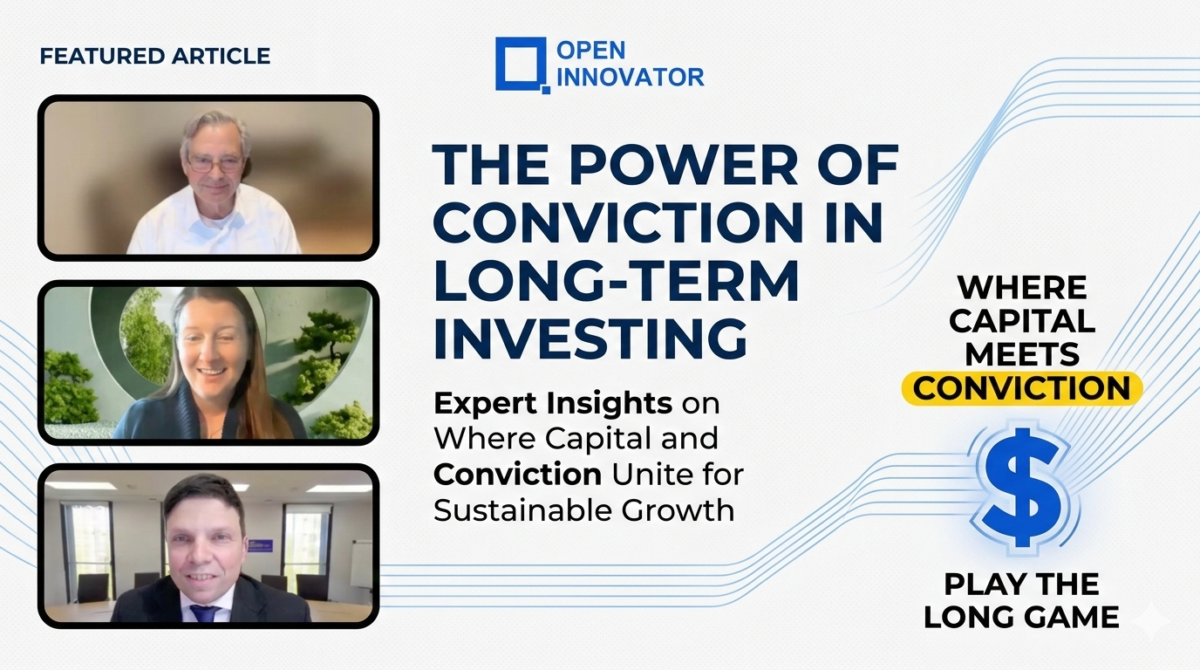
The panel featured George Jones, Managing Director at Woodside Capital Partners; Keshia Theobald-van Gent, Venture Capital Partner at B Dev Ventures; and Matteo R. Oldani, Associate Partner at Your Group and Fractional CFO at Rosetta Omics. Together, they unpacked the structural realities of investing in technologies that require seven to eleven years to mature.
The consensus among the panel was clear: in sectors such as semiconductors, photonics, and life sciences, time is not a liability, but a strategic moat. When managed with financial discipline and commercial validation, long-horizon ventures offer superior defensibility and enhanced terminal value.
I. Deconstructing the Liquidity Myth
A primary friction point for LPs and GPs is the perceived “capital lock-up” inherent in deep tech. However, historical data and fund behavior suggest a more nuanced reality:
- Fund Lifecycle Elasticity: While nominally ten-year vehicles, most venture funds operate on 15-to-17-year horizons through extensions, aligning naturally with the 9-year maturity average for semiconductors and 11-year average for IoT.
- The Maturity Premium: Delayed liquidity often results in higher-quality exits. Companies with a decade of development enter acquisition talks with validated Intellectual Property (IP), stabilized risk profiles, and crystallized product-market fit.
“Liquidity is not absent in long-gestation cycles; it is deferred in exchange for enhanced valuation and competitive insulation.”
II. Risk Mitigation: Beyond the Binary “Moonshot”
The panel rejected the trope that deep tech is a binary “all-or-nothing” bet. Instead, they proposed a model of Incremental De-risking through disciplined milestone execution:
- Structured Experimentation: Success is predicated on completing full pilot cycles before pivoting.
- Market-Anchored Pivots: Tactical shifts must be driven by external feedback, not internal technical frustration.
- Mission Continuity: While tactics evolve, the core strategic objective must remain constant to maintain investor alignment.
III. The Transition: From Technical Elegance to Economic Validation
A critical failure point identified by Keshia Theobald-van Gent (B Dev Ventures) is the “Innovation Trap”—optimizing technology at the expense of market readiness.
| Stage | Focus | Primary Objective |
| Seed | Product Validation | Technical Proof of Concept |
| Series B | Economic Validation | Repeatable Sales & Unit Economics |
To bridge this gap, founders must prioritize a clearly defined Ideal Customer Profile (ICP) and early evidence of Willingness to Pay (WTP). As the session noted: “Innovation gets you to Seed; discipline gets you to Series B.”
IV. Financial Architecture and Capital Efficiency
From a CFO perspective, Matteo R. Oldani emphasized that strategic patience is only viable when paired with rigorous financial oversight. Long-gestation founders must distinguish between EBITDA and Cash Flow while maintaining an acute understanding of investor incentives.
Lessons from the 2020–2025 Cycle:
The recent era of “cheap money” served as a cautionary tale. Excess capital often distorts discipline and inflates valuations beyond sustainable levels. The panel’s directive: Raise what is required, not what is offered. Efficiency is a structural advantage that reduces future fundraising pressure.
V. Designing for the Exit
The sequence of development should ideally follow a Sell → Design → Build methodology. By validating customer demand before final construction, downstream risks are significantly mitigated.
Exit Pathway Realities:
- Acquisition Readiness: Should be integrated into the corporate DNA from Day 1.
- Secondaries: Partial sales can provide interim liquidity, easing the pressure of the 10-year wait.
- Ego vs. Tech: Investors cited “ego-driven decision making” and “founder detachment” as more frequent deal-killers than technical failure or messy cap tables.
Conclusion: The Decade Test
The session concluded with a shift in perspective on what constitutes a “successful” investment. While financial returns remain the primary metric, the enduring impact on healthcare, energy, and infrastructure provides the underlying stability of the asset class.
The Bottom Line:
The greatest wealth in the current venture ecosystem is not being built on 18-month hype cycles. It is being forged in the decade-long pursuit of hard tech. For the disciplined investor, long-horizon thinking remains the ultimate competitive edge.
Write us to at open-innovator@quotients.com to participate and get more information on our upcoming sessions.