






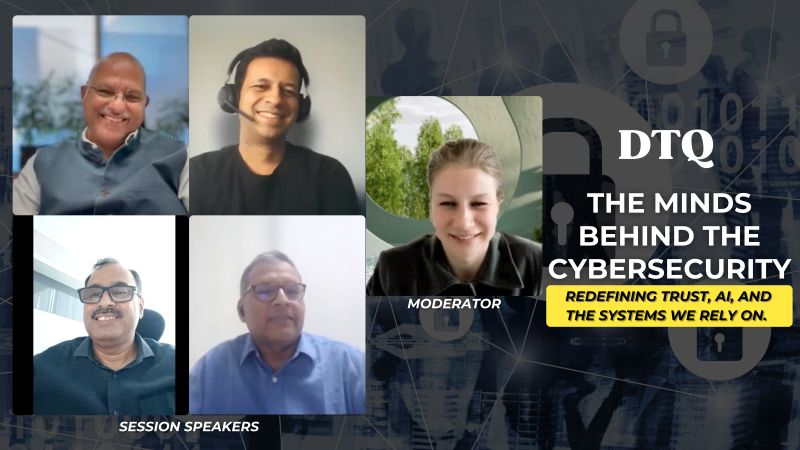
DTQ organized a virtual session on March 23, 2026, titled “Building Digital Trust in an Untrusted World”, bringing together thought leaders to explore the intersection of cybersecurity, AI ethics, and organizational resilience. In a digital era where compliance is often mistaken for genuine trust, the discussion emphasized that true trust is not achieved through audits or technical sophistication alone, but through transparency, predictability, and ethical responsibility.
This report captures the key insights from the session, highlighting the philosophical shift toward viewing trust as a dynamic currency, the hidden vulnerabilities beneath compliance, and the strategic frameworks needed to embed trust into the very architecture of digital systems.
The Architects of Trust: Panel Participants
- Ella Tiuriumina: Moderator and Siemens Brand Ambassador.
- Vipin Chawla: Executive VP and CTO at Max Group.
- Abhishek Kulkarni: Cybersecurity Expert and Technical Lead, Lloyd Technology
- Ritesh Kumar: Director of Cybersecurity at ARCON
- Piyush Govil: Director of IT Admin and HR at Infozec Software.
The Digital Trust Mandate: News & Analysis
In a world increasingly dominated by “secure and compliant” marketing narratives, a panel of industry veterans recently met to strip away the corporate jargon and address the uncomfortable truths of the digital age. The consensus was clear: Compliance is not trust. While an organization might pass every audit on paper, the true measure of digital trust is found in the “unseen layers”—the behavior of AI models, the integrity of internal cultures, and the predictability of user experiences.
The following report details the deep-dive insights and strategic learnings from the session.
The Philosophical Shift: Trust as Currency
The panel opened by challenging the standard definition of trust. In the digital realm, trust is often mistakenly viewed as a static “state” achieved via encryption or firewalls. The experts reframed it as a dynamic, fragile currency that is earned through predictability, transparency, and empathy.
- The Paradox of Convenience: A significant insight shared was the “strange paradox” where users click “Accept All” on privacy cookies without a second thought (trading data for convenience), yet will spend hours researching a third-party review site because they don’t trust the brand’s own claims. This highlights a massive “Trust Deficit” that brands must bridge.
- Predictability vs. Sophistication: Tech sophistication doesn’t build trust; predictability does. If a system behaves inconsistently—even if it is technically superior—trust evaporates.
Unpacking the “Uncomfortable Truths” of Cybersecurity
One of the most provocative segments of the discussion revolved around what happens beneath the “secure and compliant” surface.
- The Compliance Trap: The panel warned that many organizations use compliance as a shield to hide fundamental vulnerabilities. Being “compliant” does not mean a system is “trustworthy.” Trust breaks at the experience layer—how the data is actually used—rather than the policy layer.
- The Internal Perimeter: We often focus on external hackers, but the “uncomfortable truth” is that trust often fails internally. If an employee flags a security concern and it is ignored or buried in “low priority” tickets, that internal breach of trust eventually manifests as an external security failure.
- Data Drift and AI Opacity: As AI becomes central to operations, “data drift” (where models become less accurate over time) and the “black box” nature of AI decision-making create new trust gaps that traditional security frameworks are not equipped to handle.
Strategic Learnings: Architectural Resilience
The experts moved from identifying problems to outlining architectural solutions, emphasizing that trust cannot be a “bolted-on” feature.
- Trust by Design (Day Zero)
The panel emphasized that trust must be an architectural requirement from “Day Zero.” This means asking not just “Is it secure?” but “Is it transparent?” and “Is it fair?”
- Example: In AI-driven recruitment, if the algorithm filters candidates based on hidden biases without human oversight, the trust in the brand’s HR process is fundamentally broken, regardless of how “secure” the database is.
- Zero Trust for AI Agents
A key technical learning involved the evolution of Zero Trust. In a world of interconnected AI agents, we can no longer trust any entity—internal or external—by default. However, the challenge lies in balancing this “Zero Trust” posture with the need for data fluidity to drive innovation.
- Information Integrity (The New CIA Triad)
Beyond Confidentiality, Integrity, and Availability, the panel suggested a focus on Information Veracity. In an era of deepfakes and AI-generated misinformation, the ability to prove that data is “true” and “original” is the next frontier of digital trust.
Leadership and the “Trust-First” Mindset
To move forward, the panel argued that Digital Trust must be elevated from the server room to the boardroom.
- Commercializing Trust: Leadership must stop viewing security as a cost center. Instead, trust should be framed in commercial terms: Customer Lifetime Value (CLV) and Brand Equity. A trusted brand has lower customer acquisition costs and higher retention.
- The KPI of Trust: Organizations should manage trust through outcome-based KPIs. This includes not just “uptime,” but “transparency scores” and “resolution empathy”—measuring how effectively a company communicates when things go wrong.
Conclusion: Scale Requires Trust
The session concluded with a powerful takeaway: “If I cannot see it, I cannot scale it.” Innovation is only as fast as the trust underlying it. Without a “trust-first” mindset, rapid scaling in the age of AI is not an achievement; it is a liability.
As the digital landscape becomes increasingly complex, the organizations that survive will not be those with the most complex security tech, but those that treat trust as a foundational design constraint.
DTQ serves as a platform dedicated to mapping global industry shifts and providing “information capital” before it reaches the mainstream. in cybersecurity space. Please write us at open-innovator@quotients.com for more information.