






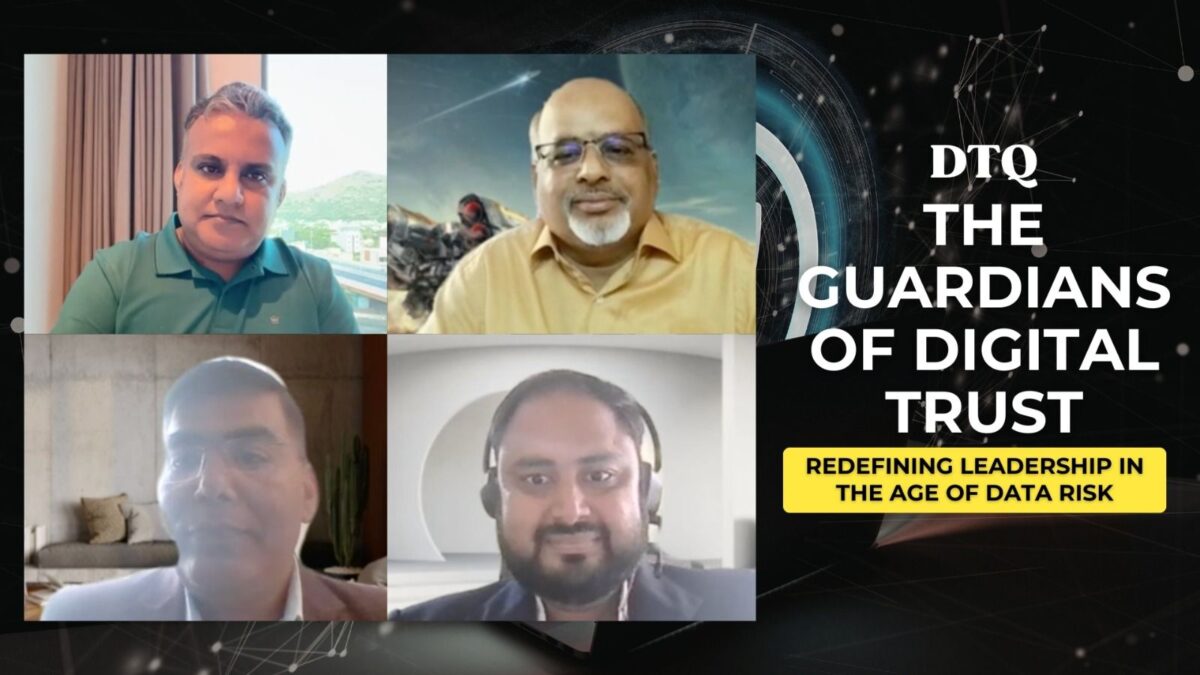
On June 5, 2026, DTQ hosted an executive panel discussion titled “Data Is the New Risk: How Leaders Can Protect Digital Trust.” It is known, Data Trust Quotients (DTQ) is a strategic cybersecurity and governance platform that convenes leaders, practitioners, and innovators to address the evolving challenges of digital trust.
The session explored how organizations can navigate an increasingly complex digital landscape by balancing innovation, security, governance, and accountability. With AI adoption accelerating and data flowing across borders, the panel emphasized that trust is now the most valuable currency in the digital economy.
The session brought together industry leaders and governance experts to explore how enterprises can maintain digital trust, prevent accidental exposure, and build robust architectures in an era where data itself has become the modern risk perimeter.
Panelists and Speakers
- Subhashish Saha — Moderator, Cybersecurity Professional
- Vishwajeet Mokashi — Security Leader with experience in high-stakes environments
- Soumak Roy — Cybersecurity Strategist specializing in identity and cloud security
- Anil Chiplunkar — Veteran CISO and Governance Expert
Key Insights
- The Fluid Perimeter and the Exposure-Centric Shift: Traditional network perimeters are completely dissolving because enterprise data dynamically moves across clouds, SaaS applications, APIs, mobile devices, and complex third-party vendor ecosystems. Relying on the Verizon 2026 Data Breach Investigations Report (DBIR), the panel highlighted that roughly 30% to 31% of cyber breaches now originate from software vulnerabilities—surpassing stolen credentials. Consequently, companies must evolve their cyber defense methodologies from purely identity-centric systems to exposure-centric models that target unpatched infrastructure, internet-facing assets, and misconfigured environments.
- Identity as the Primary Control Plane: Because permanent boundaries no longer exist, identity is now the primary security control plane. Panelists stressed that “identity” goes well beyond employee credentials; it encompasses contractors, service accounts, bots, machine identities, and API keys. If access privileges are excessive or poorly managed, standard controls like file encryption fail to secure data.
- Unintentional Risk, Shadow AI, and Human Slips: Massive enterprise data risk is driven less by malicious intent and more by operational speed and an absence of governance. This creates “Shadow IT” and “Shadow AI,” where employees inadvertently feed company IP, confidential codes, or sensitive customer details into unauthorized public AI platforms to expedite tasks or draft responses. Furthermore, casual operational actions—such as failure to mute microphones during training calls when discussing active corporate projects—result in minor but highly problematic data leakages.
- Embedding Security to Safely Enable Business Growth: Governance should not be positioned as an obstacle to business delivery. Instead of telling commercial teams they cannot execute, successful organizations pair business teams with “cybersecurity guards” who help safely structure processes and directly educate clients on the value of secure operations, creating mutual commercial trust.
Strategic Action Framework
To address data-centric business risks, leaders should execute against the following foundational framework established during the discussion:
- Enforcing a Top-Down Boardroom Culture: Cybersecurity must be treated as a comprehensive corporate threat and a board-level priority rather than an isolated IT problem delegated solely to a CISO. Security strategies must originate at the executive level and flow down to ensure accountability becomes deep-seated in organizational culture.
- Mapping the Data Supply Chain: Organizations can only build reliable defenses if they intimately know their business environment. This demands comprehensive visibility over corporate “crown jewels”—specifically mapping where sensitive data resides, auditing third-party integrations, identifying which identities possess administrative privileges, and evaluating system-to-system communications.
- Comprehensive Lifecycle Governance: Rather than viewing data protection purely as threat prevention, leadership must monitor data across its full lifecycle: collection, classification, secure access management, ongoing usage, partner sharing, retention limits, and secure purging protocols.
- Simulations and Incident Drills: A notable blind spot for leadership teams is lacking an active, actionable roadmap for the immediate aftermath of an actual breach. Frameworks and playbooks must be aggressively tested via proactive simulations, crisis drills, and executive tabletop exercises on a rolling basis.
- Human-in-the-Loop Safeguards for Critical Processes: Automated reliance on advanced AI models introduces structural risks like data poisoning. In highly sensitive verticals (such as patient diagnostic reporting within healthcare), leaders must implement human verification milestones to act as a mechanical “kill switch,” confirming that AI outputs operate within acceptable business tolerances before execution.
Takeaway
The executive roundtable emphasized that as organizations accelerate digital adoption, data cannot be viewed merely as an innovation asset—it must be actively managed as an organizational liability. Relying purely on legacy technical infrastructure or automated oversight dashboards is insufficient in a landscape redefined by fluid perimeters, cloud speed, and pervasive AI. Ultimately, digital trust is won or lost at the leadership level. Achieving sustainable resilience requires establishing rigorous, lifecycle-wide data governance, embedding security as an active business enabler, and maintaining continuous executive ownership over structural exposure risks.
DTQ serves as a platform dedicated to mapping global industry shifts and providing “information capital” before it reaches the mainstream. in cybersecurity space. Reach out to us at Innovate@quotients.com for more information.