




Categories
DTQ Events

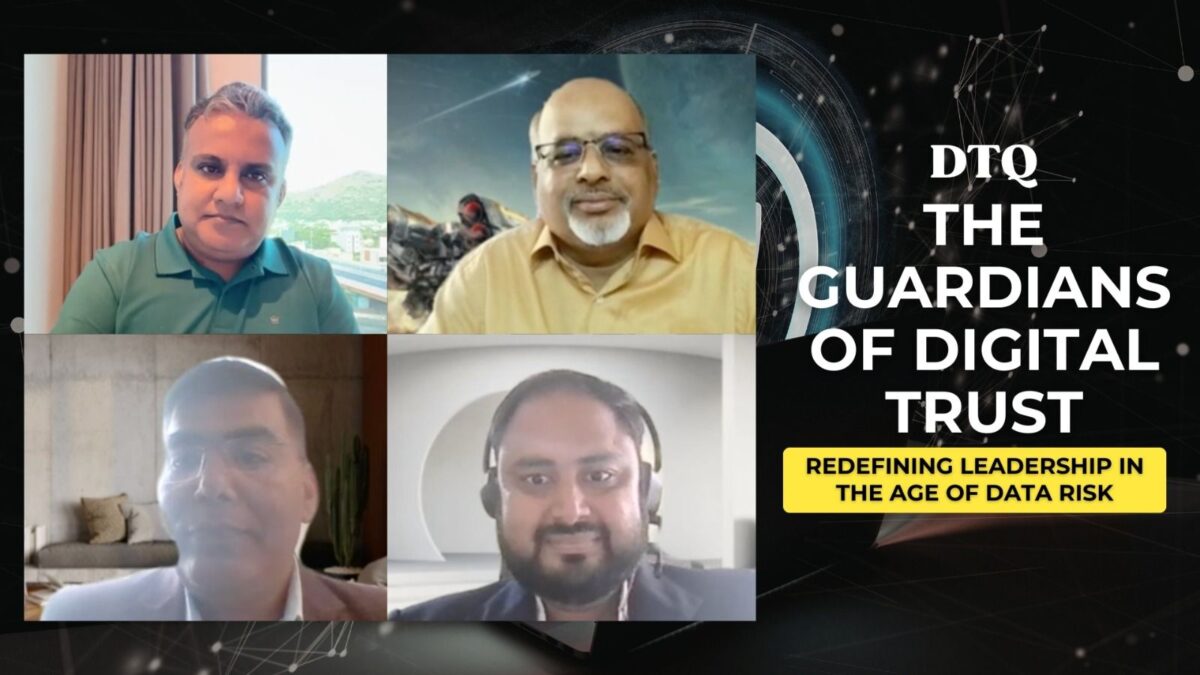
Report: Data Is the New Risk: How Leaders Can Protect Digital Trust

Categories
DTQ Events

Report: Data Is the New Risk: How Leaders Can Protect Digital Trust

On June 5, 2026, DTQ hosted an executive panel discussion titled “Data Is the New Risk: How Leaders Can Protect Digital Trust.” It is known, Data Trust Quotients (DTQ) is a strategic cybersecurity and governance platform that convenes leaders, practitioners, and innovators to address the evolving challenges of digital trust.

The session explored how organizations can navigate an increasingly complex digital landscape by balancing innovation, security, governance, and accountability. With AI adoption accelerating and data flowing across borders, the panel emphasized that trust is now the most valuable currency in the digital economy.

The session brought together industry leaders and governance experts to explore how enterprises can maintain digital trust, prevent accidental exposure, and build robust architectures in an era where data itself has become the modern risk perimeter.

Panelists and Speakers

  • Subhashish Saha — Moderator, Cybersecurity Professional
  • Vishwajeet Mokashi — Security Leader with experience in high-stakes environments
  • Soumak Roy — Cybersecurity Strategist specializing in identity and cloud security
  • Anil Chiplunkar — Veteran CISO and Governance Expert

Key Insights

  • The Fluid Perimeter and the Exposure-Centric Shift: Traditional network perimeters are completely dissolving because enterprise data dynamically moves across clouds, SaaS applications, APIs, mobile devices, and complex third-party vendor ecosystems. Relying on the Verizon 2026 Data Breach Investigations Report (DBIR), the panel highlighted that roughly 30% to 31% of cyber breaches now originate from software vulnerabilities—surpassing stolen credentials. Consequently, companies must evolve their cyber defense methodologies from purely identity-centric systems to exposure-centric models that target unpatched infrastructure, internet-facing assets, and misconfigured environments.

  • Identity as the Primary Control Plane: Because permanent boundaries no longer exist, identity is now the primary security control plane. Panelists stressed that “identity” goes well beyond employee credentials; it encompasses contractors, service accounts, bots, machine identities, and API keys. If access privileges are excessive or poorly managed, standard controls like file encryption fail to secure data.

  • Unintentional Risk, Shadow AI, and Human Slips: Massive enterprise data risk is driven less by malicious intent and more by operational speed and an absence of governance. This creates “Shadow IT” and “Shadow AI,” where employees inadvertently feed company IP, confidential codes, or sensitive customer details into unauthorized public AI platforms to expedite tasks or draft responses. Furthermore, casual operational actions—such as failure to mute microphones during training calls when discussing active corporate projects—result in minor but highly problematic data leakages.

  • Embedding Security to Safely Enable Business Growth: Governance should not be positioned as an obstacle to business delivery. Instead of telling commercial teams they cannot execute, successful organizations pair business teams with “cybersecurity guards” who help safely structure processes and directly educate clients on the value of secure operations, creating mutual commercial trust.

Strategic Action Framework

To address data-centric business risks, leaders should execute against the following foundational framework established during the discussion:

  • Enforcing a Top-Down Boardroom Culture: Cybersecurity must be treated as a comprehensive corporate threat and a board-level priority rather than an isolated IT problem delegated solely to a CISO. Security strategies must originate at the executive level and flow down to ensure accountability becomes deep-seated in organizational culture.

  • Mapping the Data Supply Chain: Organizations can only build reliable defenses if they intimately know their business environment. This demands comprehensive visibility over corporate “crown jewels”—specifically mapping where sensitive data resides, auditing third-party integrations, identifying which identities possess administrative privileges, and evaluating system-to-system communications.

  • Comprehensive Lifecycle Governance: Rather than viewing data protection purely as threat prevention, leadership must monitor data across its full lifecycle: collection, classification, secure access management, ongoing usage, partner sharing, retention limits, and secure purging protocols.

  • Simulations and Incident Drills: A notable blind spot for leadership teams is lacking an active, actionable roadmap for the immediate aftermath of an actual breach. Frameworks and playbooks must be aggressively tested via proactive simulations, crisis drills, and executive tabletop exercises on a rolling basis.

  • Human-in-the-Loop Safeguards for Critical Processes: Automated reliance on advanced AI models introduces structural risks like data poisoning. In highly sensitive verticals (such as patient diagnostic reporting within healthcare), leaders must implement human verification milestones to act as a mechanical “kill switch,” confirming that AI outputs operate within acceptable business tolerances before execution.

Takeaway

The executive roundtable emphasized that as organizations accelerate digital adoption, data cannot be viewed merely as an innovation asset—it must be actively managed as an organizational liability. Relying purely on legacy technical infrastructure or automated oversight dashboards is insufficient in a landscape redefined by fluid perimeters, cloud speed, and pervasive AI. Ultimately, digital trust is won or lost at the leadership level. Achieving sustainable resilience requires establishing rigorous, lifecycle-wide data governance, embedding security as an active business enabler, and maintaining continuous executive ownership over structural exposure risks.

DTQ serves as a platform dedicated to mapping global industry shifts and providing “information capital” before it reaches the mainstream. in cybersecurity space. Reach out to us at Innovate@quotients.com for more information.

Categories
Data Trust Quotients DTQ Visibility Quotient

The AI Trust Fall: Building Confidence in an Era of Hallucination

Categories
Data Trust Quotients DTQ Visibility Quotient

The AI Trust Fall: Building Confidence in an Era of Hallucination

Data Trust Knowledge Session | February 9, 2026

Open Innovator organized a critical knowledge session on AI trust as systems transition from experimental tools to enterprise infrastructure. With tech giants leading trillion-dollar-plus investments in AI, the focus has shifted from model performance to governance, real-world decision-making, and managing a new category of risk: internal intelligence that can hallucinate facts, bypass traditional logic, and sound completely convincing. The session explored how to design systems, governance, and human oversight so that trust is earned, verified, and continuously managed across cybersecurity, telecom infrastructure, healthcare, and enterprise platforms.

Expert Panel

Vijay Banda – Chief Strategy Officer pioneering cognitive security, where monitors must monitor other monitors and validation layers become essential for AI-generated outputs.

Rajat Singh – Executive Vice President bringing telecommunications and 5G expertise where microsecond precision is non-negotiable and errors cascade globally.

Rahul Venkat – Senior Staff Scientist in AI and healthcare, architecting safety nets that leverage AI intelligence without compromising clinical accuracy.

Varij Saurabh – VP and Director of Products for Enterprise Search, with 15-20 years building platforms where probabilistic systems must deliver reliable business foundations.

Moderated by Rudy Shoushany, AI governance expert and founder of BCCM Management and TxDoc. Hosted by Data Trust, a community focused on data privacy, protection, and responsible AI governance.

Cognitive Security: The New Paradigm

Vijay declared that traditional security from 2020 is dead. The era of cognitive security has arrived like having a copilot monitor the pilot’s behavior, not just the plane’s systems. Security used to be deterministic with known anomalies; now it’s probabilistic and unpredictable. You can’t patch a hallucination like you patch a server.

Critical Requirements:

  • Validation layers for all AI-generated content, cross-checked by another agent using golden sources of truth
  • Human oversight checking if outputs are garbage in/garbage out, or worse-confidential data leakage
  • Zero trust of data-never assume AI outputs are correct without verification
  • Training AI systems on correct parameters, acceptable outputs, and inherent biases

The shift: These aren’t insider threats anymore, but probabilistic scenarios where data from AI engines gets used by employees without proper validation.

Telecom Precision: Layered Architecture for Zero Error

Rajat explained why the AI trust question has become urgent. Early social media was a separate dimension from real life. Now AI-generated content directly affects real lives-deepfakes, synthesized datasets submitted to governments, and critical infrastructure decisions.

The Telecom Solution: Upstream vs. Downstream

Systems are divided into two zones:

Upstream (Safe Zone): AI can freely find correlations, test hypotheses, and experiment without affecting live networks.

Downstream (Guarded Zone): Where changes affect physical networks. Only deterministic systems allowed-rule engines, policy makers, closed-loop automation, and mandatory human-in-the-loop.

Core Principle: Observation ≠ Decision ≠ Action. This separation embedded in architecture creates the first step toward near-zero error.

Additional safeguards include digital twins, policy engines, and keeping cognitive systems separate from deterministic ones. The key insight: zero error means zero learning. Managed errors within boundaries drive innovation.

Why Telecom Networks Rarely Crash: Layered architecture with what seems like too many layers but is actually the right amount, preventing cascading failures.

Healthcare: Knowledge Graphs and Moving Goalposts

Rahul acknowledged hallucination exists but noted we’re not yet at a stage of extreme worry. The issue: as AI answers more questions correctly, doctors will eventually start trusting it blindly like they trust traditional software. That’s when problems will emerge.

Healthcare Is Different from Code

You can’t test AI solutions on your body to see if they work. The costs of errors are catastrophically higher than software bugs. Doctors haven’t started extensively using AI for patient care because they don’t have 100% trust—yet.

The Knowledge Graph Moat

The competitive advantage isn’t ChatGPT or the AI model itself—it’s the curated knowledge graph that companies and institutions build as their foundation for accurate answers.

Technical Safeguards:

  • Validation layers
  • LLM-as-judge (another LLM checking if the first is lying)
  • Multiple generation testing (hallucinations produce different explanations each time)
  • Self-consistency checks
  • Mechanistic interpretability (examining network layers)

The Continuous Challenge: The moment you publish a defense technique, AI finds a way to beat it. Like cybersecurity, this is a continuous process, not a one-time solution.

AI Beyond Human Capabilities

Rahul challenged the assumption that all ground truth must come from humans. DeepMind can invent drugs at speeds impossible for humans. AI-guided ultrasounds performed by untrained midwives in rural areas can provide gestational age assessments as accurately as trained professionals, bringing healthcare to underserved communities.

The pragmatic question for clinical-grade AI: Do benefits outweigh risks? Evaluation must go beyond gross statistics to ensure systems work on every subgroup, especially the most marginalized communities.

Enterprise Platforms: Living with Probabilistic Systems

Varij’s philosophy after 15-20 years building AI systems: You have to learn to live with the weakness. Accept that AI is probabilistic, not deterministic. Once you accept this reality, you automatically start thinking about problems where AI can still outperform humans.

The Accuracy Argument

When customers complained about system accuracy, the response was simple: If humans are 80% accurate and the AI system is 95% accurate, you’re still better off with AI.

Look for Scale Opportunities

Choose use cases where scale matters. If you can do 10 cases daily and AI enables 1,000 cases daily with better accuracy, the business value is transformative.

Reframe Problems to Create New Value

Example: Competitors used ethnographers with clipboards spending a week analyzing 6 hours of video for $100,000 reports. The AI solution used thousands of cameras processing video in real-time, integrated with transaction systems, showing complete shopping funnels for physical stores—value impossible with previous systems.

The Product Manager’s Transformed Role

Traditional PM workflow–write user stories, define expectations, create acceptance criteria, hand to testers–is breaking down.

The New Reality:

Model evaluations (evals) have moved from testers to product managers. PMs must now write 50-100 test cases as evaluations, knowing exactly what deserves 100% marks, before testing can begin.

Three Critical Pillars for Reliable Foundations:

1. Data Quality Pipelines – Monitor how data moves into systems, through embeddings, and retrieval processes. Without quality data in a timely manner, AI cannot provide reliable insights.

2. Prompt Engineering – Simply asking systems to use only verified links, not hallucinate, and depend on high-quality sources increases performance 10-15%. Grounding responses in provided data and requiring traceability are essential.

3. Observability and Traceability – If mistakes happen, you must trace where they started and how they reached endpoints. Companies are building LLM observation platforms that score outputs in real-time on completeness, accuracy, precision, and recall.

The shift from deterministic to probabilistic means defining what’s good enough for customers while balancing accuracy, timeliness, cost, and performance parameters.

Non-Negotiable Guardrails

Single Source of Truth – Enterprises must maintain authentic sources of truth with verification mechanisms before AI-generated data reaches employees. Critical elements include verification layers, single source of truth, and data lineage tracking to differentiate artificiality from fact.

NIST AI RMF + ISO 42001 – Start with NIST AI Risk Management Framework to tactically map risks and identify which need prioritizing. Then implement governance using ISO 42001 as the compliance backbone.

Architecture First, Not Model First – Success depends on layered architectures with clear trust boundaries, not on having the smartest AI model.

Success Factors for the Next 3-5 Years

The next decade won’t be won by making AI perfectly truthful. Success belongs to organizations with better system engineers who understand failure, leaders who design trust boundaries, and teams who treat AI as a junior genius rather than an oracle.

What Telecom Deploys: Not intelligence, but responsibility. AI’s role is to amplify human judgment, not replace it. Understanding this prevents operational chaos and enables practical implementation.

AI Will Always Generalize: It will always overfit narratives. Everyone uses ChatGPT or similar tools for context before important sessions—this will continue. Success depends on knowing exactly where AI must not be trusted and making wrong answers as harmless as possible.

The AGI Question and Investment Reality

Panel perspectives on AGI varied from already here in certain forms, to not caring because AI is just a tool, to being far from achieving Nobel Prize-winning scientist level intelligence despite handling mediocre middle-level tasks.

From an investment perspective, AGI timing matters critically for companies like OpenAI. With trillions in commitments to data centers and infrastructure, if AGI isn’t claimed by 2026-2027, a significant market correction is likely when demand fails to match massive supply buildout.

Key Takeaways

1. Cognitive Security Has Replaced Traditional Security – Validation layers, zero trust of AI data, and semantic telemetry are mandatory.

2. Separate Observation from Decision from Action – Layered architecture prevents errors from cascading into mission-critical systems.

3. Knowledge Graphs Are the Real Moat – In healthcare and critical domains, competitive advantage comes from curated knowledge, not the LLM.

4. Accept Probabilistic Reality – Design around AI being 95% accurate vs. humans at 80%, choosing use cases where AI’s scale advantages transform value.

5. PMs Now Own Evaluations – The testing function has moved to product managers who must define what’s good enough in a probabilistic world.

6. Human-in-the-Loop Is Non-Negotiable – Structured intervention at critical decision points, not just oversight.

7. Single Source of Truth – Authentic data sources with verification mechanisms before AI outputs reach employees.

8. Continuous Process, Not One-Time Fix – Like cybersecurity, AI trust requires ongoing vigilance as defenses and attacks evolve.

9. Responsibility Over Intelligence – Deploy systems designed for responsibility and amplifying human judgment, not autonomous decision-making.

10. Better System Engineers Win – Success belongs to those who understand where AI must not be trusted and design boundaries accordingly.

Conclusion

The session revealed a unified perspective: The question isn’t whether AI can be trusted absolutely, but how we architect systems where trust is earned through verification, maintained through continuous monitoring, and bounded by clear human authority.

From cognitive security frameworks to layered telecom architectures, from healthcare knowledge graphs to PM evaluation ownership, the message is consistent: Design for the reality that AI will make mistakes, then ensure those mistakes are caught before they cascade into catastrophic failures.

The AI trust fall isn’t about blindly falling backward hoping AI catches you. It’s about building safety nets first—validation layers, zero trust of data, single sources of truth, human-in-the-loop checkpoints, and organizational structures where responsibility always rests with humans who understand both the power and limitations of their AI tools.

Organizations that thrive won’t have the most advanced AI—they’ll have mastered responsible deployment, treating AI as the junior genius it is, not the oracle we might wish it to be.


This Data Trust Knowledge Session provided essential frameworks for building AI trust in mission-critical environments. Expert panel: Vijay Banda, Rajat Singh, Rahul Venkat, and Varij Saurabh. Moderated by Rudy Shoushany.


Categories
Applied Innovation

Digital Public Infrastructure: A Catalyst for MSME Growth

Categories
Applied Innovation

Digital Public Infrastructure: A Catalyst for MSME Growth

Digital Public Infrastructure (DPI) is essential for the success of Micro, Small, and Medium Enterprises (MSMEs), which can benefit from increased financial services access, simplified operations, or innovation. Modern economies have incorporated DPI as a fundamental factor, supporting the growth and financial inclusion of MSMEs.

Elements of Digital Public Infrastructure

A significant aspect of Digital Public Infrastructure (DPI) is its digital identity. By providing online identity verification, it enables secure and efficient access to a range of services for both individuals and businesses. Digital identity plays a vital role in Know Your Customer (KYC) processes, loan approvals, and access to financial services for MSMEs. By having a verified digital identity, MSMEs can better navigate the financial landscape, increase their credibility, and facilitate smoother transactions. Also, digital identities make it easier for MSMEs to establish trust with lenders and other financial institutions due to reduced time & effort required for verification.

Digital payment systems play a crucial role in Digital Payment Infrastructure (DPI) by facilitating smooth and secure financial transactions. Payment gateways, digital wallets, and online banking services offer MSMEs effective payment options, decreasing their dependence on cash and enhancing transaction efficiency. Digital platforms like e-commerce marketplaces, government portals, and industry-specific sites link MSMEs with customers, suppliers, and service providers, broadening their market reach and optimizing operations. A strong data infrastructure, which encompasses data storage, processing, and analysis capabilities, is vital for the successful operation of DPI. Reliable internet access and strong cybersecurity measures are essential to ensure secure transactions and protect sensitive information, making DPI a key driver for the growth and development of MSMEs.

Key Benefits of DPI for MSMEs

Digital Public Infrastructure (DPI) can provide a range of benefits for Micro, Small, and Medium Enterprises (MSMEs), greatly improving their operational and financial efficiency. A key advantage of DPI is the provision of digital identities, which are crucial for Know Your Customer (KYC) processes and securing loans. These digital identities make the verification process easier for lenders, saving both time and effort, and facilitating access to credit for MSMEs. Furthermore, DPI allows MSMEs to utilize various financial services like digital wallets, payment gateways, and online banking, which help streamline financial transactions and enhance business operations

Effective cash flow management is a crucial area where DPI plays a significant role. There are platforms that help MSMEs manage their cash flow more effectively by allowing for early payments on invoices giving MSMEs quicker access to working capital. This enhanced cash flow is vital for the daily operations and long-term growth of these businesses. By shortening the payment waiting period, DPI improves liquidity and financial stability for MSMEs.

The digital revolution has broadened the market reach of MSMEs by creating new opportunities through e-commerce platforms. These platforms can allow MSMEs to sell their products and services to a worldwide audience, greatly enhancing market accessibility. This ability to connect with previously unreachable customer bases fosters growth and competitiveness for MSMEs.

Furthermore, e-commerce platforms may provide valuable insights into customer preferences and market trends, enabling MSMEs to make informed business decisions and customize their offerings to align with market demands. This improved market reach empowers MSMEs to scale their operations and compete effectively on a global level

Digital tools and technologies have the potential to transform how MSMEs operate by cutting down on paperwork and automating various processes. The use of digital solutions like Enterprise Resource Planning (ERP) systems, Customer Relationship Management (CRM) software, and supply chain management tools can greatly boost productivity and innovation. These technologies allow MSMEs to manage their resources more efficiently, streamline workflows, and enhance overall operational effectiveness. By concentrating on growth and innovation instead of administrative duties, MSMEs can better position themselves for success in a competitive market.

Additionally, the government is planning to roll out several initiatives to aid the growth and development of MSMEs to bolster the financial infrastructure by encouraging technology upgrades and tackling payment delays. This collaborative strategy equips MSMEs with the essential support and resources they need to thrive in the digital economy. By creating a nurturing ecosystem, the government can ensure that MSMEs have access to the necessary tools and technologies to succeed, helping them overcome challenges and capitalize on opportunities in the digital age.

Takeaway

The development of Digital Public Infrastructure is crucial for empowering MSMEs. It enhances access to financial services, boosts operational efficiency, and broadens market opportunities, thereby supporting individual businesses and playing a significant role in national economic growth. As India strives to become a key economic player by 2030, the importance of DPI in fostering the MSME sector will only grow. Digital Public Infrastructure goes beyond being a mere technological upgrade; it serves as a cornerstone for a vibrant, inclusive economy where MSMEs can thrive. By leveraging DPI, these enterprises can discover new opportunities, foster innovation, and contribute to the nation’s overall prosperity.