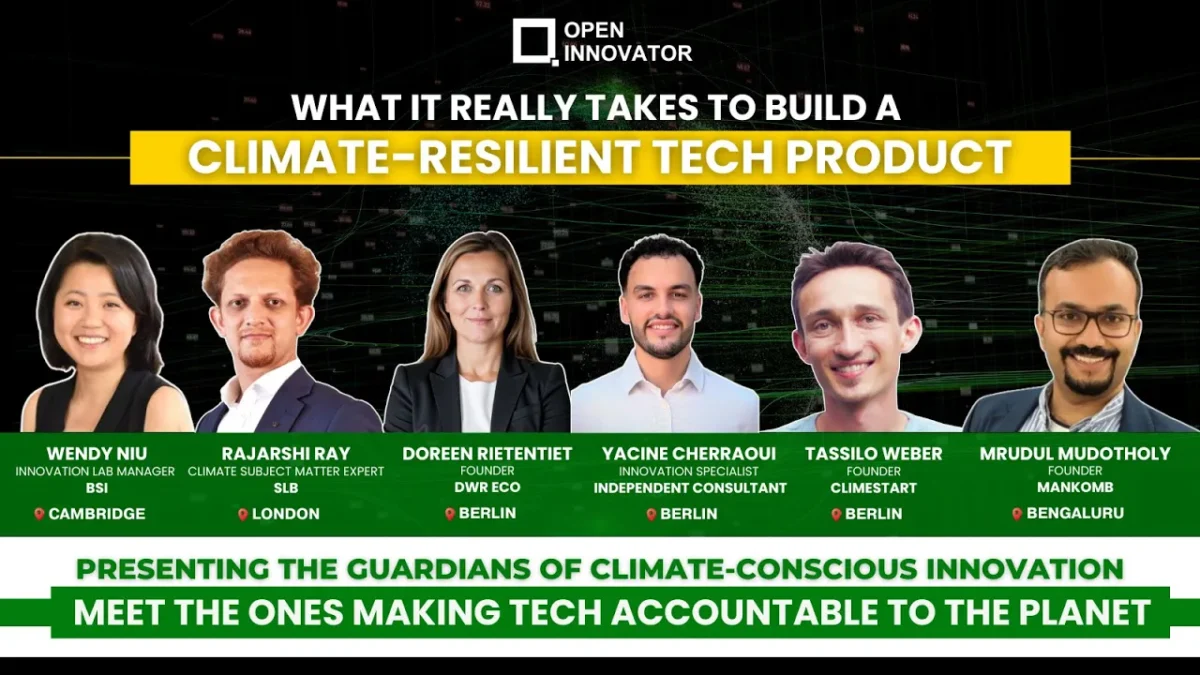







Climate Resilience: A New Mandate for Technology
The role of technology is changing from mitigation to adaptation as climate change gather momentum. Resilience is now a fundamental design concept, whether it is used in software that adapts to unpredictable energy sources or sensors that withstand floods.
Building climate-resilient value chains across businesses requires tech-enabled adaptation, according to the World Economic Forum. The problem is strategic as well as technological, and innovation must be infused with climate resilience, which should influence every choice from conception to implementation.
Designing for Environmental Extremes
Materials and architecture that can tolerate environmental stress are the foundation of climate-resilient technology. Products must function without degrading when exposed to high temperatures, high humidity, or wetness. This entails reconsidering everything, including housing enclosures and circuit boards. Additionally, software needs to be resilient—able to continue operating even in the face of erratic connectivity or deteriorated data inputs. In agriculture, for instance, remote monitoring systems need to function even during droughts or storms.
Modularity and redundancy are essential; systems should fail pleasantly rather than disastrously. The use of “climate proofing” techniques by engineers is growing, particularly in disaster-prone areas. These consist of adaptable firmware, corrosion-resistant parts, and raised installations. Sustained performance, not just survival, is the aim. The goal of climate-resilient design is to foresee failure modes and create products that endure disturbance.
AI and Predictive Adaptation
Our ability to predict and address climate dangers is being revolutionized by artificial intelligence. With growing accuracy, machine learning models can predict crop failures, heat waves, and floods. Preemptive measures like modifying irrigation schedules, rerouting logistics, or initiating emergency procedures are made possible by these forecasts.
Dynamic resource optimization, including balancing energy loads during periods of high demand, is also powered by AI. Predictive analytics is used in urban planning to assist pinpoint areas at risk and direct infrastructure expenditures.
AI enhances human judgment in addition to automating tasks. It becomes a force multiplier for adaptation when included into climate-resilient products, allowing for quicker and more intelligent reactions to environmental instability.
Climate data, however, is complicated and frequently lacking. Diverse datasets must be used to train models, and they must be updated often to account for shifting circumstances. Explainability and transparency are also essential, particularly when actions have an impact on public safety.
Sensor Networks and Real-Time Monitoring
The first line of defense against climate change is sensors. They gather information for adaptive systems by detecting changes in the air quality, temperature, moisture content, and structural stress. Precision irrigation in agriculture is guided by soil sensors. Air quality monitors in urban areas cause traffic changes and alarms. Structural sensors in buildings identify earthquake or wind-induced stress. These networks need to be reliable, power-efficient, and compatible with one another. They frequently work in difficult or isolated locations, necessitating robust communication protocols and lengthy battery life. Dynamic reaction is made possible by real-time monitoring; systems can modify their operations in response to real-time situations, enhancing efficiency and safety. Sensor networks will be essential for early warning and quick adaptation as climatic events become more common. Their incorporation into infrastructure and appliances signifies a move away from reactive recovery and toward proactive resilience.
Decentralized and Modular Systems
Particularly during climate disasters, centralized systems are susceptible to single points of failure. Through the distribution of functionality among nodes, decentralization improves resilience. Microgrids in the energy sector enable autonomous community operations amid blackouts. Modular purification units can be placed where necessary in water management.
Decentralized data systems in logistics guarantee continuity even in the event of a server failure. Rapid scaling and maintenance are also made possible by modular design. It is possible to upgrade, replace, or repurpose components without completely redesigning systems. This adaptability is essential in dynamic settings where demands change rapidly.
In addition to being effective, decentralized and modular technologies are also flexible. They lessen reliance on brittle centralized infrastructure by enabling users to react locally. These design principles will serve as the foundation for the upcoming generation of resilient goods and services as climate hazards increase.
Climate-Conscious Software Architecture
Although software is essential to climate resilience, it must be created with environmental considerations in mind. Energy consumption is decreased via lightweight code, particularly on edge devices. When connectivity is lost, offline functionality guarantees continuity. Adaptive algorithms adapt to inputs that change over time, such as shifting sensor data or human behavior in emergency situations. Because computer vulnerabilities frequently coincide with climate catastrophes, security is equally crucial. Software needs to be self-healing and resistant to attacks.
Interoperability is also important since systems need to be able to communicate across platforms, industries, and regions. Climate-conscious software emphasizes accountability as much as performance. Developers need to think about the ethical ramifications of automated judgments, the robustness of their design, and the environmental impact of their code. Software is the unseen backbone of climate-resilient products, facilitating trust, collaboration, and adaptation.
Circular Economy Integration
Reducing the long-term environmental effect is the goal of climate resilience, not only surviving natural calamities. Sustainable product design is based on the circular economy’s tenets of reuse, repair, and recycling. Technologies need to be designed for material recovery, disassembly, and longevity. This lessens waste and preserves resources, particularly in areas vulnerable to natural disasters where supply routes could be interrupted. End-of-life planning and predictive maintenance are made possible by smart tracking systems that can track a product’s lifecycle. Platforms that make it easier to exchange materials or reuse components help industry become more resilient. Additionally, circularity is in line with consumer expectations and legislative tendencies.
Environmentally conscious products have a higher chance of becoming popular and receiving institutional support. Innovators develop systems that not only adapt but also regenerate by incorporating the concepts of the circular economy into climate-resilient technology. Resilience as endurance is giving way to resilience as renewal.
Localization and Contextual Intelligence
The effects of climate change differ significantly by location, with heatwaves occurring in urban areas, droughts in dry regions, and floods in coastal zones. Localizing technology is necessary to take these realities into account. Adapting hardware, software, and user interfaces to particular regions, languages, and cultural norms is known as localization. It also entails using infrastructure profiles and area climatic data to train AI models. Products may react appropriately thanks to contextual knowledge, whether that means improving water use in semi-arid regions or modifying cooling systems in tropical climes.
Localization increases impact, uptake, and relevance. It enables communities to make efficient use of technology, especially in environments with limited resources. Innovation that is climate resilient needs to be locally based but globally scaled. Developers make sure that their products fulfill actual needs rather than idealistic ones by designing for context.
Investment and Market Dynamics
Climate-resilient technology is a business opportunity as well as a moral requirement. According to McKinsey, by 2030, the need for climate adaption technologies may open up $1 trillion in private investment. Ventures that exhibit resilience, sustainability, and scalability are becoming more and more important to investors.
Governments are providing incentives for disaster preparedness equipment and climate-proof infrastructure. Technology is being incorporated by insurance companies into claims processing and risk modeling. But making money off of resilience is difficult.
Many advantages are long-term or intangible, such as prevented losses or ecological preservation. Value must be expressed by innovators in a way that appeals to a variety of stakeholders. Impact can be measured with the use of metrics such as community empowerment, carbon offsets, and downtime reduction. Technology will be essential in protecting resources, livelihoods, and ecosystems as climate concerns turn into financial hazards. The market is prepared; innovation needs to come next.
The Road Ahead: Principles for Climate-Tech Innovation
Integration, ethics, and foresight are key components of climate-resilient technology’s future. Products need to be made with purpose in mind, not merely performance. They need to restore ecosystems, empower users, and foresee disruption. Bio-adaptive materials, edge AI for disaster response, and blockchain for climate data integrity are examples of emerging concepts. But tools by themselves are insufficient. The values of openness, diversity, and planetary sustainability must serve as the foundation for innovation.
Building climate resilience is a team effort that crosses boundaries, industries, and specialties. We can create systems that not only withstand the climatic crisis but also contribute to human well-being in the future by integrating resilience into the very fabric of technology.
Reach out to us at open-innovator@quotients.com or drop us a line to delve into the transformative potential of groundbreaking technologies. We’d love to explore the possibilities with you.