






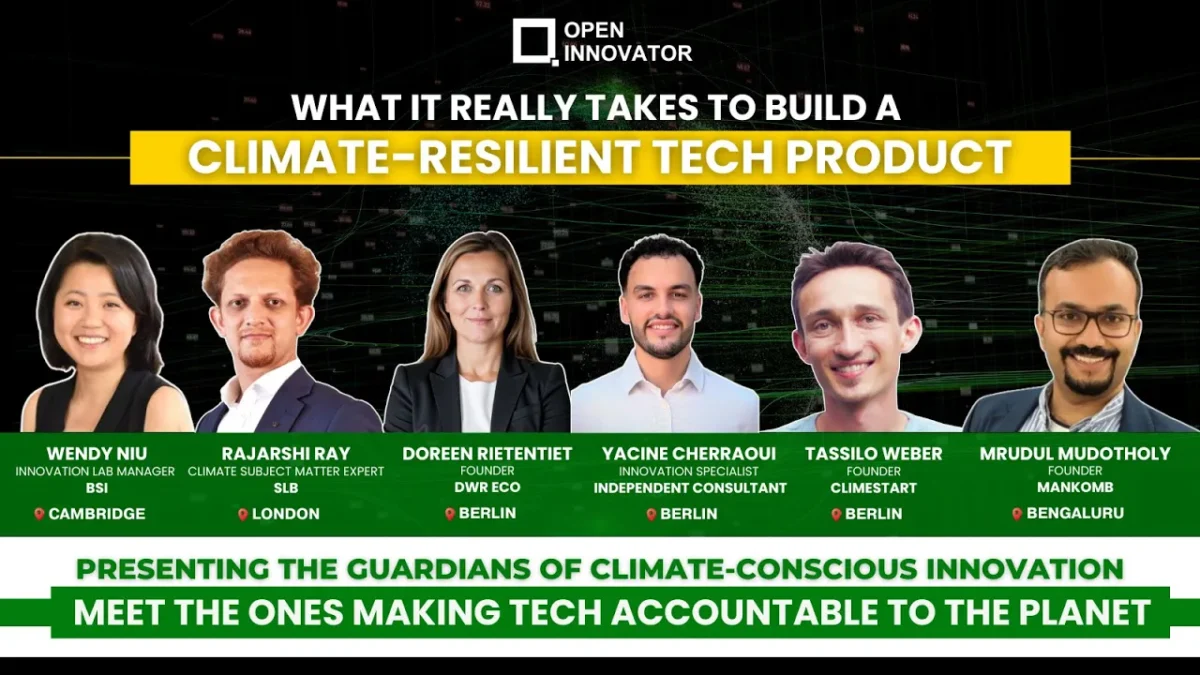
A distinguished international panel of climate technology experts recently convened at our recent Open Innovator Virtual Session to address the urgent challenges facing innovation in the climate crisis era. The discussion featured:
- Doreen Rietentiet, Founder & CEO based in Berlin, a climate adaptation technology specialist focused on energy solutions
- Rajarshi Ray, Co-Founder & CEO based in London, an expert in regional climate tech implementation and market analysis
- Wendy Niu, Co-Founder & CMO based in Bangalore, a sustainability strategist emphasizing regulatory adaptation
- Tassilo Weber, Co-Founder & CTO based in Berlin, a climate tech ecosystem development professional
- Yacine Cherraoui, Founder & Independent Consultant based in Berlin, a specialist in sustainable business models and market viability
- Mrudul Mudothoty, Head of Product based in Bangalore, founder of an AI-powered waste management solution.
The session was moderated by Naman K, Nasscom COE who opened with the sobering statistic that climate disasters have cost the world over the past two decades, setting the urgent context for discussing how technology must evolve to address not just climate mitigation but adaptation to irreversible environmental changes.
Key Discussion Points
The Critical Shift from Mitigation to Adaptation
Doreen emphasized the fundamental need to transition from purely mitigation-focused climate technologies toward adaptation solutions that help communities survive and thrive despite changing environmental conditions. This represents a significant mindset shift for the climate tech industry, which has traditionally focused on preventing climate change rather than preparing for its inevitable impacts.
The discussion highlighted innovative air conditioning and cooling technologies as critical adaptation needs, particularly as rising global temperatures make traditional cooling methods unsustainable and insufficient for maintaining human health and productivity in extreme heat conditions.
Regional Disparities and Market Challenges
Rajshri Ray brought crucial insights about the significant disparities in climate tech market conditions across different global regions. He stressed that solutions effective in developed markets often require substantial adaptation for implementation in developing economies, where resource constraints and infrastructure limitations create unique challenges.
The panel discussed how understanding these regional differences becomes essential for creating truly scalable climate tech solutions that can address global challenges while remaining economically viable across diverse market conditions.
Navigating Regulatory Uncertainty and Flexibility
Wendy emphasized the importance of building flexibility into climate tech solutions to adapt to rapidly evolving regulatory landscapes. As governments worldwide implement new climate policies and standards, technology companies must design products and services that can quickly adapt to changing compliance requirements without losing effectiveness or market viability.
This regulatory uncertainty creates both challenges and opportunities for climate tech innovators, requiring strategic approaches that balance compliance with innovation speed and market responsiveness.
Ecosystem Collaboration and Sustainable Business Models
Some panelists addressed critical barriers to launching climate-focused products, emphasizing that successful climate tech requires unprecedented collaboration across traditional industry boundaries. They argued that climate challenges are too complex for any single organization to address effectively, requiring coordinated efforts among innovators, investors, policymakers, and community organizations.
The discussion focused on developing sustainable business models that maintain economic viability while delivering genuine environmental benefits, challenging the traditional assumption that environmental responsibility necessarily conflicts with financial success.
Transparency and Ethical Responsibility
Rajshri Ray stressed the crucial importance of transparency and auditability in climate tech solutions, particularly for startups seeking investment in sustainability-focused ventures. Investors and customers increasingly demand verifiable evidence of environmental impact, requiring climate tech companies to build transparency into their core operations rather than treating it as a marketing afterthought.
This emphasis on ethical responsibility extends beyond environmental impact to include social equity and community benefit, ensuring that climate tech solutions don’t inadvertently exacerbate existing inequalities while addressing environmental challenges.
Innovative Solutions in Practice
Mrudul presented a practical example through an AI-powered home appliance that manages waste decomposition by converting organic waste into usable soil. This demonstration illustrated how climate tech innovations can address multiple sustainability challenges simultaneously while providing clear value propositions for consumers.
The example highlighted key principles for successful climate tech: addressing real user needs, providing measurable environmental benefits, and creating economically sustainable value chains that support widespread adoption.
Core Principles for Climate-Resilient Technology
The panel identified several fundamental principles for developing effective climate tech solutions:
- Systems Thinking Approach: Climate challenges require holistic solutions that consider interconnected environmental, social, and economic systems rather than addressing isolated problems independently.
- Long-term Sustainability Focus: Successful climate tech must prioritize long-term environmental and social benefits over short-term financial gains, though economic viability remains essential for scaling impact.
- Adaptive Design Philosophy: Climate tech solutions must be designed for flexibility and adaptation as environmental conditions and regulatory requirements continue evolving rapidly.
- Cross-Sector Collaboration: No single organization or industry can address climate challenges effectively, requiring unprecedented collaboration across traditional boundaries.
Practical Implementation Strategies
The experts provided concrete recommendations for developing climate-resilient technologies. Innovators should focus on user-centered design that addresses real community needs while delivering measurable environmental benefits. This approach ensures that climate tech solutions gain adoption and create genuine impact rather than remaining theoretical possibilities.
Startups and established companies should build transparency and auditability into their core operations from the beginning rather than adding these capabilities later. This proactive approach builds investor confidence and customer trust while ensuring that environmental claims can be verified and validated.
Business model development must balance environmental impact with economic sustainability, creating value propositions that support widespread adoption while generating sufficient revenue for continued innovation and scaling.
Future Outlook and Vision
The panelists shared their visions for climate tech development over the next five to ten years, emphasizing the need for sustained long-term thinking and unwavering commitment from stakeholders across industries. They envision a future where climate adaptation technologies become as common and essential as current digital technologies.
The discussion highlighted the importance of maintaining optimism and determination despite the scale of climate challenges, focusing on actionable solutions that can create measurable progress toward climate resilience.
Call for Collective Action
The session concluded with strong encouragement for continued collaboration and innovation in addressing climate challenges. Panelists emphasized that the climate crisis requires collective action across all sectors of society, with technology playing a crucial but not exclusive role in creating sustainable solutions.
The experts stressed that everyone involved in innovation and technology development has a responsibility to consider climate impacts and adaptation needs in their work, regardless of their specific industry or focus area.
The panel reinforced that building climate-resilient technology requires not just technical innovation but fundamental changes in how organizations approach business models, collaboration, and long-term planning, making climate adaptation a central consideration in all technology development decisions.
Reach out to us at open-innovator@quotients.com or drop us a line to delve into the transformative potential of groundbreaking technologies and participate in our OI sessions. We’d love to explore the possibilities with you.