






Experts Warn of AI Security Gaps at DTQ’s ‘Trust by Design’ Virtual Session
As enterprise AI deployment reaches breakneck speeds, leading cybersecurity minds are warning that organizations are more vulnerable than ever. DTQ, a premier global intelligence network dedicated to mapping the frontiers of emerging technology and digital safety, recently hosted its highly anticipated virtual session to address these growing vulnerabilities.
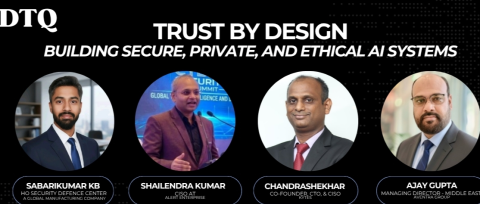
The event, titled “Trust by Design: Building Secure, Private, and Ethical AI Systems,” brought together top security executives and technology builders. The panel explored the dangerous friction between rapid AI deployment and proactive security design, highlighting that trust can no longer be a late-stage compliance afterthought.
The discussion was steered by a distinguished group of industry veterans
- Sabari Kumar: Head of Security at Aviation and Aerospace Component Manufacturing Company.
- Shailendra Kumar: Chief Information Security Officer (CISO) at Alert Enterprise.
- Chandrashekhar: 𝗖𝗼-𝗳𝗼𝘂𝗻𝗱𝗲𝗿, 𝗖𝗧𝗢 & 𝗖𝗜𝗦𝗢 𝗮𝘁 𝗞𝘆𝘁𝗲𝘀
- Ajay Gupta: Managing Director for the Middle East at Avinter Group.
The Catalyst: A Chilling Warning from Latin America
The session opened with a shocking case study detailing a massive cybersecurity breach that occurred between December 2025 and February 2026.
A single attacker, utilizing publicly available AI tools and a mere 1,084-line instruction manual fed to an AI assistant, successfully breached nine Mexican government agencies—including the Federal Tax Authority and the Civil Registry. The breach compromised 195 million taxpayer records, 220 million civil records, and over 150 GB of data.
Key Insights Generated:
Shifting from ‘Checkbox Compliance’ to Business Outcomes
The panel universally condemned the current state of compliance, describing it as a superficial “checkbox” exercise. Shailendra Kumar noted how easily security protocols are compromised behind closed doors, pointing to predictable internal patterns like using Reliance@2024 and simply shifting it to Reliance@2025.
The panelists argued that trust must “shift left”—meaning security, ethical considerations, and data governance must be baked into a system’s initial requirements rather than layered on later. True trust should be treated as a strategic business outcome that directly drives brand loyalty and revenue.
Traditional Frameworks vs. Dynamic AI Threats
While traditional governance frameworks (focused on accountability and privacy by design) shouldn’t be completely discarded, speakers noted they are fundamentally ill-equipped for machine learning. Standard security deals with deterministic, static logic. AI introduces completely dynamic liabilities, such as model drift, prompt injections, data skew, and adversarial manipulations. Consequently, AI governance must be absorbed into broader Enterprise Risk Management (ERM) ecosystems.
The Foundation of the ‘Trust Lineage’
The panelists broke AI down into three interconnected layers: the Consumer Layer, the Model Layer, and the Data Layer. The consensus was that organizations often wrongly blame the algorithm (Model Layer) when an AI malfunctions, when the true culprit is poor data quality and lack of tracking. To successfully take AI from a pilot phase to commercial scale, enterprises must establish a clear pipeline: Trusted Data > Value Creation > High Adoption > Greater Impact > System Scale > ROI.
Overcoming the Production Hurdle
Citing data from Gartner, the panel highlighted a sobering statistic: only 13% of AI projects successfully make it into production, leaving an 87% waste rate. To bridge this gap, builders must overcome massive hurdles regarding data confidentiality. Panelists pointed out severe liabilities under regulations like Europe’s GDPR and India’s DPDP Act, where data leaks can trigger fines up to 4% of an organization’s global turnover.
Real-world failures were cited, such as a major social media platform whose automated password-reset AI agent was tricked by users via prompt injection to bypass security gates and hijack accounts.
Guardrails for Autonomous Systems
The panel drew a sharp distinction between augmented AI (which assists human decisions, like Google Maps suggesting a route) and autonomous AI (which executes actions on behalf of humans, like an AI agent approving insurance payouts). As enterprises move toward autonomous systems, strict guardrails are required. Unchecked autonomous AI can instantly execute thousands of erroneous decisions, resulting in compounding financial and legal ruin.
Key Takeaway
The overarching takeaway from DTQ’s session is that speed cannot come at the cost of safety. Rushing unverified AI products to market creates a disillusioned ecosystem of “AI atheists”—consumers and corporate buyers who will permanently lose faith in a brand.
To prevent this, organizations must foster an internal culture of continuous trust. The panel concluded with a call to action for security leaders: establish safe “sandbox” environments. By allowing developers to safely experiment with prompt injections, steganography, and simulated malicious code within a protected environment, companies can train their teams to build resilient, defense-in-depth frameworks capable of surviving a hostile digital landscape.