



Categories
Events DTQ

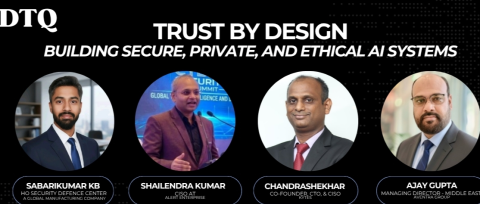
Report: Trust by Design- Building Secure, Private, and Ethical AI Systems

Categories
Events DTQ

Report: Trust by Design- Building Secure, Private, and Ethical AI Systems

Experts Warn of AI Security Gaps at DTQ’s ‘Trust by Design’ Virtual Session

As enterprise AI deployment reaches breakneck speeds, leading cybersecurity minds are warning that organizations are more vulnerable than ever. DTQ, a premier global intelligence network dedicated to mapping the frontiers of emerging technology and digital safety, recently hosted its highly anticipated virtual session to address these growing vulnerabilities.

The event, titled “Trust by Design: Building Secure, Private, and Ethical AI Systems,” brought together top security executives and technology builders. The panel explored the dangerous friction between rapid AI deployment and proactive security design, highlighting that trust can no longer be a late-stage compliance afterthought.

The discussion was steered by a distinguished group of industry veterans

  • Sabari Kumar: Head of Security at Aviation and Aerospace Component Manufacturing Company.
  • Shailendra Kumar: Chief Information Security Officer (CISO) at Alert Enterprise.
  • Chandrashekhar: 𝗖𝗼-𝗳𝗼𝘂𝗻𝗱𝗲𝗿, 𝗖𝗧𝗢 & 𝗖𝗜𝗦𝗢 𝗮𝘁 𝗞𝘆𝘁𝗲𝘀
  • Ajay Gupta: Managing Director for the Middle East at Avinter Group.

The Catalyst: A Chilling Warning from Latin America

The session opened with a shocking case study detailing a massive cybersecurity breach that occurred between December 2025 and February 2026.

A single attacker, utilizing publicly available AI tools and a mere 1,084-line instruction manual fed to an AI assistant, successfully breached nine Mexican government agencies—including the Federal Tax Authority and the Civil Registry. The breach compromised 195 million taxpayer records, 220 million civil records, and over 150 GB of data.

Key Insights Generated:

Shifting from ‘Checkbox Compliance’ to Business Outcomes

The panel universally condemned the current state of compliance, describing it as a superficial “checkbox” exercise. Shailendra Kumar noted how easily security protocols are compromised behind closed doors, pointing to predictable internal patterns like using Reliance@2024 and simply shifting it to Reliance@2025.

The panelists argued that trust must “shift left”—meaning security, ethical considerations, and data governance must be baked into a system’s initial requirements rather than layered on later. True trust should be treated as a strategic business outcome that directly drives brand loyalty and revenue.

Traditional Frameworks vs. Dynamic AI Threats

While traditional governance frameworks (focused on accountability and privacy by design) shouldn’t be completely discarded, speakers noted they are fundamentally ill-equipped for machine learning. Standard security deals with deterministic, static logic. AI introduces completely dynamic liabilities, such as model drift, prompt injections, data skew, and adversarial manipulations. Consequently, AI governance must be absorbed into broader Enterprise Risk Management (ERM) ecosystems.

The Foundation of the ‘Trust Lineage’

The panelists broke AI down into three interconnected layers: the Consumer Layer, the Model Layer, and the Data Layer. The consensus was that organizations often wrongly blame the algorithm (Model Layer) when an AI malfunctions, when the true culprit is poor data quality and lack of tracking. To successfully take AI from a pilot phase to commercial scale, enterprises must establish a clear pipeline: Trusted Data > Value Creation > High Adoption > Greater Impact > System Scale > ROI.

Overcoming the Production Hurdle

Citing data from Gartner, the panel highlighted a sobering statistic: only 13% of AI projects successfully make it into production, leaving an 87% waste rate. To bridge this gap, builders must overcome massive hurdles regarding data confidentiality. Panelists pointed out severe liabilities under regulations like Europe’s GDPR and India’s DPDP Act, where data leaks can trigger fines up to 4% of an organization’s global turnover.

Real-world failures were cited, such as a major social media platform whose automated password-reset AI agent was tricked by users via prompt injection to bypass security gates and hijack accounts.

Guardrails for Autonomous Systems

The panel drew a sharp distinction between augmented AI (which assists human decisions, like Google Maps suggesting a route) and autonomous AI (which executes actions on behalf of humans, like an AI agent approving insurance payouts). As enterprises move toward autonomous systems, strict guardrails are required. Unchecked autonomous AI can instantly execute thousands of erroneous decisions, resulting in compounding financial and legal ruin.

Key Takeaway

The overarching takeaway from DTQ’s session is that speed cannot come at the cost of safety. Rushing unverified AI products to market creates a disillusioned ecosystem of “AI atheists”—consumers and corporate buyers who will permanently lose faith in a brand.

To prevent this, organizations must foster an internal culture of continuous trust. The panel concluded with a call to action for security leaders: establish safe “sandbox” environments. By allowing developers to safely experiment with prompt injections, steganography, and simulated malicious code within a protected environment, companies can train their teams to build resilient, defense-in-depth frameworks capable of surviving a hostile digital landscape.


Categories
Evolving Use Cases

The Ethical Algorithm: How Tomorrow’s AI Leaders Are Coding Conscience Into Silicon

Categories
Evolving Use Cases

The Ethical Algorithm: How Tomorrow’s AI Leaders Are Coding Conscience Into Silicon

Ethics-by-Design has emerged as a critical framework for developing AI systems that will define the coming decade, compelling organizations to radically overhaul their approaches to artificial intelligence creation. Leadership confronts an unparalleled challenge: weaving ethical principles into algorithmic structures as neural networks grow more intricate and autonomous technologies pervade sectors from finance to healthcare.

This forward-thinking strategy elevates justice, accountability, and transparency from afterthoughts to core technical specifications, embedding moral frameworks directly into development pipelines. The transformation—where ethics are coded into algorithms, validated through automated testing, and monitored via real-time bias detection—proves vital for AI governance. Companies mastering this integration will dominate their industries, while those treating ethics as mere compliance tools face regulatory penalties, reputational damage, and market irrelevance.

Engineering Transparency: The Technology Stack Behind Ethical AI

Revolutionary improvements in AI architecture and development processes are necessary for the technical implementation of Ethics-by-Design. Advanced explainable AI (XAI) frameworks, which use methods like SHAP values, LIME, and attention mechanism visualization to make black-box models understandable to non-technical stakeholders, are becoming crucial elements. Federated learning architectures allow financial institutions and healthcare providers to work together without disclosing sensitive information by enabling privacy-preserving machine learning across remote datasets. In order to mathematically ensure individual privacy while preserving statistical utility, differential privacy algorithms introduce calibrated noise into training data.

When AI systems provide unexpected results, forensic investigation is made possible by blockchain-based audit trails, which produce unchangeable recordings of algorithmic decision-making. By augmenting underrepresented demographic groups in training datasets, generative adversarial networks (GANs) are used to generate synthetic data that tackles prejudice. Through automated testing pipelines that identify discriminatory behaviors before to deployment, these solutions translate abstract ethical concepts into tangible engineering specifications.

Automated Conscience: Building Governance Systems That Scale

The governance framework that supports the development of ethical AI has developed into complex sociotechnical systems that combine automated monitoring with human oversight. AI ethics committees currently use natural language processing-powered decision support tools to evaluate proposed projects in light of ethical frameworks such as EU AI Act requirements and IEEE Ethically Aligned Design guidelines. Fairness testing libraries like Fairlearn and AI Fairness 360 are included into continuous integration pipelines, which automatically reject code updates that raise disparate effect metrics above acceptable thresholds.

Ethical performance metrics, such as equalized odds, demographic parity, and predictive rate parity among production AI systems, are monitored via real-time dashboard systems. By simulating edge situations and adversarial attacks, adversarial testing frameworks find weaknesses where malevolent actors could take advantage of algorithmic blind spots. With specialized DevOps teams overseeing the ongoing deployment of ethics-compliant AI systems, this architecture establishes an ecosystem where ethical considerations receive the same rigorous attention as performance optimization and security hardening.

Trust as Currency: How Ethical Excellence Drives Market Dominance

Organizations that exhibit quantifiable ethical excellence through technological innovation are increasingly rewarded by the competitive landscape. In order to distinguish out from competitors in competitive markets, advanced bias mitigation techniques like adversarial debiasing and prejudice remover regularization are becoming standard capabilities in enterprise AI platforms. Homomorphic encryption and other privacy-enhancing technologies make it possible to compute on encrypted data, enabling businesses to provide previously unheard-of privacy guarantees that serve as potent marketing differentiators. Consumer confidence in delicate applications like credit scoring and medical diagnosis is increased by transparency tools that produce automated natural language explanations for model predictions.

Businesses that engage in ethical AI infrastructure report better talent acquisition, quicker regulatory approvals, and increased customer retention rates as data scientists favor employers with a solid ethical track record. With ethical performance indicators showing up alongside conventional KPIs in quarterly profits reports and investor presentations, the technical application of ethics has moved beyond corporate social responsibility to become a key competitive advantage.

Beyond 2025: The Quantum Leap in Ethical AI Systems

Ethics-by-Design is expected to progress from best practice to regulatory mandate by 2030, with technical standards turning into legally binding regulations. New ethical issues will arise as a result of emerging technologies like neuromorphic computing and quantum machine learning, necessitating the creation of proactive frameworks. The next generation of engineers will see ethical issues as essential as data structures and algorithms if AI ethics are incorporated into computer science curricula.

As AI systems become more autonomous in crucial fields like financial markets, robotic surgery, and driverless cars, the technical safeguards for moral behavior become public safety issues that need to be treated with the same rigor as aviation safety regulations. Leaders who implement strong Ethics-by-Design procedures now put their companies in a position to confidently traverse this future, creating AI systems that advance technology while promoting human flourishing.

Quotients is a platform for industry, innovators, and investors to build a competetive edge in this age of disruption. We work with our partners to meet this challenge of metamorphic shift that is taking place in the world of technology and businesses by focusing on key organisational quotients. Reach out to us at open-innovator@quotients.com.