






Introduction
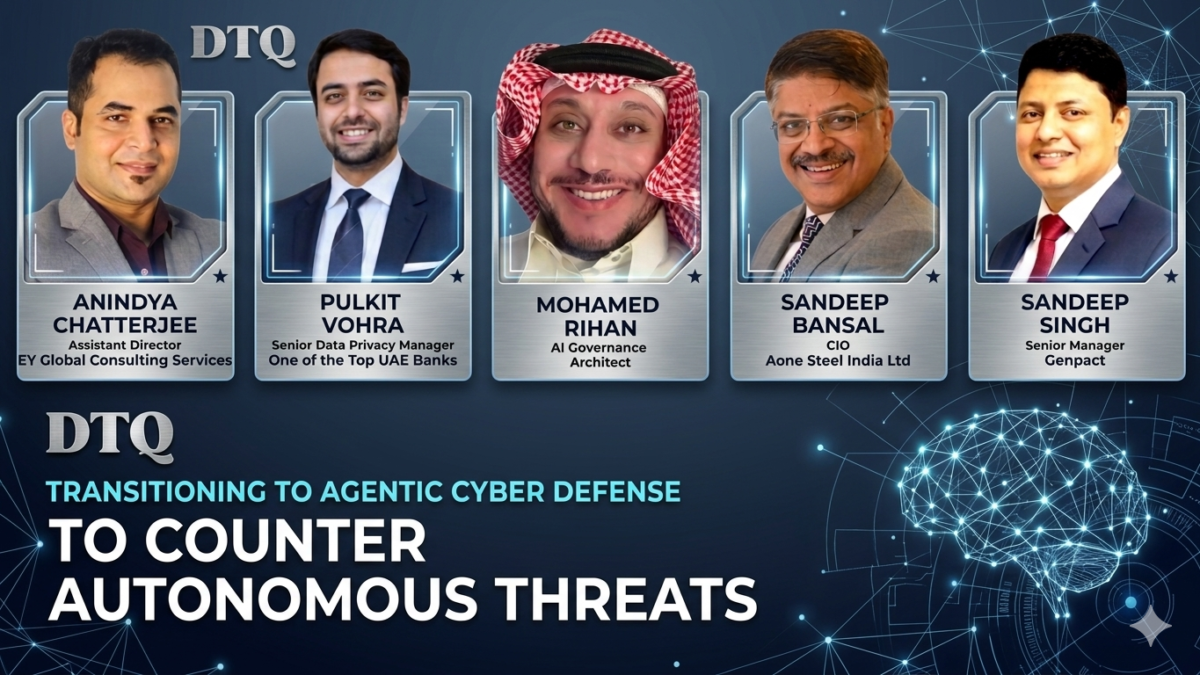
DTQ recently convened a specialized session, “Transitioning to Agentic Cyber Defense to Counter Autonomous Threats,” to explore the evolution of defensive strategies in an era of self-evolving adversarial tactics. The online discussion framed “agentic defense” not merely as an upgrade in tooling, but as a strategic pivot from reactive, signature-based controls toward autonomous systems capable of reasoning and adapting within defined risk parameters.
The Speakers
The panel featured a cross-disciplinary group of leaders representing the financial, industrial, and consulting sectors:
- Anindya Chatterjee — Assistant Director, EY Global Consulting Services
- Pulkit Vohra — Senior Data Privacy Manager, Top UAE Financial Institution
- Mohamed A. S. — AI Governance Architect
- Sandeep Bansal — CIO, Aone Steel India Ltd
- Sandeep Singh — Senior Manager, Genpact
Key Insights
The Changing Threat Landscape
- Lowered Barriers to Entry: AI and automation allow low-skill actors to execute high-sophistication attacks. Phishing and credential harvesting are becoming indistinguishable from human activity.
- Compressed Response Windows: The primary vulnerability is no longer just the “bad decision,” but the “unquestioned execution” of rapid, automated attacks.
- Cognitive Overload: Traditional SOC workflows are structurally incapable of managing the current volume of alerts; governed automation is now a survival requirement.
Principles of Agentic Defense
- Bounded Autonomy: Systems must operate within “guardrails.” High-confidence, low-risk actions can be fully automated, while high-impact shifts require human-in-the-loop (HITL) authorization.
- Radical Transparency: Every autonomous action must be explainable and auditable, detailing the rationale and data inputs for regulatory and forensic purposes.
- Collateral-Aware Logic: Systems must calculate the potential business impact (e.g., service downtime) before executing a defensive maneuver, with built-in “safe rollback” capabilities.
Governance and Accountability
- Human-Centric Liability: Regardless of the level of autonomy, accountability remains with human stakeholders. Responsibilities must be clearly mapped across model owners and business leaders.
- Policy-as-Code: Governance should be machine-readable, allowing agentic systems to enforce legal and internal constraints at the same speed as the threats they counter.
- Cross-Functional Oversight: Alignment between Security, Legal, and Privacy teams is essential to define the boundaries of “acceptable” autonomous behavior.
Privacy and Data Strategy
- Privacy-Preserving Telemetry: Implementation of data minimization and pseudonymization ensures that detection needs do not compromise privacy obligations.
- Engineering-Led Privacy: Privacy cannot be a checkbox; it must be baked into the architecture and model training phases to prevent data “scope creep.”
Operationalization Strategy
- Phased Deployment: Start with “low-hanging fruit,” such as quarantining known malware or blocking confirmed fraud, before scaling to complex decision-making.
- Continuous Simulation: Use red-teaming and “chaos experiments” to test how autonomous playbooks behave under extreme or unpredictable stress.
- Legacy Integration: Agentic capabilities should augment—not replace—existing SIEM, EDR, and IAM investments to ensure telemetry continuity.
Technical & Sector Considerations
Technical Design
- Model Lifecycle Management: Rigorous versioning and drift detection are required to prevent adversarial manipulation of the defense models themselves.
- Fail-Safe Defaults: When confidence scores are low, systems must default to “Alert Only” modes rather than taking disruptive actions.
Sector-Specific Applications
- Financial Services: Focus on real-time fraud prevention and identity risk scoring while maintaining high explainability for regulators.
- Industrial/OT: Priority is placed on Operator-Assist recommendations. Given the risk of physical damage, direct autonomous actuation must be approached with extreme caution.
- Managed Services (MSSPs): Providers can act as a force multiplier by centralizing model management and threat intelligence for multiple clients.
Practical Recommendations for Leaders
- Tier Your Automation: Classify defensive actions by risk level. Automate the “obvious” and assist the “complex.”
- Codify Your Rules: Move from written PDFs to machine-executable Policy-as-Code.
- Enrich Your Context: Invest in high-quality telemetry (Identity, Asset, and Business process mapping) to improve the “reasoning” of agentic tools.
- Monitor the Models: Treat your security AI as a high-value asset; implement drift monitoring and adversarial testing.
- Foster Collaboration: Establish a cross-functional forum where Legal and IT define the rules of engagement together.
Conclusion
Agentic cyber defense is no longer a futuristic concept—it is an operational necessity. To successfully transition, organizations must balance the speed of AI with the wisdom of human oversight. By adopting a phased, risk-aware approach grounded in Policy-as-Code and explainable AI, security leaders can build a resilient posture that scales with the threat while remaining firmly under human control.
DTQ serves as a platform dedicated to mapping global industry shifts and providing “information capital” before it reaches the mainstream. in cybersecurity space. Please write us at open-innovator@quotients.com for more information.