






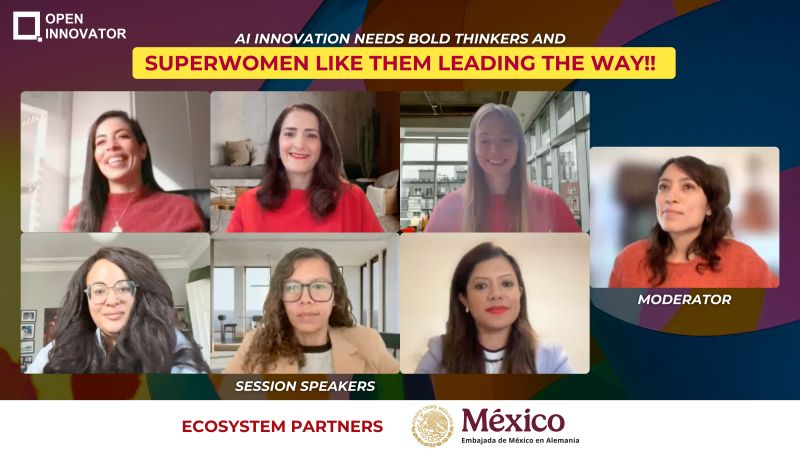
The rapid ascent of Artificial Intelligence is often discussed through the lens of silicon, datasets, and compute power. However, as the global tech landscape shifts toward 2026, a more critical narrative is emerging: the human architecture behind the algorithms. On March 9, 2026, a landmark session titled “Women Across the AI Value Chain” brought together a powerhouse of leaders to dismantle the stereotypes and structural barriers that have historically sidelined female voices in technology. Hosted by Open Innovator, and supported by the Mexican Embassy in Germany, the dialogue served as more than just a commemorative event for International Women’s Day; it was a strategic masterclass on leadership, influence, and the future of innovation.
Panelists
- Isma Khemies – Advocate for inclusive leadership in AI
- Shayma Kurz – Driving innovation through ethical AI practices
- Sina Landorff – Championing diversity in tech ecosystems
- Angeley Mullins – Scaling global AI-driven businesses
- Linda Kohl – Breaking barriers in AI adoption and strategy
- Jomy Jose – Empowering women in AI entrepreneurship
Co-Hosts
- Adriana Carmona Beltran – Facilitating dialogue on women in AI leadership
- Tedix – Partner organization amplifying voices in technology
Ecosystem Partners
- Oliver Contla – Secretaría de Relaciones Exteriores de México, supporting international collaboration
- Francisco Quiroga – Secretaría de Relaciones Exteriores de México, strengthening global AI networks
The Invisible Foundation of Leadership
The conversation opened with a poignant reflection on the nature of unrecognized leadership. Drawing a parallel between the high-stakes world of AI and the domestic sphere, the host highlighted how women have historically managed complex systems—families, communities, and educational environments—with resilience and innovation, yet these efforts are rarely labeled as “leadership.”
In the context of the AI value chain, this invisibility often persists. While women are integral to the development, ethical oversight, and deployment of AI, their contributions frequently remain behind the scenes.
The goal of the panel was to bridge this gap, moving from quiet contribution to radical visibility. As emphasized during the discussion, visibility creates opportunity. When a woman is seen as a decisive founder or an expert engineer, she provides a blueprint for the next generation. The panel sought to redefine traits like empathy and decisiveness not as gendered characteristics, but as essential human qualities necessary for navigating the “real system” of AI: the people who make the decisions.
Navigating the “Boys’ Club” and Building Credibility
Shayma Kurz, a veteran of the automotive industry and a former engineer at Mercedes-Benz, provided a visceral look at the challenges of navigating male-dominated technical environments. In industries like automotive and AI infrastructure, women often find themselves as the “only one in the room.” Kurz’s journey is a testament to the fact that influence in technical spaces is not built through the volume of one’s voice, but through the undeniable quality of one’s work.
Kurz identified three pillars for building credibility: competency, value creation, and strategic relationships. She emphasized that to succeed in a “boys’ club,” a woman must often solve the problems that others cannot. By becoming the person who can fix a broken data architecture or streamline a complex process, the focus shifts from gender to utility. However, Kurz also warned against the trap of waiting for an invitation to speak. Influence, she noted, is often built before a meeting starts. By aligning stakeholders and understanding the technical “pain points” of a project ahead of time, women can enter decision-making rooms with a foundation of support that makes their presence undeniable.
The Shift from Hierarchy to Data-Augmented Decisions
Jomy Jose, bringing two decades of experience across hospitality and insurance, explored how the nature of decision-making itself is evolving. In the past, corporate structures were strictly hierarchical, with decisions flowing from the top down based largely on seniority and intuition. Today, the integration of AI has transformed this into a data-augmented process.
According to Jose, AI acts as a “helper” that compresses the time between analysis and action. Decisions are now a hybrid of human judgment and AI-supported insights. This shift presents a unique opportunity for women. As AI agents and agentic workflows take over operational tasks, the value of strategic oversight increases. Jose emphasized that communities play a vital role here. By creating psychologically safe spaces for women to experiment with new tools and ask “stupid” questions, professional networks accelerate the learning curve and help women stay at the forefront of the AI value chain.
The Structural Gap: Informal Power vs. Formal Title
One of the most striking segments of the discussion was led by Isma Khemies, an executive coach with deep roots in international key account management. Isma deconstructed the “structural gap” that exists in large organizations. On paper, decisions are made by C-suite executives and board members. In reality, power resides where risk, revenue, and relationships intersect.
Isma shared a sobering personal account of the “competency paradox.” In her previous role, she was the “Wikipedia of the company,” holding deep influence over clients worth millions. Yet, she was passed over for a Sales Director position precisely because she was too valuable in her current role. This highlights a recurring theme for women in tech: holding immense informal power (resolving conflicts, spotting risks, and maintaining client trust) without the formal title or compensation to match. To close this gap, Isma argued that women must move closer to the Profit and Loss (P&L) statements. Influence must be made measurable. If a woman’s leadership is the reason a multi-million dollar account remains loyal, that impact must be quantified and used as leverage for formal advancement.
Scaling AI Through Diversity and Inclusion
The panelists, including Sina Landorff, Angeley Mullins, and Linda Kohl, collectively reinforced the idea that scaling AI requires a diversity of perspectives. AI is not just about the model; it is about the deployment of that model in a human world. When women lead AI teams, they bring a holistic view of the “value chain”—from the ethical sourcing of data to the final user experience.
The discussion touched upon the “double bind” mentioned by Adriana Carmona Beltran: the reality that women are often criticized for being “too manly” if they are decisive, or “too feminine” if they are soft. The consensus among the superwomen on the panel was to reject these labels entirely. By focusing on the high-stakes outcomes—revenue growth, risk mitigation, and technological breakthrough—these leaders are carving out a new definition of authority that is based on impact rather than performance of gender.
A Community of Innovation
The success of the “Women Across the AI Value Chain” event was a collaborative effort. A huge shoutout is deserved for the superwomen panelists: Isma Khemies, Shayma Kurz, Sina Landorff, Angeley Mullins, Linda Kohl, and Jomy Jose. Their willingness to share raw, unvarnished experiences provided a masterclass for everyone in the room.
The conversation was brought to life by co-host Adriana Carmona Beltran and the support of Tedix. Furthermore, the dialogue was amplified by incredible ecosystem partners Oliver Contla and Francisco Quiroga from the Secretaría de Relaciones Exteriores de México, whose support underscores the global importance of inclusive innovation.
Conclusion
As we look toward the future of the AI ecosystem, it is clear that technical skill alone is not enough. The leaders of tomorrow will be those who can navigate complex social architectures, leverage data-augmented insights, and turn informal influence into formal power. The journey of these women shows that while the glass ceiling still exists, it is being cracked by the sheer force of competency and community. By stepping into the spotlight and claiming their roles as builders, scalers, and influencers, women are not just participating in the AI value chain—they are defining it.
About Open Innovator
Open Innovator is a global platform dedicated to fostering collaboration, breaking down silos, and empowering the next generation of tech leaders. We believe that the best innovations happen when diverse minds meet at the intersection of technology and humanity. Through sessions like these, we aim to bridge the gap between theory and real-world impact.
Join the Movement
Are you ready to be part of the future of AI? We are always looking for passionate innovators, thinkers, and leaders to join our growing ecosystem.
Write to us today at open-innovator@quotients.com to join our community and stay updated on upcoming sessions!