







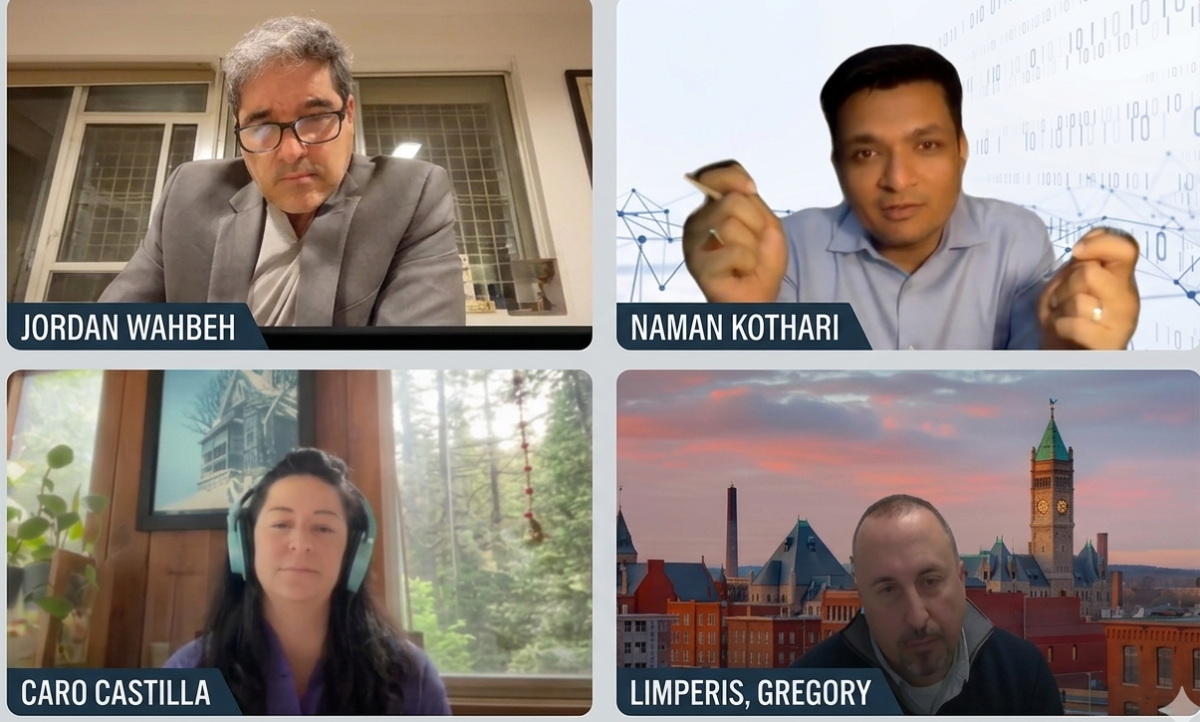
On March 27, 2026, Open Innovator hosted a panel discussion titled “AI in the Core vs AI at the Edge: Where Is Real Value Being Created?”. The virtual session explored whether AI’s true impact lies in centralized infrastructure (the core) or in real-world applications (the edge). The conversation highlighted hype versus utility, the importance of trust, and the evolving role of AI across education, enterprise, and culture.
- Naman Kothari (Nasscom CoE) – Moderator, framing the debate around core vs edge AI.
- Gregory Limperis – Education leader, focused on classroom transformation.
- Carolina Castilla – Venture capitalist, TEDx speaker, and electronic music producer.
- Jordan Wahbeh (SV Venture Group) – Venture capital veteran and COO, specializing in enterprise AI.
Key Findings and Insights
1. Core vs Edge Value
Core AI, which refers to cloud-based centralized models, is often likened to potential energy. It holds immense power and capability but is sometimes misapplied to tasks that do not fully leverage its strengths. On the other hand, Edge AI represents the kinetic energy of artificial intelligence, where the technology is applied directly in real-world scenarios to solve practical problems and create compounded value. This distinction underscores the debate about where AI’s real value is generated—whether in the centralized core infrastructure or at the edge where human interaction and application occur.
2. Education Perspective (Gregory Limperis)
From the viewpoint of education, AI’s greatest value is realized at the edge. Here, AI assists teachers by streamlining lesson planning, enabling personalized learning experiences, and reducing administrative burdens. This application of AI shifts the educational focus away from rote memorization and repetitive tasks toward fostering higher-order thinking and meaningful classroom discussions. However, this integration comes with a strong emphasis on data safety, the establishment of clear guidelines, and ensuring the appropriate use of AI tools to protect student privacy and maintain trust.
3. Venture Capital & Culture (Caro Castilla)
Carolina Castilla brings a critical perspective from the venture capital and cultural domains, cautioning against confusing fluency with wisdom and speed with quality. She highlighted that many AI-driven demos, while impressive, often lack lasting impact and durability. Instead, she stressed that trust and genuine utility are paramount for sustainable AI adoption. Furthermore, AI is reshaping cultural landscapes by enabling synthetic companionship, producing polished creative outputs, and challenging traditional notions of authorship. Despite these advances, the human-in-the-loop remains essential to ensure ethical standards and meaningful outcomes in AI-generated content.
4. Enterprise & Startups (Jordan Wahbeh)
In the enterprise and startup ecosystem, the real value of AI lies not merely in owning AI engines but in developing AI-enabled solutions that integrate seamlessly into business processes. AI is becoming foundational infrastructure, akin to CRM or ERP systems, that supports back-office operations, product development, and go-to-market strategies. Startups leverage AI to gain competitive advantages, but as AI access becomes more universal, this edge is diminishing globally. The challenge for enterprises is to move beyond hype and focus on practical, scalable AI applications that drive measurable business outcomes.
5. Common Themes
Across these diverse perspectives, several common themes emerge. There is a clear need to distinguish noise from signal, separating hype from durable utility. The human-in-the-loop concept is critical for maintaining trust, ethical integrity, and contextual relevance in AI applications. The panel also recognizes that AI is transitioning from a phase of magical demonstrations to one of practical utility, where integration into everyday workflows becomes the norm.
Conclusion
The panelists collectively agreed on a nuanced understanding that real value in AI emerges when core AI infrastructure and edge applications converge in trusted, human-centered ways. While the core provides the scale and potential power, the edge delivers tangible impact by addressing complex, real-world challenges. Looking ahead, the next decade will be defined not by AI’s novelty but by its utility, trustworthiness, and seamless integration into daily work and life, marking a maturation of the technology from hype to meaningful, sustained value creation
Open Innovator (OI) is at the forefront of fostering meaningful conversations and collaborations around AI, driving innovation that balances technological advancement with ethical responsibility. Through events like this panel, OI continues to champion the integration of AI in ways that create real, trusted value for society. Reach out to us at open-innovator@quotients.com.