



Categories
DTQ

Trust at Risk: Governing the Digital Future

Categories
DTQ

Trust at Risk: Governing the Digital Future

The Shift from Asset to Liability

Data breaches have a quantifiable, substantial, and expanding financial and operational impact that is no longer abstract. Businesses in all sectors and geographical areas are increasingly suffering multimillion-dollar losses as a result of breaches. Furthermore, the percentage of companies that encounter serious events is increasing year. These are systemic flaws that impact businesses regardless of their size, location, or level of cybersecurity program maturity. They are not isolated instances of carelessness.

Even if the financial impact is significant, it is only one aspect of the situation. Data breaches put businesses at risk of serious churn, a decline in consumer trust, and harm to their brand. Reports confirms that consumers no longer accept vague assurances about data protection — they want transparent, verifiable proof. When organisations fail to provide it, users disengage. The trust gap has become as much a commercial threat as a security one, and closing it demands executive-level ownership, not delegation to the IT department.

The Threat Landscape Has Fundamentally Changed

The risks that organizations face have changed significantly over time. According to PwC’s 2025 Global Digital Trust Insights report, cloud threats are now the top cyber risk for business and IT leaders. Interconnection, not antiquated technology, is the culprit: misconfigured cloud storage, SaaS connections, and stolen OAuth credentials offer attack surfaces that perimeter-based security was never intended to address. Attackers are now taking advantage of the trust connections that organizations have covertly built over years of digital transformation across systems, providers, and apps rather than breaking through the front door.

Exposure to other parties and the supply chain exacerbates the issue. According to some reports, supply chain risk is now the biggest obstacle to cyber resilience for most of large firms, and third-party involvement in breaches quadrupled year over year. Hack-and-leak operations, which involve the exfiltration and public publication of data instead of just holding it for ransom, are becoming more common; leaders have identified them as a top-tier danger. The repercussions include short-term financial loss, long-term harm to one’s image, and growing governmental action.

In the future, autonomous AI is changing the danger environment. According to the 2026 Security Predictions study by cybersecurity firm Trend Micro, agentic AI will soon be able to perform whole attack chain tasks without human guidance, including ransom negotiation, vulnerability detection, and reconnaissance. According to the World Economic Forum, a majority of world executives believe AI will have the biggest impact on cybersecurity in the upcoming year. According to defenders, organizations that just make reactive investments are already falling behind in this fight against automation.

The AI Paradox Leaders Cannot Ignore

Artificial intelligence confronts business leaders with a paradox: it is both the most powerful tool for strengthening cyber defence and one of the greatest sources of new risk. Investment in AI capabilities is accelerating, but so too is recognition that these technologies expand the attack surface more than any other recent innovation. The organisations that succeed are those that establish strong governance frameworks before deploying AI at scale.

The governance gap remains significant. Many breaches stem from AI systems lacking basic safeguards such as access controls or clear usage policies, and the rise of “shadow AI” — employees using tools without oversight — compounds the risk. At the same time, well‑governed AI deployments demonstrate clear benefits, from faster breach detection to dramatically reduced costs. The lesson is not to slow adoption, but to embed governance rigorously from the outset.

Zero‑trust architecture is emerging as the structural answer to both AI risk and broader cybersecurity challenges. By assuming no user, device, or system can be trusted until verified, zero‑trust eliminates the implicit trust that attackers exploit. Its pillars — identity and access management, data classification, encryption, and continuous monitoring — provide a resilient foundation. Yet despite the evidence, only a small fraction of organisations have achieved true cyber resilience, underscoring the urgency for boards and leaders to act decisively.

A Leadership Framework for Digital Trust

Building digital trust is not a technology project — it is a governance transformation. Leaders must begin by defining a trust formula that aligns with their organisation’s strategic objectives, supported by clear metrics that reflect the experience of stakeholders rather than generic security scores. They must then establish accountability structures, such as dedicated trust leadership roles and cross‑functional committees that bring together expertise in ethics, governance, and risk.

Trust must be integrated into enterprise risk management, ensuring that it is treated as a core dimension of resilience rather than a compliance checkbox. Investment should shift toward proactive defence, embedding prevention into daily operations instead of relying on reactive crisis response. Finally, trust is earned not through policy alone but through consistent, demonstrable action — communicated in the language of respect and reinforced by transparency.

Conclusion

Cybersecurity is no longer a technical footnote. Digital trust is the new competitive currency, and data is the new risk. In a world where customers and regulators are growing impatient, companies that invest in governance, AI supervision, zero-trust architecture, and open data practices will stand out. Failure to do so will result in breaches measured not just in millions of dollars but also in the irreversible loss of the relationships that support them. The message to executives is clear: safeguarding digital trust is the business, not an expense.

DTQ serves as a platform dedicated to mapping global industry shifts and providing “information capital” before it reaches the mainstream. in cybersecurity space. Please write us at open-innovator@quotients.com for more information.
Categories
DTQ Data Trust Quotients

Report Virtual Session- Is Your Data Really Yours: Ownership in the Digital Age

Categories
DTQ Data Trust Quotients

Report Virtual Session- Is Your Data Really Yours: Ownership in the Digital Age

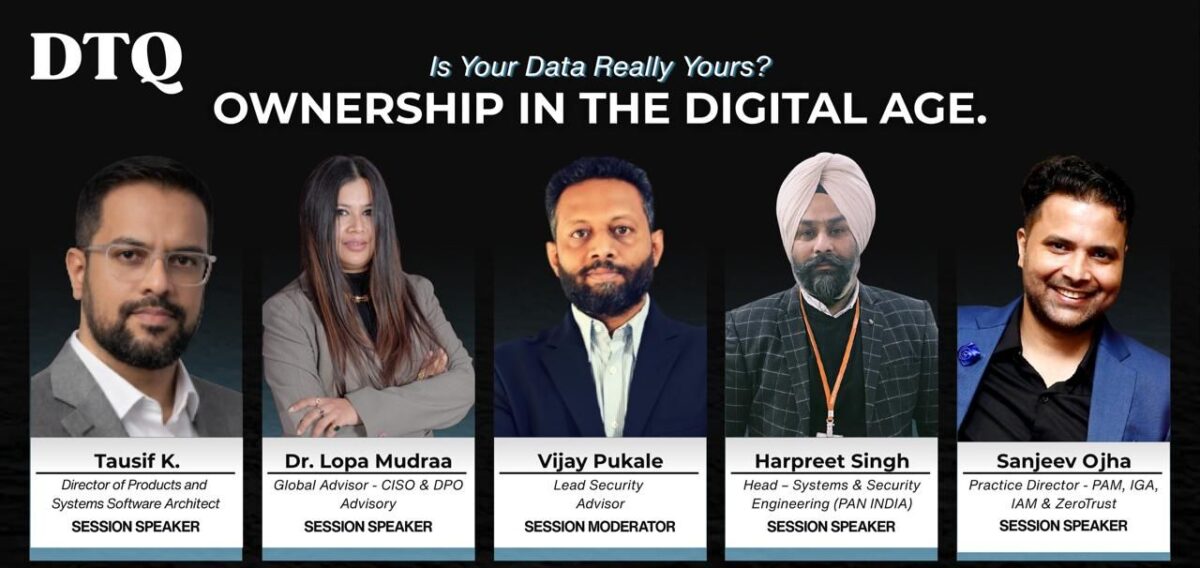
In an era where data is frequently termed the “new oil,” a critical question remains largely unanswered: who truly owns the drill, and more importantly, who owns the oil once it leaves the ground? On May 15, 2026, a high-impact virtual session titled “Is Your Data Really Yours: Ownership in the Digital Age” brought together a panel of global cybersecurity luminaries to dismantle the “consent illusion” and redefine the landscape of data stewardship.

The virtual session explored the uncomfortable truth that while users may generate data, they often lose control of it the moment it enters the complex enterprise ecosystem. As organizations rush to deploy Generative AI (GenAI) at breakneck speeds, the panel argued that the industry is facing a crisis of accountability that transcends traditional technical boundaries.

The Distinguished Panel

The dialogue featured four sharp minds, each bringing a unique perspective from the front lines of global cybersecurity and technology architecture:

  • Dr. Lopa Mudraa Basuu: A recognized visionary leader and former VP at JPMorgan Chase.
  • Harpreet Singh: A Managing Director with 25+ years of expertise in architecting technology solutions.
  • Sanjeev Ojha: Practice Director and a leading expert in Identity and Access Management (IAM) and Zero Trust.
  • Tausif Kazi: A Principal Analytics Consultant and platform

The “Consent Illusion” and the Transparency Gap

The session opened with a sobering look at current statistics. Host highlighted that 4 out of 5 global internet users feel they have lost all control over their personal information. This “consent illusion” is fueled by lengthy, incomprehensible terms of service that users click through out of necessity, not understanding that their data is being replicated across analytics engines, third-party platforms, and cross-border infrastructures.

Dr. Lopa Mudraa Basuu argued that the digital economy is predominantly engineered around “data leverage,” where the user is often the product rather than the customer. She noted that once data enters a corporate ecosystem, ownership becomes “largely theoretical” because the visibility for the user is almost non-existent.

Identity—The New (and Only) Perimeter

Sanjeev Ojha provided a deep dive into the shifting architecture of the enterprise. In a world of cloud-native and AI-driven environments, the traditional “castle and moat” security model is obsolete. Identity is no longer just a control layer; it is the foundation of security itself.

A particularly pressing concern raised by Ojha is the rise of “Agentic AI”—autonomous systems that can elevate their own permissions or access data without direct human awareness. He warned that many organizations are currently “not yet ready” for this shift. To combat this, he proposed a robust lifecycle management approach:

  1. Discovery: Identifying all identities (human and non-human) in the system.
  2. Governance: Assigning a “human in the loop” to manage the lifecycle of these autonomous agents.
  3. Guardrails: Implementing centralized systems like Identity Threat Detection and Response (ITDR) to take feeds from endpoints, XDR, and SIEM servers.

Architecting for Resilience, Not Just Compliance

Harpreet Singh challenged the audience to rethink the “Mahakum style” of operations—large-scale, high-velocity systems where security is often an afterthought. He emphasized that security should not be a “review gate” that slows down innovation but a “product requirement” integrated from the start.

One of the most effective tools in this arsenal is Multi-Factor Authentication (MFA) and Role-Based Access Control (RBAC). Singh broke down the three pillars of MFA:

  • Knowledge: Something you know (e.g., a password).
  • Possession: Something you have (e.g., a hardware token or phone).
  • Inherence: Something you are (e.g., biometrics).

However, the panel agreed that technical controls are insufficient if the architecture doesn’t allow for visibility into traffic and proactive threat prevention.

The Leadership Crisis and the $50 Billion Risk

Perhaps the most provocative segment of the session involved the role of leadership in the age of AI. Dr. Basuu noted that she is less worried about “insecure technology” and more worried about leadership teams deploying AI at a velocity that exceeds their governance maturity.

The financial stakes are astronomical. Sharma cited numbers from IBM Security and legal analysts suggesting that more than $50 billion in cumulative data is currently under “extraction risk” due to active copyrights and privacy lawsuits related to AI training. Despite this, 83% of organizations reportedly have no technical controls to prevent employees from uploading confidential data into public AI tools.

The “Employee as the Weakest Link” Myth

Dr. Basuu offered a strong critique of the common cybersecurity trope that “employees are the weakest link.” She argued that if an employee is the weakest link, it is actually a failure of organizational governance and security deployment.

“Employee needs to be the strongest link of your security,” she stated. This requires unlearning old processes and moving toward a culture where security is part of every role’s responsibility—from the junior scientist to the payroll consolidator. Training must move away from “once a year” compliance checks to a daily “injection” of security awareness.

Conclusion: From “Everyone’s Responsibility” to “My Responsibility”

The session concluded with a powerful call to action. Vijay Pukale (Varij) summarized the shift needed in corporate culture: “Let’s break the myth that security is everyone’s responsibility. From now, we can say that security is my responsibility“.

The consensus among the speakers was clear: reclaiming data ownership in the digital age requires a three-pronged approach:

  1. Ethical Stewardship: Organizations must treat user data with the same dignity and protection they would their own proprietary secrets.
  2. Technological Guardrails: Implementing Zero Trust and advanced IAM to govern the “wild west” of agentic AI.
  3. Leadership Accountability: Slowing down AI deployment enough to ensure that ethical and legal governance can keep pace with innovation.

As the “picture perfect panel” concluded, the sentiment was that while one hour was not enough to solve the crisis of digital ownership, it provided the necessary blueprint for a more secure, accountable future.

Data Trust Quotients (DTQ) is a strategic ecosystem architect that aims to bridge gaps between industry, startups, and investors. DTQ blends data privacy, governance, and cutting-edge AI to accelerate transformative breakthroughs in different domains.