



Categories
Events

Ethics by Design: Global Leaders Convene to Address AI’s Moral Imperative

Categories
Events

Ethics by Design: Global Leaders Convene to Address AI’s Moral Imperative

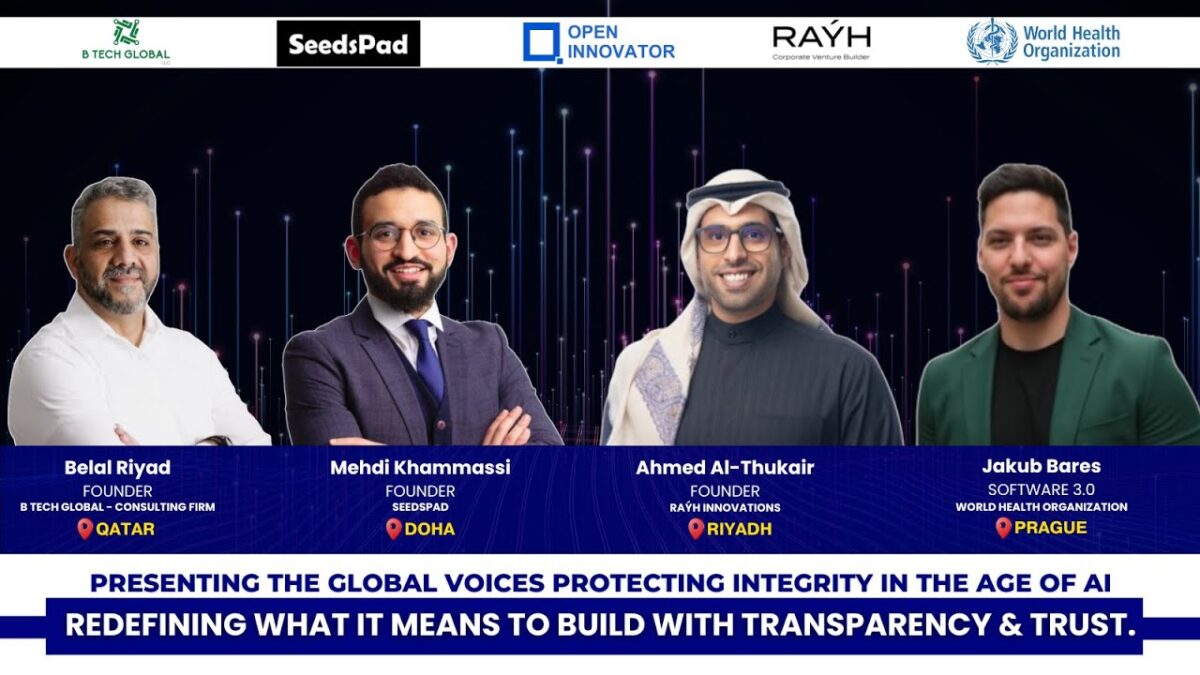
In a world where ChatGPT gained 100 million users in two months—a accomplishment that took the telephone 75 years—the importance of ethical technology has never been more pressing. Open Innovator on November 14th hosted a global panel on “Ethical AI: Ethics by Design,” bringing together experts from four continents for a 60-minute virtual conversation moderated by Naman Kothari of Nasscom. The panelists were Ahmed Al Tuqair from Riyadh, Mehdi Khammassi from Doha, Bilal Riyad from Qatar, Jakob Bares from WHO in Prague, and Apurv from the Bay Area. They discussed how ethics must grow with rapidly advancing AI systems and why shared accountability is now required for meaningful, safe technological advancement.

Ethics: Collective Responsibility in the AI Ecosystem

The discussion quickly established that ethics cannot be attributed to a single group; instead, founders, investors, designers, and policymakers build a collective accountability architecture. Ahmed stressed that ethics by design must start with ideation, not as a late-stage audit. Raya Innovations examines early enterprises based on both market fit and social effect, asking direct questions about bias, damage, and unintended consequences before any code is created. Mehdi developed this into three pillars: human-centricity, openness, and responsibility, stating that technology should remain a benefit for humans rather than a danger. Jakob added the algorithmic layer, which states that values must be testable requirements and architectural patterns. With the WHO implementing multiple AI technologies, identifying the human role in increasingly automated operations has become critical.

Structured Speed: Innovating Responsibly While Maintaining Momentum

Maintaining both speed and responsibility became a common topic. Ahmed proposed “structured speed,” in which quick, repeatable ethical assessments are integrated directly into agile development. These are not bureaucratic restrictions, but rather concise, practical prompts: what is the worst-case situation for misuse? Who might be excluded by the default options? Do partners adhere to key principles? The goal is to incorporate clear, non-negotiable principles into daily workflows rather than forming large committees. As a result, Ahmed claimed, ethics becomes a competitive advantage, allowing businesses to move rapidly and with purpose. Without such guidance, rapid innovation risks becoming disruptive noise. This narrative resonated with the panelists, emphasizing that prudent development can accelerate, rather than delay, long-term growth.

Cultural Contexts and Divergent Ethical Priorities

Mehdi demonstrated how ethics differs between cultural and economic environments. Individual privacy is a priority in Western Europe and North America, as evidenced by comprehensive consent procedures and rigorous regulatory frameworks. In contrast, many African and Asian regions prioritize collective stability and accessibility while functioning under less stringent regulatory control. Emerging markets frequently focus ethical discussions on inclusion and opportunity, whereas industrialized economies prioritize risk minimization. Despite these inequalities, Mehdi pushed for universal ethical principles, claiming that all people, regardless of place, need equal protection. He admitted, however, that inconsistent regulations result in dramatically different reality. This cultural lens highlighted that while ethics is internationally relevant, its local expression—and the issues connected with it—remain intensely context-dependent.

Enterprise Lessons: The High Costs of Ethical Oversights

Bilal highlighted stark lessons from enterprise organizations, where ethical failings have multimillion-dollar consequences. At Microsoft, retrofitting ethics into existing products resulted in enormous disruptions that could have been prevented with early design assessments. He outlined enterprise “tenant frameworks,” in which each feature is subject to sign-offs across privacy, security, accessibility, localization, and geopolitical domains—often with 12 or more reviews. When crises arise, these systems maintain customer trust while also providing legal defenses. Bilal used Google Glass as a cautionary tale: billions were lost because privacy and consent concerns were disregarded. He also mentioned Workday’s legal challenges over alleged employment bias. While established organizations can weather such storms, startups rarely can, making early ethical guardrails a requirement of survival rather than preference.

Public Health AI Designing for Integrity and Human Autonomy

Jakob provided a public-health viewpoint, highlighting how AI design decisions might harm millions. Following significant budget constraints, WHO’s most recent AI systems are aimed at enhancing internal procedures such as reporting and finance. In one donor-reporting tool, the team focused “epistemic integrity,” which ensures outputs are factual while protecting employee autonomy. Jakob warned against Goodhart’s Law, which involves overoptimizing a particular statistic at the detriment of overall value. They put in place protections to prevent surveillance overreach, automation bias, power inequalities, and data exploitation. Maintaining checks and balances across measures guarantees that efficiency gains do not compromise quality or hurt employees. His findings revealed that ethical deployment necessitates continual monitoring rather than one-time judgments, especially when AI replaces duties previously conducted by specialists.

Aurva’s Approach: Security and Observability in the Agentic AI Era

The panel then moved on to practical solutions, with Apurv introducing Aurva, an AI-powered data security copilot inspired by Meta’s post-Cambridge Analytica revisions. Aurva enables enterprises to identify where data is stored, who has access to it, and how it is used—which is crucial in contexts where information is scattered across multiple systems and providers. Its technologies detect misuse, restrict privilege creep, and give users visibility into AI agents, models, and permissions. Apurv contrasted between generative AI, which behaves like a maturing junior engineer, and agentic AI, which operates independently like a senior engineer making multi-step judgments. This autonomy necessitates supervision. Aurva serves 25 customers across different continents, with a strong focus on banking and healthcare, where AI-driven risks and regulatory needs are highest.

Actionable Next Steps and the Imperative for Ethical Mindsets

In conclusion, panelists provided concrete advice: begin with human-impact visibility, undertake early bias and harm evaluations, construct feedback loops, teach teams to acquire a shared ethical understanding, and implement observability tools for AI. Jakob underlined the importance of monitoring, while others stressed that ethics must be integrated into everyday decisions rather than marketing clichés. The virtual event ended with a unifying message: ethical AI is no longer optional. As agentic AI becomes more independent, early, preemptive frameworks protect both consumers and companies’ long-term viability.

Reach out to us at open-innovator@quotients.com or drop us a line to delve into the transformative potential of groundbreaking technologies and participate in our events. We’d love to explore the possibilities with you.

Categories
Global News of Significance

Technology Trends Reshaping 2025: AI, Quantum Computing, and Beyond

Categories
Global News of Significance

Technology Trends Reshaping 2025: AI, Quantum Computing, and Beyond

In 2025, the technology landscape is undergoing unparalleled change in a number of areas. The rate of innovation keeps speeding up, from autonomous AI agents transforming business operations to quantum computers moving from research labs to commercial applications. This thorough analysis looks at the most important technology developments that are reshaping sectors and creating new commercial and research opportunities.

The Rise of Autonomous AI Agents

Artificial intelligence is now much more advanced than simple chatbots. In 2025, autonomous AI agents that can operate without human input are becoming essential to business operations, marking a significant change in how companies use AI technology.

These advanced agents perform continuous data analysis, automate multi-step business processes, and communicate directly with other software systems. Compared to earlier AI tool generations that needed ongoing human supervision and involvement, this represents a substantial advancement. These agents’ autonomy allows them to manage intricate workflows, make choices based on real-time data, and adjust to changing circumstances without requiring manual reconfiguration.

Copilots and generative AI are concurrently speeding up coding, decision-making, and content production across industries. Driven by developments in massive language models, agentic AI has become a key enabler in a number of industries, radically altering the way work is done. These systems are being implemented by organizations as essential parts of their operational architecture, not only to increase efficiency.

Notable examples include the incorporation of AI into digital twins, cyber-physical systems, and edge computing. By removing latency problems and facilitating automation at the data generating stage, these apps enable real-time insights and quicker reaction times. Applications ranging from smart city infrastructure to industry automation are finding that this distributed approach to AI implementation is crucial.

Semiconductor Industry: Powering the AI Revolution

The semiconductor industry is going through an unprecedented period of growth in terms of both size and strategic significance. The sector is experiencing rapid innovation and significant investment due to the demand for AI chips and high-performance processors.

In order to support generative AI workloads, specialized AI accelerators and graphics processing units have become essential. The market is reacting with impressive growth forecasts: sales of generative AI chips are predicted to reach $150 billion in 2025 alone. Companies are accelerating their development schedules as a result of this growing demand, which is changing the competitive landscape.

The production of advanced chips is developing at a breakneck speed. Higher transistor density and increased power efficiency are made possible by the development of node technology, which is a major milestone in shrinking. More integration and performance improvements that were previously unattainable are now available thanks to advanced packaging techniques like TSMC’s CoWoS (Chip-on-Wafer-on-Substrate) technology. In order to meet the computing requirements of next-generation AI applications, these manufacturing advancements are essential.

The market for memory is changing, especially in the area of High-Bandwidth Memory (HBM). Because it provides the data throughput required for training and operating big AI models, this specialized memory technology has become crucial for AI accelerators. Due to the unquenchable desire for quicker, more effective memory solutions, the HBM industry is predicted to propel overall memory revenues up by an astounding rate in 2025.

The development of neuromorphic circuits, which imitate organic neural systems to provide incredibly effective AI processing, is arguably the most fascinating. A radically different approach to computing is represented by these specialized processors, which may allow for the development of new kinds of applications with significantly reduced power requirements.

Quantum Computing: From Laboratory to Marketplace

In 2025, quantum computing has reached a turning point, moving from strictly scholarly study to early commercial influence. This change is the result of years of consistent work to overcome the basic obstacles that have long prevented quantum computing from being used outside of research facilities.

Significant gains in qubit performance, including improved coherence times and reduced error rates, have been made recently. More useful quantum systems are being made possible by the integration of specialized hardware and software, and hybrid quantum-AI systems are creating new opportunities by fusing the advantages of both processing paradigms.

Quantum computing’s application fields are growing quickly and getting more tangible. Quantum simulations, which can predict chemical interactions with previously unheard-of accuracy, are helping in drug discovery. Quantum computing is being used in climate modeling applications to process complicated atmospheric and oceanic data at previously unattainable scales. While post-quantum cryptography initiatives are planning for a future where conventional encryption techniques may be susceptible, materials science researchers are harnessing quantum systems to create novel materials with particular features.

These applications are no longer just theoretical. Pharmaceutical businesses, climate research institutes, and materials manufacturers are investing in quantum computing capabilities, which is driving real-world pilots across industries. The technology is demonstrating its worth by resolving optimization issues and simulations that are too complex for traditional computers.

Governments and business executives are increasing investments and workforce development programs in recognition of the strategic significance of quantum technology. With countries seeing quantum capacity as crucial to their future technical and economic competitiveness, the battle to take the lead in quantum computing is getting fiercer.

Next-Generation Connectivity and Extended Reality

The networking infrastructure that facilitates digital transformation is changing quickly. The capabilities and reach of 5G and next-generation wireless networks are growing, radically altering the possibilities for mobile communication.

5G is making real-time, high-bandwidth applications possible on a large scale, with rates as high as 20 gigabits per second. Both the deployment of augmented and virtual reality systems and the Internet of Things are greatly benefiting from this increased connectedness. Most importantly, 5G is enabling autonomous cars by supplying the high-reliability, low-latency connectivity required for safe operation.

Systems for virtual reality and augmented reality are evolving on their own, with advancements in wearability, resolution, and interaction propelling acceptance in a variety of industries. Although gaming is still a significant business, the technology is rapidly being used in healthcare, education, and industrial training. Long usage sessions are now feasible for the first time thanks to the enhanced fidelity and comfort of contemporary XR devices.

These days, immersive job training programs that lower costs and increase safety are powered by extended reality technologies. While remote work and cooperation are changing due to the merging of digital and physical environments, virtual campuses are increasing access to education. The way people engage with information and with one another over long distances has been fundamentally expanded by these technologies.

Sustainable Technology Infrastructure

AI and advanced computing’s massive energy requirements are posing new problems and spurring innovation in energy infrastructure. The technology sector is searching for sustainable solutions as a result of the enormous amounts of electricity needed to run data centers at scale and train massive AI models.

There is a resurgence of interest in nuclear power as a remedy for these energy problems. In order to supply clean, dependable electricity for data centers and high-performance computing facilities, next-generation reactors are being built.

Innovations in batteries and renewable energy technologies, aside from nuclear energy, are growing quickly. In order to meet both short-term environmental aims and long-term climate change objectives, carbon capture systems are being implemented to offset emissions. The technology industry is realizing more and more that sustainable operations are crucial for long-term viability from both an environmental and strategic standpoint.

Biotechnology: AI Meets Life Sciences

In 2025, biotechnology and artificial intelligence are coming together to produce amazing discoveries. AI algorithms that can forecast editing results and improve targeting tactics are improving gene-editing tools like CRISPR. The period from pathogen identification to effective vaccine candidates is being accelerated by new platforms for vaccine development. Finding interesting medicinal molecules is becoming much faster and less expensive thanks to AI-enhanced drug discovery.

With AI algorithms evaluating genetic data to suggest customized treatment plans, personalized medicine is becoming more and more feasible. These same technologies are being used in agriculture to create resilient crops that can sustain or increase yields while withstanding climate difficulties.

AI-powered digital health solutions and synthetic biology are developing completely new diagnostic and therapeutic categories. Emerging bio-based manufacturing techniques have the potential to replace conventional chemical processes with more environmentally friendly biological ones. These developments signify a profound extension of the possibilities in biological engineering and healthcare.

Looking Ahead

The technical innovations of 2025 are linked patterns that support and magnify one another rather than discrete breakthroughs. The need for sophisticated semiconductors, which enable more potent AI systems, is fueled by AI. While AI optimizes quantum systems, quantum computing promises to speed up AI development. While demanding sophisticated connectivity and computing capacity, extended reality develops new interfaces for intricate technologies.

When taken as a whole, these developments are speeding up digital transformation in every industry area. They are enabling innovative business models, expanding the boundaries of research, and radically changing operating paradigms. The state of technology in 2025 reflects not only little but significant advancements but also a number of turning points that will influence the course of innovation for years to come.

As these technologies develop and converge, their influence will go much beyond the technology industry itself, affecting every facet of how we work, communicate, learn, and address society’s major problems. 2025’s breakthroughs are setting the stage for a future that will be more digital, linked, and able to solve issues that were previously thought to be unsolvable.

Quotients is a platform for industry, innovators, and investors to build a competetive edge in this age of disruption. We work with our partners to meet this challenge of metamorphic shift that is taking place in the world of technology and businesses by focusing on key organisational quotients. Reach out to us at open-innovator@quotients.com

Categories
Events

Agentic AI: Shaping the Business Landscape of Tomorrow

Categories
Events

Agentic AI: Shaping the Business Landscape of Tomorrow

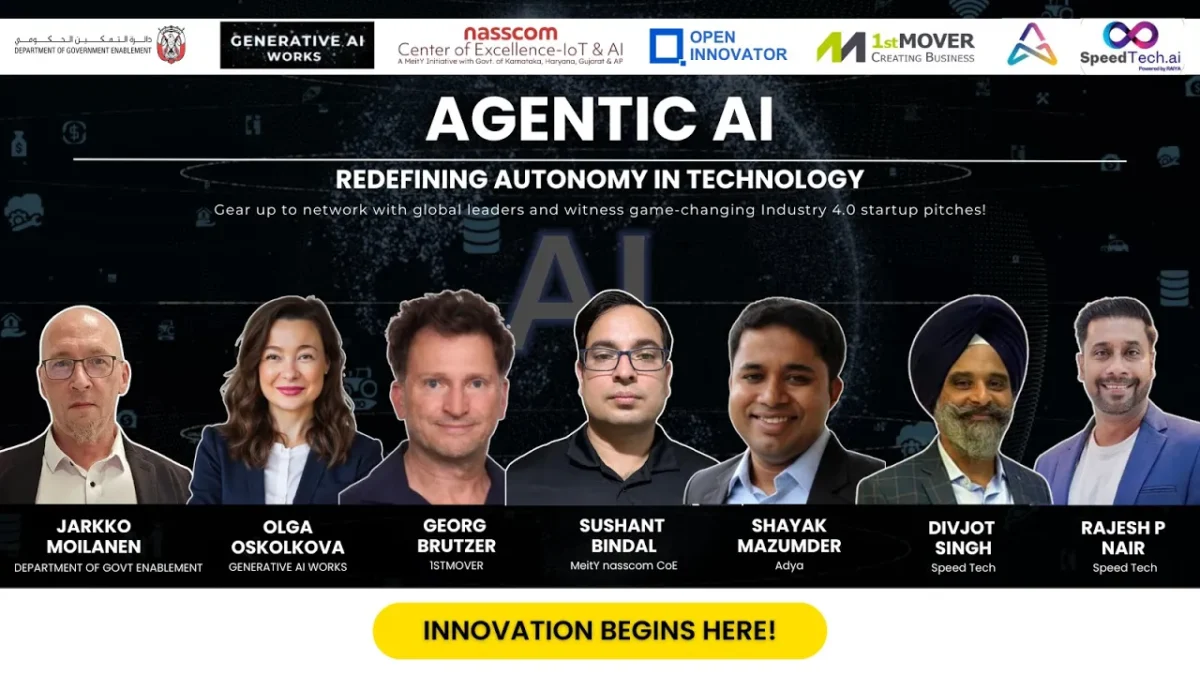
Open Innovator hosted Agentic AI Knowledge Session convened an assembly of distinguished thought leaders, innovators, and industry professionals to delve into the transformative prospects of agentic AI in revamping business practices, fostering innovation, and bolstering collaboration.

The virtual event held on March 21st , moderated by Naman Kothari, underscored the distinctive traits of agentic AI—its proactive and dynamic nature contrasting with the traditional, reactive AI models. The session encompassed engaging panel discussions, startup presentations, and profound insights on how small and medium enterprises (SMEs) can exploit agentic AI to enhance productivity, efficiency, and decision-making capabilities.

Prominent Speakers and Discussion Points:

  • Sushant Bindal, Innovation Partnerships Head at MeitY-Nasscom CoE, steered conversations about nurturing innovation within Indian businesses.
  • Dr. Jarkko Moilanen, Platform Product Head for the Department of Government Enablement in Abu Dhabi, UAE, offered insights into AI’s evolving role within governmental and public domains.
  • Olga Oskolkova, Founder of Generative AI Works, and Georg Brutzer, Agentic AI Strategy Consultant, delved into the long-term implications of agentic AI for commerce and governance frameworks.
  • Shayak Mazumder, CEO of Adya, presented their technology platform, which is instrumental in advancing ONDC adoption in India and simplifying AI integration.
  • Divjot Singh and Rajesh P. Nair, the masterminds behind Speed Tech, showcased their intelligent enterprise assistant aimed at optimizing operations and enhancing decision-making processes.

Overview of the Future of AI in Business

Naman Kothari initiated the session by distinguishing between conventional AI and agentic AI, likening the latter to a proactive participant in a classroom setting. This distinction laid the foundation for an exploration of how AI can transcend automation to facilitate real-time decision-making and collaboration across various industries.

Agentic AI’s Impact on SMEs

A pivotal theme was the substantial benefits that agentic AI can offer to SMEs. Georg Brutzer underscored that SMEs are at disparate levels of digital maturity, necessitating tailored AI approaches. More digitized firms can integrate AI via SaaS platforms, while less digitized ones should prioritize controlled generative AI projects to cultivate trust and understanding. Olga Oskolkova reinforced the importance of strategic AI adoption to prevent resource waste and missed opportunities.

Building Confidence in AI: Education and Strategy

A prevailing challenge highlighted was the need to establish trust in AI within organizational structures. Sushant Bindal advocated for starting with bite-sized AI projects that yield evident ROI, particularly in sectors like manufacturing and logistics where AI can enhance processes without causing disruptions.

Olga Oskolkova placed emphasis on AI literacy, suggesting businesses prioritize employee education on AI’s capabilities, limitations, and ethical ramifications. This approach fosters an environment conducive to learning and helps navigate beyond the hype to derive actual value from AI adoption.

Governance and Ethical Considerations

The increasing integration of AI into business processes has brought to the fore the necessity for robust governance frameworks and ethical considerations. Dr. Jarkko Moilanen spoke on the evolving nature of AI and the imperative for businesses to adapt governance models as AI systems become more autonomous. Balancing machine autonomy with human oversight remains vital for AI to serve as a complementary tool rather than a human replacement.

AI as a Catalyst for Startup and Enterprise Synergy

AI’s role in fostering collaboration between startups and large corporations was another key discussion point. Sushant Bindal pointed out that AI agents can function as matchmakers, identifying supply chain gaps and business needs to facilitate beneficial partnerships. These collaborations can spur innovation and ensure mutual growth for startups and established enterprises.

SaaS Companies and AI’s Evolution

The session touched on the challenges and opportunities SaaS companies face as AI advances. Olga Oskolkova discussed how AI’s transition from basic automation to complex agentic systems would affect business models, suggesting a shift from traditional subscription-based to token-based pricing models tied to output and effectiveness.

Moreover, as AI takes on more sophisticated tasks, businesses must reevaluate their approach to adoption and integration, maintaining human engagement while leveraging AI’s potential.

Startup Showcases: Adya AI and Speed Tech

The session included captivating startup pitches from two innovative companies:

– Adya AI, presented by Shayak Mazumder, showcased their platform’s ability to create custom AI agents using a user-friendly drag-and-drop interface, streamlining data integration and app development. This underscored the potential for agentic AI to boost productivity, innovation, and accessibility.

– Divjot Singh and Rajesh P. Nair introduced Speed Tech’s intelligent enterprise assistant, designed to optimize operations and decision-making. Their product, Rya, demonstrated AI’s ability to enhance customer service and minimize operational costs by addressing challenges such as long wait times and document processing errors.

Concluding Remarks and Key Takeaways

The session concluded with an emphasis on collaboration, innovation, and continuous learning as essential for harnessing agentic AI’s potential. The session encouraged the audience to embrace the evolving AI landscape and recognize the vast potential for business transformation. The speakers collectively highlighted the importance of education, strategy, and collaboration in navigating AI integration successfully. The event left participants with a clear understanding of the profound impact of AI and a call to stay informed, explore emerging opportunities, and drive innovation within the realm of AI.