






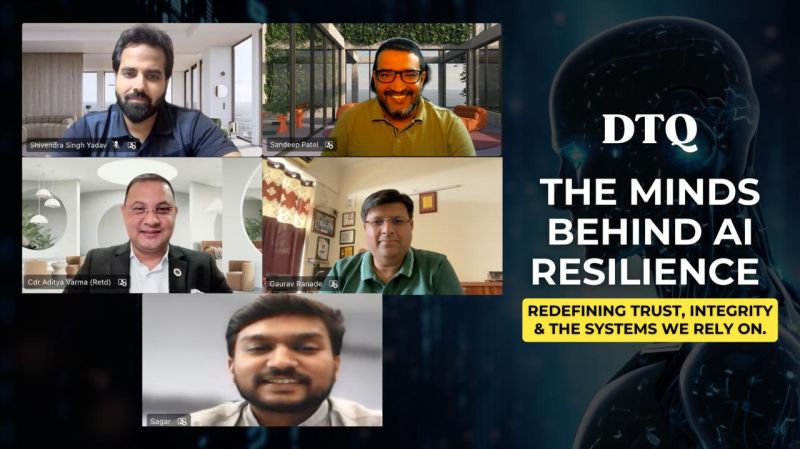
Data Trust Quotient, a strategic platform and community of thought leaders working at the intersection of data protection, cybersecurity, and data governance, on May 27, 2026, convened a virtual session. The discussion, moderated by Commander Aditya Varma (Retd), brought together five leaders from cybersecurity, enterprise AI, operational resilience, compliance, and critical infrastructure to confront one of the most urgent and under-governed risks in enterprise technology today: Shadow AI — the quiet, well-intentioned, and deeply dangerous adoption of AI tools outside organizational oversight.
Speaker Profiles
Commander Aditya Varma (Retd) — Moderator, Leader Public Sector Security, Cisco (India & SAARC)
The moderator brought two decades of military service and deep experience in public sector cybersecurity to the panel. Drawing on his background at Cisco, where he leads public sector security for India and SAARC, he guided the conversation with sharp operational framing — connecting shadow AI governance to cybersecurity fundamentals like zero trust, observability, and the “security is everybody’s responsibility” doctrine. He closed the main discussion with a crisp four-point synthesis that captured the session’s collective message.
Shivendra Singh Yadav — CTO, NVIDIA Ecosystem, HCL Tech
With a focus on AI transformation, generative AI, and scalable enterprise architecture, this speaker offered a practitioner’s view of what shadow AI looks like from inside a large technology organisation. He coined the memorable phrase “competence camouflage” to describe employees using public LLMs to produce polished outputs without disclosing their AI use — a psychological response to performance pressure, not malicious intent. He also outlined practical architectural responses including API monitoring tools, enterprise-licensed frontier model access, and the concept of AI factories — on-premise AI infrastructure that can reduce both risk and token costs simultaneously.
Sandeep Patel — Independent Cybersecurity & Compliance Consultant
With twenty years of experience across cybersecurity readiness, global operations, and digital transformation, this speaker focused on the governance and regulatory dimensions of shadow AI. He highlighted the particular vulnerability of mid-market and small organisations, which lack both the budget and the personnel to establish governance structures. He raised pointed concerns about India’s regulatory readiness, noting that the Digital Personal Data Protection (DPDP) Act’s enforcement deadline is still being treated with complacency by many organisations. He also made the session’s most forward-looking educational argument: that AI accountability must become part of school curricula, not just corporate training.
Sagar S — Principal Business Continuity & Operational Resilience Consultant, Cohesity
Drawing on extensive experience in operational risk, cyber disruption, and resilience — including frontline work during the 2017 NotPetya cyberattack — this speaker brought a resilience-first lens to the shadow AI problem. He argued that accountability for AI usage cannot sit only at leadership level; it must be distributed to every individual using the tools. He noted that many organisations are knowingly accepting AI governance risk in the short term in exchange for productivity gains, with a plan to govern later — a posture he treated with cautious concern.
Gaurav Ranade — CTO, Technocentric Advisory
With over 27 years of experience across cybersecurity, telecom, and digital transformation, this speaker offered the session’s most technically grounded and systemically wide perspective. He argued that shadow AI is not only an employee behaviour problem but an infrastructure problem — AI tools embedded in enterprise systems may themselves be passing data to unknown third parties or state actors. He drew a sharp parallel between the current shadow AI situation and the BYOD (Bring Your Own Device) crisis of years past, and warned that no organisation has yet built a truly integrated architecture combining data center design, security framework, and AI governance.
Key Insights from the Discussion
1. Shadow AI Is Not an IT Problem — It Is a Human and Leadership Problem
The session’s opening framing was clear and deliberate: shadow AI does not enter organisations because employees are bad actors. It enters because they are trying to work faster, look smarter, and stay competitive — and the organisation has not given them a sanctioned way to do so.
The host’s reference to the Samsung incident was the clearest illustration. Engineers pasting source code into ChatGPT were not acting irresponsibly by their own logic. They were solving an immediate problem. The failure was upstream — no governance structure had anticipated the behaviour, and no sanctioned alternative had been provided.
The moderator summarised the root cause plainly: shadow AI is caused by unmet enterprise demand for speed, intelligence, and productivity. Governance must therefore enable, not merely restrict.
“Shadow AI isn’t just a security problem caused by bad actors. It’s a human problem created via good intentions.” — The Host
2. Competence Camouflage: The Psychological Driver Nobody Talks About
One of the session’s most striking concepts came from the enterprise AI leader at HCL Tech: “competence camouflage.” Employees across seniority levels — managers, team leads, individual contributors — face performance pressure that creates a psychological incentive to use AI tools secretly. When the organisation has not yet mandated or provided AI access, employees turn to public LLMs to produce more polished presentations, better-structured emails, and refined reports.
The tell-tale sign: when output quality suddenly spikes uniformly across a team, and enterprise AI utilisation logs show near-zero usage, the gap reveals where the work is actually being done.
His observation about the consequences went further: employees unknowingly training public LLMs with proprietary organisational data means that structured reports, internal analyses, and strategic frameworks are effectively becoming freely accessible to anyone querying the same tools. The data flows out not through any malicious exfiltration, but through the normal act of trying to do a better job.
3. Banning AI Is a Failed Strategy — Bring It Inside Instead
All five speakers converged on a consistent and emphatic position: organisations that respond to shadow AI by banning tools or threatening employees are making the problem worse, not better.
The enterprise AI leader noted that employees will simply pay for a personal subscription — $10 or $20 a month — and continue using the tools outside any line of visibility. The cybersecurity and compliance consultant confirmed that threats of disciplinary action drove more usage underground, not less. The result: the organisation has neither visibility nor control.
The solution proposed was consistent across the panel — channelise rather than restrict. Bring frontier models into the enterprise environment under appropriate guardrails. Offer enterprise-licensed access. Give employees a sanctioned alternative that is better than what they would access privately. As one speaker framed it: if employees are using a free Gemini subscription and you offer them a $20 Gemini Pro subscription under enterprise terms, no one refuses.
“The faster you bring all these tools into your enterprise purview, the better it is — rather than refraining people from using it.” — Enterprise AI Leader, HCL Tech
4. Mid-Market and SME Organisations Face a Disproportionate Risk
While large enterprises have gatekeepers, audit functions, and dedicated security teams, the cybersecurity and compliance consultant identified small and medium organisations as the sector most exposed to shadow AI damage — and least equipped to respond.
These organisations view AI productivity tools as a business benefit, not a governance challenge. They lack the budget to deploy monitoring infrastructure. They often have no designated person evaluating which AI tools are safe for use. And when a breach occurs, the impact on customer confidence and operational integrity can be existential.
The broader India-specific point raised was equally significant: with DPDP enforcement deadlines still being treated as flexible and AI adoption accelerating rapidly, a large portion of the economy is building on a governance foundation that does not yet exist.
5. Digital Sovereignty Is the Deeper, Less-Discussed Risk
The enterprise AI leader reframed shadow AI as a sovereignty problem, not just a security problem. Sovereignty, he argued, means three things: your data, your infrastructure, and your trusted people. In the current shadow AI landscape, none of those three conditions is being met.
When an employee submits organisational data to a public LLM hosted in another country, the data is not theirs anymore. The infrastructure is not theirs. And the model is being trained — unknowingly — by every user who submits data to it, including competitors, analysts, and adversaries doing the same.
The CTO at Technocentric Advisory expanded this to critical infrastructure: AI tools embedded in defence, government, and public sector environments may themselves be transmitting data to unknown external parties or state actors. This is not a behavioural risk — it is an architectural risk. And it is one that no governance framework in India has yet addressed at the systemic level.
6. Governance Needs Architecture and Telemetry, Not Just Policy
A consistent thread running through the technical answers was that policy documents cannot solve a shadow AI problem. The enterprise AI leader was direct: by the time a policy has been written, circulated, and acknowledged, employees have already adopted three new tools that the policy does not cover.
What organisations need instead is observability — end-to-end visibility across the technology stack, from the API calls being made to the data egressing through employee devices. Tools cited during the session included Microsoft Purview, Varonis, AWS Bedrock Guardrails, and NVIDIA’s guardrails framework.
The moderator added a key structural point: the CICD pipeline needs to be monitored from model onboarding through to deployment, with stress testing at each stage. The conversation also flagged AI agents as the next observability frontier — autonomous systems that act on behalf of users, with their own API calls, data access, and decision-making, represent an exponential expansion of the attack surface. An ungoverned AI agent with access to financial systems or communication channels is not a hypothetical risk; it is an imminent operational reality.
7. Accountability Must Be Distributed, Not Delegated Upward
The operational resilience consultant made a point that echoed the moderator’s military background: accountability for AI usage cannot sit only at the CISO level, the CTO level, or any single function. It must exist at every layer — the individual contributor, the team lead, the business unit head, and the board.
The moderator reinforced this with a principle from naval service: security is everybody’s responsibility. If someone sees unsafe AI usage in their team, the correct response is not to wait for a governance committee to convene. It is to intervene.
The enterprise AI leader framed this behaviourally: accountability is not achieved through policy mandates but through behavioural design. Making safe AI tools more attractive than unsafe ones, building enterprise guardrails into tools people already want to use, and measuring shadow AI usage through indirect means — like blog writing contests that reveal whether employees are drawing on enterprise tools or external LLMs — are the kinds of creative accountability mechanisms that actually work.
8. The Insider Threat Has Been Permanently Redefined
The session closed with audience questions that crystallised one final insight: the boundary between cyber risk and human risk has dissolved.
The cybersecurity and compliance consultant noted that physical security controls — no phones in server rooms, paper-based data handling — are now entirely irrelevant. Every browser, every application, every AI assistant running on every device is a potential exfiltration point. The risk now lives in every click, every prompt, every query an employee submits without fully understanding its downstream consequences.
The CTO at Technocentric Advisory was unambiguous: shadow AI will not go away. It is not a phase. It is an enduring structural condition of modern enterprise, just as insider threats have always existed. The goal is not to eliminate it; it is to mature the organisation’s ability to see it, contain it, and respond when it surfaces.
“Shadow AI will remain in future forever.” — CTO, Technocentric Advisory
Conclusion
The session closed with the moderator drawing together four dimensions that every enterprise leader must now hold simultaneously: shadow AI creates invisible operational exposure; it challenges trust, sovereignty, and organisational control; it requires architecture and telemetry, not just policy; and it directly affects customer confidence, privacy, and accountability.
The answer, the panel agreed, is not fear-led restriction. It is responsible enablement — giving employees safe AI pathways, making usage visible, classifying data rigorously, governing the tools in the environment, holding vendors accountable, and keeping humans responsible for every consequential decision.
The human, as the moderator concluded, must stay in the loop.