







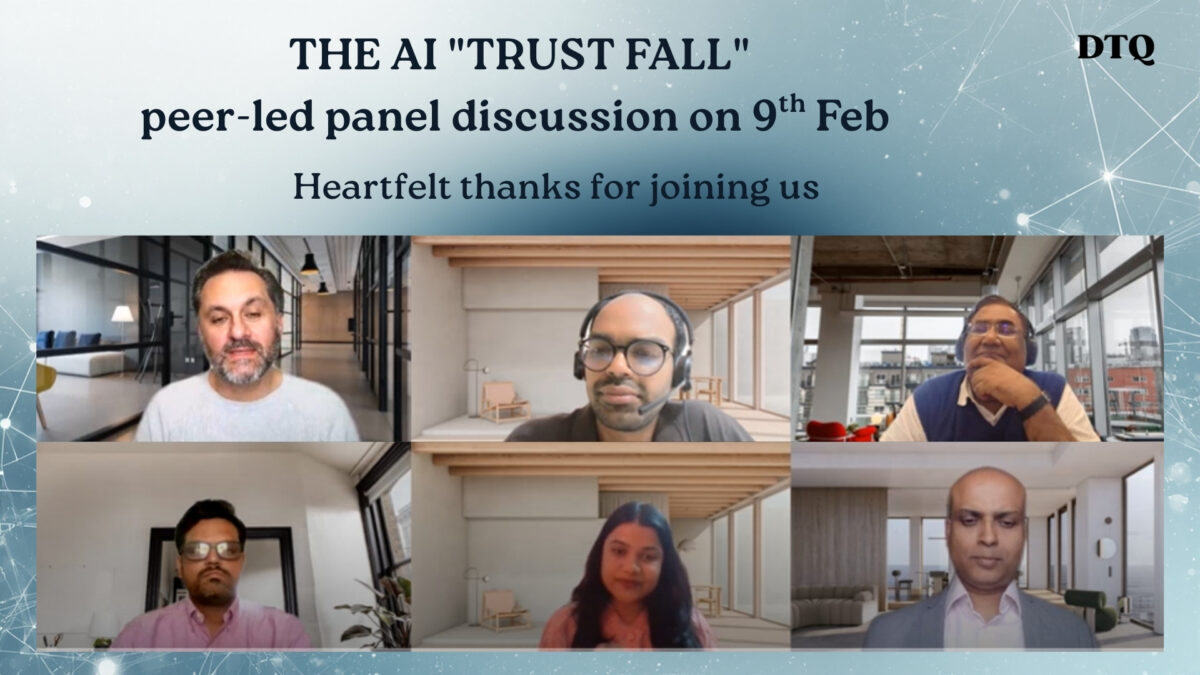
Data Trust Knowledge Session | February 9, 2026
Open Innovator organized a critical knowledge session on AI trust as systems transition from experimental tools to enterprise infrastructure. With tech giants leading trillion-dollar-plus investments in AI, the focus has shifted from model performance to governance, real-world decision-making, and managing a new category of risk: internal intelligence that can hallucinate facts, bypass traditional logic, and sound completely convincing. The session explored how to design systems, governance, and human oversight so that trust is earned, verified, and continuously managed across cybersecurity, telecom infrastructure, healthcare, and enterprise platforms.
Expert Panel
Vijay Banda – Chief Strategy Officer pioneering cognitive security, where monitors must monitor other monitors and validation layers become essential for AI-generated outputs.
Rajat Singh – Executive Vice President bringing telecommunications and 5G expertise where microsecond precision is non-negotiable and errors cascade globally.
Rahul Venkat – Senior Staff Scientist in AI and healthcare, architecting safety nets that leverage AI intelligence without compromising clinical accuracy.
Varij Saurabh – VP and Director of Products for Enterprise Search, with 15-20 years building platforms where probabilistic systems must deliver reliable business foundations.
Moderated by Rudy Shoushany, AI governance expert and founder of BCCM Management and TxDoc. Hosted by Data Trust, a community focused on data privacy, protection, and responsible AI governance.
Cognitive Security: The New Paradigm
Vijay declared that traditional security from 2020 is dead. The era of cognitive security has arrived like having a copilot monitor the pilot’s behavior, not just the plane’s systems. Security used to be deterministic with known anomalies; now it’s probabilistic and unpredictable. You can’t patch a hallucination like you patch a server.
Critical Requirements:
- Validation layers for all AI-generated content, cross-checked by another agent using golden sources of truth
- Human oversight checking if outputs are garbage in/garbage out, or worse-confidential data leakage
- Zero trust of data-never assume AI outputs are correct without verification
- Training AI systems on correct parameters, acceptable outputs, and inherent biases
The shift: These aren’t insider threats anymore, but probabilistic scenarios where data from AI engines gets used by employees without proper validation.
Telecom Precision: Layered Architecture for Zero Error
Rajat explained why the AI trust question has become urgent. Early social media was a separate dimension from real life. Now AI-generated content directly affects real lives-deepfakes, synthesized datasets submitted to governments, and critical infrastructure decisions.
The Telecom Solution: Upstream vs. Downstream
Systems are divided into two zones:
Upstream (Safe Zone): AI can freely find correlations, test hypotheses, and experiment without affecting live networks.
Downstream (Guarded Zone): Where changes affect physical networks. Only deterministic systems allowed-rule engines, policy makers, closed-loop automation, and mandatory human-in-the-loop.
Core Principle: Observation ≠ Decision ≠ Action. This separation embedded in architecture creates the first step toward near-zero error.
Additional safeguards include digital twins, policy engines, and keeping cognitive systems separate from deterministic ones. The key insight: zero error means zero learning. Managed errors within boundaries drive innovation.
Why Telecom Networks Rarely Crash: Layered architecture with what seems like too many layers but is actually the right amount, preventing cascading failures.
Healthcare: Knowledge Graphs and Moving Goalposts
Rahul acknowledged hallucination exists but noted we’re not yet at a stage of extreme worry. The issue: as AI answers more questions correctly, doctors will eventually start trusting it blindly like they trust traditional software. That’s when problems will emerge.
Healthcare Is Different from Code
You can’t test AI solutions on your body to see if they work. The costs of errors are catastrophically higher than software bugs. Doctors haven’t started extensively using AI for patient care because they don’t have 100% trust—yet.
The Knowledge Graph Moat
The competitive advantage isn’t ChatGPT or the AI model itself—it’s the curated knowledge graph that companies and institutions build as their foundation for accurate answers.
Technical Safeguards:
- Validation layers
- LLM-as-judge (another LLM checking if the first is lying)
- Multiple generation testing (hallucinations produce different explanations each time)
- Self-consistency checks
- Mechanistic interpretability (examining network layers)
The Continuous Challenge: The moment you publish a defense technique, AI finds a way to beat it. Like cybersecurity, this is a continuous process, not a one-time solution.
AI Beyond Human Capabilities
Rahul challenged the assumption that all ground truth must come from humans. DeepMind can invent drugs at speeds impossible for humans. AI-guided ultrasounds performed by untrained midwives in rural areas can provide gestational age assessments as accurately as trained professionals, bringing healthcare to underserved communities.
The pragmatic question for clinical-grade AI: Do benefits outweigh risks? Evaluation must go beyond gross statistics to ensure systems work on every subgroup, especially the most marginalized communities.
Enterprise Platforms: Living with Probabilistic Systems
Varij’s philosophy after 15-20 years building AI systems: You have to learn to live with the weakness. Accept that AI is probabilistic, not deterministic. Once you accept this reality, you automatically start thinking about problems where AI can still outperform humans.
The Accuracy Argument
When customers complained about system accuracy, the response was simple: If humans are 80% accurate and the AI system is 95% accurate, you’re still better off with AI.
Look for Scale Opportunities
Choose use cases where scale matters. If you can do 10 cases daily and AI enables 1,000 cases daily with better accuracy, the business value is transformative.
Reframe Problems to Create New Value
Example: Competitors used ethnographers with clipboards spending a week analyzing 6 hours of video for $100,000 reports. The AI solution used thousands of cameras processing video in real-time, integrated with transaction systems, showing complete shopping funnels for physical stores—value impossible with previous systems.
The Product Manager’s Transformed Role
Traditional PM workflow–write user stories, define expectations, create acceptance criteria, hand to testers–is breaking down.
The New Reality:
Model evaluations (evals) have moved from testers to product managers. PMs must now write 50-100 test cases as evaluations, knowing exactly what deserves 100% marks, before testing can begin.
Three Critical Pillars for Reliable Foundations:
1. Data Quality Pipelines – Monitor how data moves into systems, through embeddings, and retrieval processes. Without quality data in a timely manner, AI cannot provide reliable insights.
2. Prompt Engineering – Simply asking systems to use only verified links, not hallucinate, and depend on high-quality sources increases performance 10-15%. Grounding responses in provided data and requiring traceability are essential.
3. Observability and Traceability – If mistakes happen, you must trace where they started and how they reached endpoints. Companies are building LLM observation platforms that score outputs in real-time on completeness, accuracy, precision, and recall.
The shift from deterministic to probabilistic means defining what’s good enough for customers while balancing accuracy, timeliness, cost, and performance parameters.
Non-Negotiable Guardrails
Single Source of Truth – Enterprises must maintain authentic sources of truth with verification mechanisms before AI-generated data reaches employees. Critical elements include verification layers, single source of truth, and data lineage tracking to differentiate artificiality from fact.
NIST AI RMF + ISO 42001 – Start with NIST AI Risk Management Framework to tactically map risks and identify which need prioritizing. Then implement governance using ISO 42001 as the compliance backbone.
Architecture First, Not Model First – Success depends on layered architectures with clear trust boundaries, not on having the smartest AI model.
Success Factors for the Next 3-5 Years
The next decade won’t be won by making AI perfectly truthful. Success belongs to organizations with better system engineers who understand failure, leaders who design trust boundaries, and teams who treat AI as a junior genius rather than an oracle.
What Telecom Deploys: Not intelligence, but responsibility. AI’s role is to amplify human judgment, not replace it. Understanding this prevents operational chaos and enables practical implementation.
AI Will Always Generalize: It will always overfit narratives. Everyone uses ChatGPT or similar tools for context before important sessions—this will continue. Success depends on knowing exactly where AI must not be trusted and making wrong answers as harmless as possible.
The AGI Question and Investment Reality
Panel perspectives on AGI varied from already here in certain forms, to not caring because AI is just a tool, to being far from achieving Nobel Prize-winning scientist level intelligence despite handling mediocre middle-level tasks.
From an investment perspective, AGI timing matters critically for companies like OpenAI. With trillions in commitments to data centers and infrastructure, if AGI isn’t claimed by 2026-2027, a significant market correction is likely when demand fails to match massive supply buildout.
Key Takeaways
1. Cognitive Security Has Replaced Traditional Security – Validation layers, zero trust of AI data, and semantic telemetry are mandatory.
2. Separate Observation from Decision from Action – Layered architecture prevents errors from cascading into mission-critical systems.
3. Knowledge Graphs Are the Real Moat – In healthcare and critical domains, competitive advantage comes from curated knowledge, not the LLM.
4. Accept Probabilistic Reality – Design around AI being 95% accurate vs. humans at 80%, choosing use cases where AI’s scale advantages transform value.
5. PMs Now Own Evaluations – The testing function has moved to product managers who must define what’s good enough in a probabilistic world.
6. Human-in-the-Loop Is Non-Negotiable – Structured intervention at critical decision points, not just oversight.
7. Single Source of Truth – Authentic data sources with verification mechanisms before AI outputs reach employees.
8. Continuous Process, Not One-Time Fix – Like cybersecurity, AI trust requires ongoing vigilance as defenses and attacks evolve.
9. Responsibility Over Intelligence – Deploy systems designed for responsibility and amplifying human judgment, not autonomous decision-making.
10. Better System Engineers Win – Success belongs to those who understand where AI must not be trusted and design boundaries accordingly.
Conclusion
The session revealed a unified perspective: The question isn’t whether AI can be trusted absolutely, but how we architect systems where trust is earned through verification, maintained through continuous monitoring, and bounded by clear human authority.
From cognitive security frameworks to layered telecom architectures, from healthcare knowledge graphs to PM evaluation ownership, the message is consistent: Design for the reality that AI will make mistakes, then ensure those mistakes are caught before they cascade into catastrophic failures.
The AI trust fall isn’t about blindly falling backward hoping AI catches you. It’s about building safety nets first—validation layers, zero trust of data, single sources of truth, human-in-the-loop checkpoints, and organizational structures where responsibility always rests with humans who understand both the power and limitations of their AI tools.
Organizations that thrive won’t have the most advanced AI—they’ll have mastered responsible deployment, treating AI as the junior genius it is, not the oracle we might wish it to be.
This Data Trust Knowledge Session provided essential frameworks for building AI trust in mission-critical environments. Expert panel: Vijay Banda, Rajat Singh, Rahul Venkat, and Varij Saurabh. Moderated by Rudy Shoushany.