







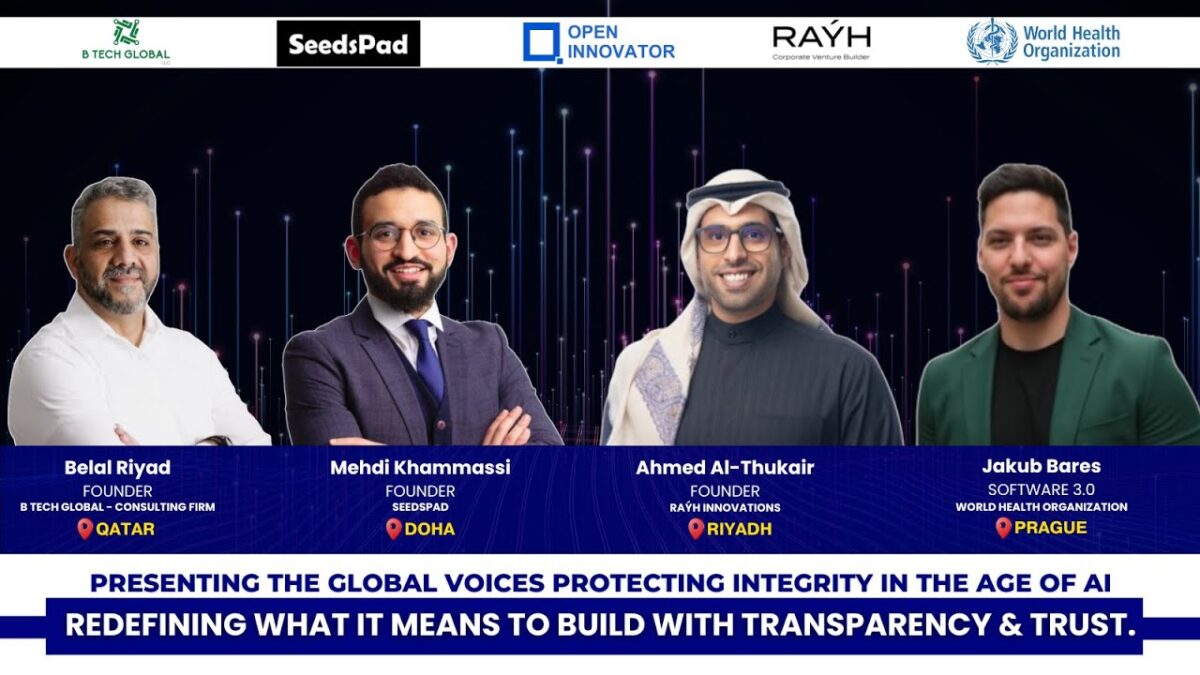
In a world where ChatGPT gained 100 million users in two months—a accomplishment that took the telephone 75 years—the importance of ethical technology has never been more pressing. Open Innovator on November 14th hosted a global panel on “Ethical AI: Ethics by Design,” bringing together experts from four continents for a 60-minute virtual conversation moderated by Naman Kothari of Nasscom. The panelists were Ahmed Al Tuqair from Riyadh, Mehdi Khammassi from Doha, Bilal Riyad from Qatar, Jakob Bares from WHO in Prague, and Apurv from the Bay Area. They discussed how ethics must grow with rapidly advancing AI systems and why shared accountability is now required for meaningful, safe technological advancement.
Ethics: Collective Responsibility in the AI Ecosystem
The discussion quickly established that ethics cannot be attributed to a single group; instead, founders, investors, designers, and policymakers build a collective accountability architecture. Ahmed stressed that ethics by design must start with ideation, not as a late-stage audit. Raya Innovations examines early enterprises based on both market fit and social effect, asking direct questions about bias, damage, and unintended consequences before any code is created. Mehdi developed this into three pillars: human-centricity, openness, and responsibility, stating that technology should remain a benefit for humans rather than a danger. Jakob added the algorithmic layer, which states that values must be testable requirements and architectural patterns. With the WHO implementing multiple AI technologies, identifying the human role in increasingly automated operations has become critical.
Structured Speed: Innovating Responsibly While Maintaining Momentum
Maintaining both speed and responsibility became a common topic. Ahmed proposed “structured speed,” in which quick, repeatable ethical assessments are integrated directly into agile development. These are not bureaucratic restrictions, but rather concise, practical prompts: what is the worst-case situation for misuse? Who might be excluded by the default options? Do partners adhere to key principles? The goal is to incorporate clear, non-negotiable principles into daily workflows rather than forming large committees. As a result, Ahmed claimed, ethics becomes a competitive advantage, allowing businesses to move rapidly and with purpose. Without such guidance, rapid innovation risks becoming disruptive noise. This narrative resonated with the panelists, emphasizing that prudent development can accelerate, rather than delay, long-term growth.
Cultural Contexts and Divergent Ethical Priorities
Mehdi demonstrated how ethics differs between cultural and economic environments. Individual privacy is a priority in Western Europe and North America, as evidenced by comprehensive consent procedures and rigorous regulatory frameworks. In contrast, many African and Asian regions prioritize collective stability and accessibility while functioning under less stringent regulatory control. Emerging markets frequently focus ethical discussions on inclusion and opportunity, whereas industrialized economies prioritize risk minimization. Despite these inequalities, Mehdi pushed for universal ethical principles, claiming that all people, regardless of place, need equal protection. He admitted, however, that inconsistent regulations result in dramatically different reality. This cultural lens highlighted that while ethics is internationally relevant, its local expression—and the issues connected with it—remain intensely context-dependent.
Enterprise Lessons: The High Costs of Ethical Oversights
Bilal highlighted stark lessons from enterprise organizations, where ethical failings have multimillion-dollar consequences. At Microsoft, retrofitting ethics into existing products resulted in enormous disruptions that could have been prevented with early design assessments. He outlined enterprise “tenant frameworks,” in which each feature is subject to sign-offs across privacy, security, accessibility, localization, and geopolitical domains—often with 12 or more reviews. When crises arise, these systems maintain customer trust while also providing legal defenses. Bilal used Google Glass as a cautionary tale: billions were lost because privacy and consent concerns were disregarded. He also mentioned Workday’s legal challenges over alleged employment bias. While established organizations can weather such storms, startups rarely can, making early ethical guardrails a requirement of survival rather than preference.
Public Health AI Designing for Integrity and Human Autonomy
Jakob provided a public-health viewpoint, highlighting how AI design decisions might harm millions. Following significant budget constraints, WHO’s most recent AI systems are aimed at enhancing internal procedures such as reporting and finance. In one donor-reporting tool, the team focused “epistemic integrity,” which ensures outputs are factual while protecting employee autonomy. Jakob warned against Goodhart’s Law, which involves overoptimizing a particular statistic at the detriment of overall value. They put in place protections to prevent surveillance overreach, automation bias, power inequalities, and data exploitation. Maintaining checks and balances across measures guarantees that efficiency gains do not compromise quality or hurt employees. His findings revealed that ethical deployment necessitates continual monitoring rather than one-time judgments, especially when AI replaces duties previously conducted by specialists.
Aurva’s Approach: Security and Observability in the Agentic AI Era
The panel then moved on to practical solutions, with Apurv introducing Aurva, an AI-powered data security copilot inspired by Meta’s post-Cambridge Analytica revisions. Aurva enables enterprises to identify where data is stored, who has access to it, and how it is used—which is crucial in contexts where information is scattered across multiple systems and providers. Its technologies detect misuse, restrict privilege creep, and give users visibility into AI agents, models, and permissions. Apurv contrasted between generative AI, which behaves like a maturing junior engineer, and agentic AI, which operates independently like a senior engineer making multi-step judgments. This autonomy necessitates supervision. Aurva serves 25 customers across different continents, with a strong focus on banking and healthcare, where AI-driven risks and regulatory needs are highest.
Actionable Next Steps and the Imperative for Ethical Mindsets
In conclusion, panelists provided concrete advice: begin with human-impact visibility, undertake early bias and harm evaluations, construct feedback loops, teach teams to acquire a shared ethical understanding, and implement observability tools for AI. Jakob underlined the importance of monitoring, while others stressed that ethics must be integrated into everyday decisions rather than marketing clichés. The virtual event ended with a unifying message: ethical AI is no longer optional. As agentic AI becomes more independent, early, preemptive frameworks protect both consumers and companies’ long-term viability.
Reach out to us at open-innovator@quotients.com or drop us a line to delve into the transformative potential of groundbreaking technologies and participate in our events. We’d love to explore the possibilities with you.