







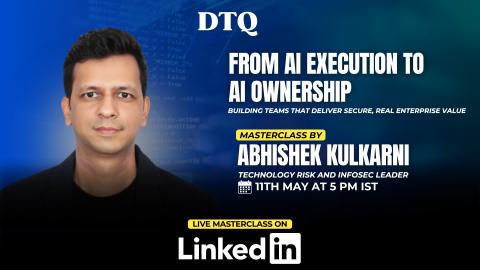
BEYOND THE COGNITIVE COPILOT: TECH LEADERS WARN OF AN ‘ILLUSION OF PROGRESS’ IN ENTERPRISE AI ADOPTION
DTQ convened a high‑impact masterclass to interrogate the state of enterprise AI adoption. The session, led by Abhishek Kulkarni (technology risk and InfoTech leader), challenged prevailing narratives of “success” in corporate AI programs. The purpose was to expose systemic blind spots and equip leaders with a governance‑driven roadmap for 2026.
As corporate investments in artificial intelligence accelerate, a critical systemic flaw is emerging within the enterprise landscape: organizations are mastering the art of AI execution, but completely failing at AI ownership.
During the virtual masterclass addressing the path to future-ready enterprise leadership, Abhishek Kulkarni, a prominent technology risk and InfoTech leader, challenged the current corporate obsession with rapid tool deployment. The central argument? While enterprises have successfully moved past basic capability doubts, they are stalling out at the Minimum Viable Product (MVP) stage because no one is taking structural accountability for the final business outcomes.
The Strategic Shift: From Running Engines to Steering Vessels
The tech risk expert highlighted that the era of treating AI as a mere sandbox experiment is officially over. Today’s boardrooms are no longer asking if a workflow can be automated—they are demanding to know who stands accountable when an automated workflow goes rogue.
The industry evolution is captured by a stark division between past execution milestones and current ownership obligations:
| Technical Execution Focus (The Engine) | Enterprise Ownership Mandate (The Steering Wheel) |
| Can AI automate this workflow? | Who are the definitive human end-users? |
| How fast can we launch an MVP? | What measurable business value is being created? |
| Which platform or copilot should we buy? | Who signs off on data decisions and model ethics? |
| How do we maximize productivity metrics? | How do we secure long-term enterprise equity? |
“Execution is the fuel, the speed, and the engine,” the speaker noted during the session. “But without defined accountability and outcome measurement, execution is just an aggressive, directionless expenditure of effort.”
Case Study: The Ghost in the Onboarding Machine
To anchor this problem in real-world stakes, a case study involving a recently deployed generative AI onboarding system was presented. On paper, the project was a resounding success—it significantly cut down customer transaction processing times and optimized data ingestion pipelines.
However, a structural compliance audit revealed an organizational vacuum:
- The Infrastructure: The technology development team claimed complete ownership of the underlying code and models.
- The Perimeter: The risk and cyber security teams took ownership of the deployment guardrails.
- The Consequences: When asked who structurally owned the actual business outputs and operational decisions made by the AI, the room went entirely silent.
This siloed approach exposes a dangerous corporate reality: technical teams are managing the tools, but no business entity is managing the outcomes.
Exposing the “Illusion of Progress”
The core takeaway of the briefing was the concept of the Illusion of Progress. High corporate activity, constant pilot program announcements, and widespread copilot usage often create a false sense of security. In reality, this technical velocity represents only the visible tip of an operational iceberg, concealing deep structural liabilities beneath the surface.
The Three Critical Fault Lines:
- The IT Ticket Fallacy: When an enterprise model behaves erratically, organizations treat it as a technical glitch by default, routing it to IT support. True ownership must belong to the functional business leader (e.g., the Head of Customer Onboarding) who relies on that system.
- The “Build vs. Buy” Escalation Void: Modern enterprises rarely build models from scratch; they fine-tune pre-existing third-party architectures. When a fine-tuned model exhibits unpredictable biases, corporations frequently lack any pre-defined legal or operational escalation framework to resolve the breakdown.
- Fragmented Corporate Silos: Responsibility is currently fractured. Tech teams own the deployment, product teams own the features, and support teams manage the fallout. Without a unified framework, holistic management of business value remains impossible.
The 2026 Action Plan for Leadership
To successfully convert AI execution into sustainable enterprise asset value, the briefing concluded with three mandatory directives for technology and operational leaders:
- Mandate Business-Side Product Owners: Stop assigning AI tools exclusively to IT. Every tool in production must have a designated business champion who is legally and operationally accountable for its outputs.
- Shift KPIs to Value Pools: Evaluate AI teams based on structural business outcomes (such as risk mitigation, customer retention, or cost reduction) rather than tool adoption metrics or engineering speed.
- Establish Cross-Functional Governance: Replace fragmented team silos with a unified decision governance framework that spans tech, security, legal, and operational leadership across the entire life cycle of the automated asset.
Conclusion
DTQ’s masterclass reframed AI adoption as a governance and accountability challenge. The warning was clear: without ownership, enterprises risk mistaking motion for progress. The path forward demands structural accountability, outcome‑driven KPIs, and unified governance to transform AI from a technical experiment into a sustainable enterprise asset.
Data Trust Quotients (DTQ) as a strategic ecosystem architect, bridges gaps between industry, startups, and investors. DTQ blends data privacy, governance, and cutting-edge AI to accelerate transformative breakthroughs in different domains.