




Categories
Enterprise Innovation

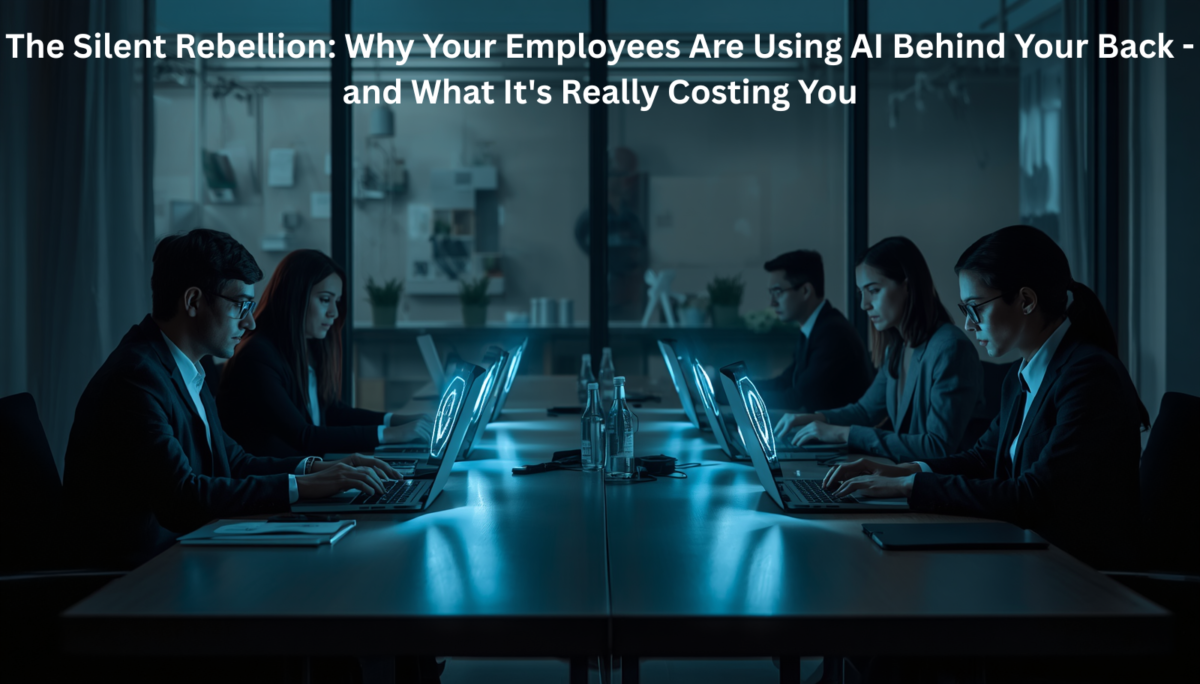
The Silent Rebellion: Why Your Employees Are Using AI Behind Your Back – and What It’s Really Costing You

Categories
Enterprise Innovation

The Silent Rebellion: Why Your Employees Are Using AI Behind Your Back – and What It’s Really Costing You

Every day, a silent uprising takes place on computers and in offices all across the world. A worker is in a hurry to fulfill a deadline. The company-approved tools are either locked behind a ticketing system, sluggish, or cumbersome. Thus, they launch a tab on their browser, enter some private information, and let an unapproved AI program do the rest. For now, the issue has been resolved. Shadow AI is changing the workplace in ways that most businesses have hardly had a chance to consider.

Shadow AI is not an isolated phenomena. It is the business equivalent of sending work files via a personal email account or utilizing a side spreadsheet when the official system is too complicated. Without the knowledge, consent, or supervision of IT or security teams, employees utilize internal or external AI technologies for job activities, such as chatbots, writing assistance, and code generators. Confidential strategy papers, proprietary code, customer information, and sensitive material are copied onto platforms that the business does not control, monitor, or regulate. What began as a productivity shortcut turns into an unseen parallel layer of AI use operating behind the formal architecture of the company.

Why it occurs?

The first step to dealing with Shadow AI honestly is to comprehend why it occurs. Malice is rarely the answer. Unsanctioned tools are used by employees because they are more effective and efficient than the alternatives. People make practical decisions when there are tight deadlines and authorized methods seem like barriers. A copywriter won’t wait three days for IT to whitelist a tool if they require a draft in thirty minutes. When troubleshooting production code at midnight, a developer will use whatever works. Most of the time, shadow AI is a sign of a malfunctioning internal system rather than a malfunctioning employee.

The Error Epidemic Nobody Is Talking About

However, this workaround culture has a higher human cost than it may seem. According to IBM research, 57% of workers say that AI has caused them to make mistakes, while 58% admit to accepting AI results without checking them. These are not isolated incidents; rather, they are common behavioral patterns that arise when individuals use technologies they do not fully comprehend in situations without supervision, direction, or responsibility. Workers are taking on personal danger in addition to organizational risk as they operate in a gray area where everyday pressure to meet deadlines collides with rules they are aware they are breaking.

Caught Between Productivity and Policy: The Stress Nobody Accounts For

In business discussions concerning AI governance, the stress factor is frequently disregarded. For employees dealing with unmanageable workloads, shadow AI often turns into a coping strategy or a pressure valve. However, the respite is fleeting. The underlying anxiousness worsens rather than goes away. Employees must balance two conflicting demands: being productive enough to maintain their position and remaining cooperative enough to avoid being dismissed for breaking a policy. When errors do ultimately come to light, and they do, people are held accountable rather than the instruments. One of the most damaging long-term consequences of unchecked AI deployment is this culture of dread and silent disengagement.

Serious regulatory repercussions:

The dangers increase quickly at the organizational level. Employees may be putting private information into systems regulated by completely different privacy conditions when they paste internal data into uncontrolled AI settings. There may be serious regulatory repercussions; GDPR, HIPAA, and industry-specific compliance standards are in place specifically to safeguard the type of data that frequently passes through Shadow AI networks. Beyond data exposure, AI-generated code poses other subtle risks, such as concealed licensing conflicts, security flaws, and technical debt that only shows up months later and is costly to resolve. And all of this is taking place while businesses pay for the problem twice: first for the dispersed, redundant AI tools that staff members are obtaining on their own, and again for incident cleanup.

Cultural effects may be the most detrimental long-term effect. Shadow AI increases the discrepancy between an organization’s stated values and reality on the ground. Governance loses credibility when practice and policy vary on a large scale. Because they can clearly see that the rules are habitually broken in order to complete tasks, employees cease taking compliance seriously. The leadership is no longer able to see how the task is being done. Employers and employees, businesses and their clients, and workers and the AI tools they use without supervision or training all see a decline in trust.

Blocking not the solution:

Blocking tools are not the solution, or at least they are insufficient. Instead of completely eradicating Shadow AI, organizations that just use prohibition tend to drive the practice more underground. Asking “why are employees reaching for unauthorized AI, and what would make the sanctioned alternative genuinely better?” rather than “how do we stop employees from using unauthorized AI,” is the most effective way to respond. A more effective set of treatments is made possible by that reframing. Compared to the shadow alternatives, approved AI solutions must be quicker, more powerful, and simpler to use. Employees will continue to circumvent the official choice if it takes three approval processes and yields subpar outcomes.

When guardrails and enablement are used in tandem, it truly works. Red lines, which are categories of data that must never leave sanctioned settings, such as customer records, source code, and confidential strategy, must be explicitly defined by organizations and communicated in plain language rather than policy-document verbiage. For higher-risk use cases, they require lightweight review procedures so that workers may complete tasks safely rather than covertly. Training is important, but only if it is useful. Employees must be aware of the dangers they are incurring as well as the safe options at their disposal. Culture matters most of all. AI governance works when employees see it as protection rather than punishment — when the organization’s position is “we want you to use AI well” rather than “we are watching for violations.”

Conclusion:

In the end, shadow AI is more of a trust issue than a technological one. Using the greatest resources at their disposal, employees are attempting to thrive inside their businesses rather than undermine them. Organizations that invest in making safe AI truly useful—fast enough to compete with shadow tools, governed enough to manage real risk, and human enough to account for the pressures workers actually face—will be the ones that successfully navigate the AI era rather than those with the strictest prohibition policies. It’s important to pay attention to the silent rebellion. The question is whether corporations will react with control or with something more intelligent: intentional trust-building, one controlled tool at a time.


Quotients is a platform for industry, innovators, and investors to build a competetive edge in this age of disruption. We work with our partners to meet this challenge of metamorphic shift that is taking place in the world of technology and businesses by focusing on key organisational quotients. Reach out to us at open-innovator@quotients.com.

Categories
DTQ Data Trust Quotients

Report: The Last Mile of AI- Why Governance and Trust Are the New ROI in 2026

Categories
DTQ Data Trust Quotients

Report: The Last Mile of AI- Why Governance and Trust Are the New ROI in 2026

The Evolution of the AI Narrative

In the initial gold rush of Generative AI, the global conversation was dominated by three pillars: speed, experimentation, and raw capability. Organizations raced to integrate Large Language Models (LLMs) into their workflows, driven by a “fear of missing out” and the allure of unprecedented productivity gains. However, as we move through 2026, the narrative has fundamentally shifted. The industry has reached a critical inflection point where the novelty of AI has worn off, replaced by a sobering realization of the complexities involved in actual production.

Ashwini Giri, a renowned Architect of Data Trust and Responsible AI, recently led a masterclass titled at DTQ “The Last Mile of AI.” The core question he posed to a room of executives and engineers was simple yet profound: How do we build and deploy AI systems that people can actually trust?

The “last mile” of AI deployment—the transition from a successful laboratory prototype to a reliable, live enterprise system—is where most real-world challenges surface. It is the bridge between a conceptual “cool tool” and a mission-critical business asset. In this virtual masterclass, Giri explored why the path to production is paved with governance, why trust has become the ultimate market differentiator, and how organizations must pivot to survive the transition from AI hype to AI responsibility.

Why Trust Matters: The New Corporate Frontier

We are currently operating under intense AI adoption pressure. Boardrooms, executive committees, and venture capitalists are no longer asking if AI should be integrated, but how fast it can happen. This pressure is driven by the hunt for Return on Investment (ROI). Yet, beneath the surface of this enthusiasm lies a deep-seated fear: the erosion of customer trust.

In the digital economy, trust is not an abstract virtue; it is a tangible asset. It is the differentiator that separates ordinary firms from “blue-chip” organizations. A blue-chip company isn’t defined just by its revenue, but by its reliability and the degree to which it safeguards customer data.

Data integrity serves as the bedrock of this trust. If an AI system hallucinates, leaks sensitive information, or makes biased decisions, the damage to the brand is often irreparable. As Giri notes, organizations are beginning to realize that while models are replaceable, the trust of a customer base, once lost, is nearly impossible to regain.

The Production Paradox: Why AI Projects Fail

To illustrate the gap between expectation and reality, Giri conducted an icebreaker poll asking: “Why do AI projects fail in production?” While many participants initially pointed toward technical hurdles like lack of compute power or poor model accuracy, the definitive answer was weak data quality and governance.

This is the production paradox: we spend millions on sophisticated algorithms, yet the systems fail because of the data they consume. Models are essentially mirrors; they reflect the quality of the input data. Without governance, there is no traceability, no accountability, and no ethical guardrail. Technical limitations are rarely the deal-breaker in 2026; rather, it is the lack of robust processes and oversight that causes projects to collapse at the finish line.

The Current Reality: A Landscape of Jittery Leaders

Despite the billions invested, the statistics regarding AI success remain startling. According to recent McKinsey reports, approximately 80% of AI programs fail to deliver their intended results.

These failures are not just academic; they carry a massive financial burden. Abandoned projects result in losses totaling millions of dollars, leaving ROI expectations unmet and shareholders frustrated. This has created what Giri describes as a “Trust Deficit.” Currently, only 30–35% of business leaders fully trust their data lineage. They lack clarity on:

  • Data Origin: Where did this information come from?
  • Data Flow: How has this data been transformed as it moved through our systems?
  • Integrity: Can we rely on this output to make a multi-million dollar decision?

This uncertainty has left leadership feeling tentative and “jittery.” When a leader cannot explain why an AI arrived at a specific conclusion, they are understandably hesitant to deploy it in high-stakes environments.

The Organizational Response: New Guardians of the Machine

To combat this deficit, a new corporate structure is emerging. We are seeing the rise of specialized leadership roles: the Chief AI Officer (CAIO) and the Chief Trust Officer (CTrO).

These roles are not merely bureaucratic additions; they are the guardians of the “last mile.” Their purpose is to:

  1. Establish Governance Frameworks: Implementing the “rules of the road” for how AI is developed and deployed.
  2. Safeguard Datasets: Ensuring that the fuel for the AI engine is clean, ethical, and legally compliant.
  3. Provide Board-Level Assurance: Translating technical AI metrics into business confidence.
  4. Enable Traceability: Creating systems where every AI-driven decision can be traced back to its source system.

Transparency is becoming a standard feature rather than an afterthought. For example, modern iterations of tools like Microsoft Copilot now prioritize showing the sources for generated responses. This “show your work” approach is essential for building confidence. When a user can see the citation, the AI moves from being a “black box” to a transparent partner.

Key Takeaways: Mastering the Last Mile

The masterclass concluded with several foundational insights that every modern organization must internalize:

  • Trust is the Differentiator: In a world where everyone has access to the same LLMs, the company that can prove its AI is safe and reliable will win the market.
  • The Bottleneck is Human, Not Technical: Data quality and governance are the real hurdles. Solving the math is easy; solving the data lineage is hard.
  • Failure is Visible: Unlike back-office software failures of the past, AI failure is often public and reputationally devastating.
  • Traceability is Mandatory: Board assurance cannot be based on “vibes” or general optimism; it must be based on a documented trail of data.

The “last mile” challenge is ultimately a shift in focus. It is not about how fast you can launch, but about how well you can govern.

Strategic Implications: A Roadmap for the Future

For organizations looking to bridge the gap between experimentation and safe deployment, Giri outlines a strategic roadmap focused on four key pillars:

1. Invest Heavily in Governance

Organizations must build frameworks that prioritize lineage and accountability. This means investing in tools that catalog data, track model versions, and monitor for bias in real-time. Governance should not be viewed as a “brake” on innovation, but as the seatbelt that allows the car to go faster safely.

2. Elevate the Roles of Trust

The Chief AI and Chief Trust Officers must have a seat at the table. They should be empowered to veto projects that do not meet ethical or data-quality standards. Their success should be measured by the organization’s resilience against AI-related risks.

3. Prioritize Data Integrity over Model Complexity

A simple model trained on pristine, high-quality data will almost always outperform a complex model trained on “garbage” data. The focus must shift from chasing the latest parameter counts to perfecting the internal data supply chain.

4. Cultivate a Cultural Shift

The organization must move from “AI Hype”—where the goal is simply to use AI—to “AI Responsibility.” This involves training employees not just on how to use prompts, but on how to critically evaluate AI outputs and understand the ethical implications of the technology.

5. Redefine Success Metrics

ROI remains important, but it is no longer the only metric. Organizations must include Trust Metrics and Governance Compliance in their KPIs. Success should be defined by how many stakeholders feel confident in the system, how transparent the decision-making process is, and how well the organization adheres to emerging global AI regulations.

Conclusion: Doing AI Right

The “last mile” of AI is arguably the most difficult part of the journey. It requires a transition from the creative, “break things” energy of a startup to the disciplined, “protect the asset” mindset of a mature enterprise. As Ashwini Giri emphasized, the goal isn’t just to do AI—it’s to do AI right. By prioritizing governance and trust today, organizations aren’t just protecting themselves from failure; they are building the foundation for the next decade of digital leadership. In 2026 and beyond, the fastest way to the finish line is a safe, governed, and transparent path.

Data Trust Quotients (DTQ) as a strategic ecosystem architect, bridges gaps between industry, startups, and investors. DTQ blends data privacy, governance, and cutting-edge AI to accelerate transformative breakthroughs in different domains.