



Categories
Data Trust Quotients DTQ Visibility Quotient

The AI Trust Fall: Building Confidence in an Era of Hallucination

Categories
Data Trust Quotients DTQ Visibility Quotient

The AI Trust Fall: Building Confidence in an Era of Hallucination

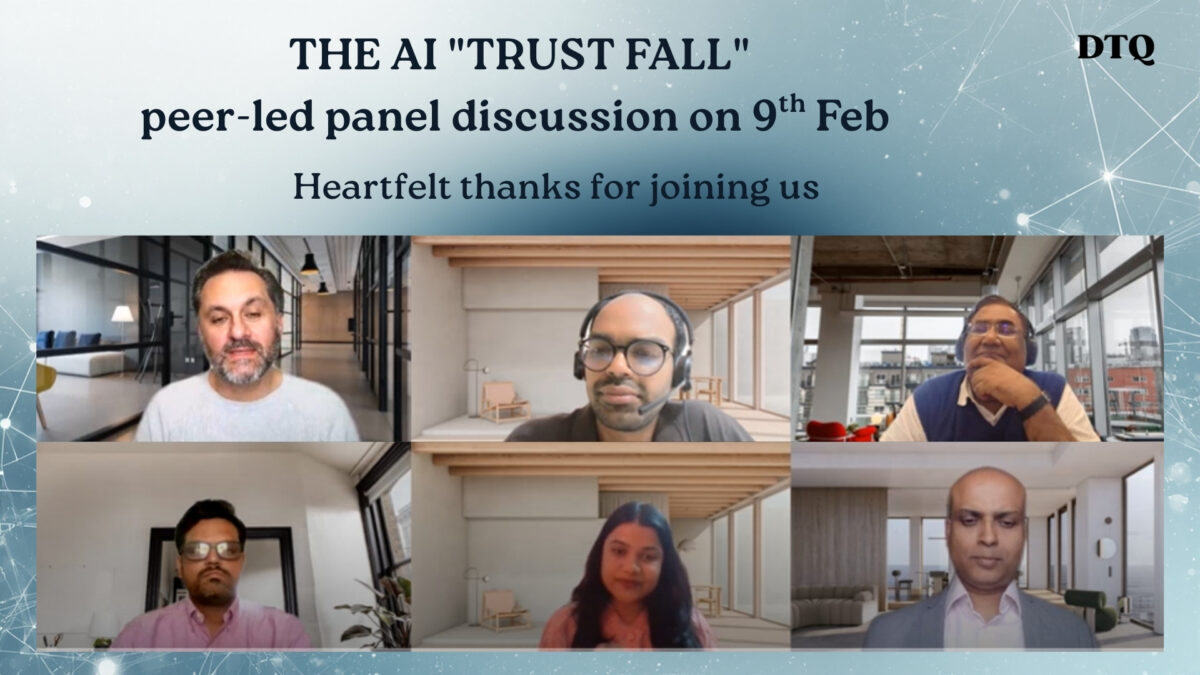
Data Trust Knowledge Session | February 9, 2026

Open Innovator organized a critical knowledge session on AI trust as systems transition from experimental tools to enterprise infrastructure. With tech giants leading trillion-dollar-plus investments in AI, the focus has shifted from model performance to governance, real-world decision-making, and managing a new category of risk: internal intelligence that can hallucinate facts, bypass traditional logic, and sound completely convincing. The session explored how to design systems, governance, and human oversight so that trust is earned, verified, and continuously managed across cybersecurity, telecom infrastructure, healthcare, and enterprise platforms.

Expert Panel

Vijay Banda – Chief Strategy Officer pioneering cognitive security, where monitors must monitor other monitors and validation layers become essential for AI-generated outputs.

Rajat Singh – Executive Vice President bringing telecommunications and 5G expertise where microsecond precision is non-negotiable and errors cascade globally.

Rahul Venkat – Senior Staff Scientist in AI and healthcare, architecting safety nets that leverage AI intelligence without compromising clinical accuracy.

Varij Saurabh – VP and Director of Products for Enterprise Search, with 15-20 years building platforms where probabilistic systems must deliver reliable business foundations.

Moderated by Rudy Shoushany, AI governance expert and founder of BCCM Management and TxDoc. Hosted by Data Trust, a community focused on data privacy, protection, and responsible AI governance.

Cognitive Security: The New Paradigm

Vijay declared that traditional security from 2020 is dead. The era of cognitive security has arrived like having a copilot monitor the pilot’s behavior, not just the plane’s systems. Security used to be deterministic with known anomalies; now it’s probabilistic and unpredictable. You can’t patch a hallucination like you patch a server.

Critical Requirements:

  • Validation layers for all AI-generated content, cross-checked by another agent using golden sources of truth
  • Human oversight checking if outputs are garbage in/garbage out, or worse-confidential data leakage
  • Zero trust of data-never assume AI outputs are correct without verification
  • Training AI systems on correct parameters, acceptable outputs, and inherent biases

The shift: These aren’t insider threats anymore, but probabilistic scenarios where data from AI engines gets used by employees without proper validation.

Telecom Precision: Layered Architecture for Zero Error

Rajat explained why the AI trust question has become urgent. Early social media was a separate dimension from real life. Now AI-generated content directly affects real lives-deepfakes, synthesized datasets submitted to governments, and critical infrastructure decisions.

The Telecom Solution: Upstream vs. Downstream

Systems are divided into two zones:

Upstream (Safe Zone): AI can freely find correlations, test hypotheses, and experiment without affecting live networks.

Downstream (Guarded Zone): Where changes affect physical networks. Only deterministic systems allowed-rule engines, policy makers, closed-loop automation, and mandatory human-in-the-loop.

Core Principle: Observation ≠ Decision ≠ Action. This separation embedded in architecture creates the first step toward near-zero error.

Additional safeguards include digital twins, policy engines, and keeping cognitive systems separate from deterministic ones. The key insight: zero error means zero learning. Managed errors within boundaries drive innovation.

Why Telecom Networks Rarely Crash: Layered architecture with what seems like too many layers but is actually the right amount, preventing cascading failures.

Healthcare: Knowledge Graphs and Moving Goalposts

Rahul acknowledged hallucination exists but noted we’re not yet at a stage of extreme worry. The issue: as AI answers more questions correctly, doctors will eventually start trusting it blindly like they trust traditional software. That’s when problems will emerge.

Healthcare Is Different from Code

You can’t test AI solutions on your body to see if they work. The costs of errors are catastrophically higher than software bugs. Doctors haven’t started extensively using AI for patient care because they don’t have 100% trust—yet.

The Knowledge Graph Moat

The competitive advantage isn’t ChatGPT or the AI model itself—it’s the curated knowledge graph that companies and institutions build as their foundation for accurate answers.

Technical Safeguards:

  • Validation layers
  • LLM-as-judge (another LLM checking if the first is lying)
  • Multiple generation testing (hallucinations produce different explanations each time)
  • Self-consistency checks
  • Mechanistic interpretability (examining network layers)

The Continuous Challenge: The moment you publish a defense technique, AI finds a way to beat it. Like cybersecurity, this is a continuous process, not a one-time solution.

AI Beyond Human Capabilities

Rahul challenged the assumption that all ground truth must come from humans. DeepMind can invent drugs at speeds impossible for humans. AI-guided ultrasounds performed by untrained midwives in rural areas can provide gestational age assessments as accurately as trained professionals, bringing healthcare to underserved communities.

The pragmatic question for clinical-grade AI: Do benefits outweigh risks? Evaluation must go beyond gross statistics to ensure systems work on every subgroup, especially the most marginalized communities.

Enterprise Platforms: Living with Probabilistic Systems

Varij’s philosophy after 15-20 years building AI systems: You have to learn to live with the weakness. Accept that AI is probabilistic, not deterministic. Once you accept this reality, you automatically start thinking about problems where AI can still outperform humans.

The Accuracy Argument

When customers complained about system accuracy, the response was simple: If humans are 80% accurate and the AI system is 95% accurate, you’re still better off with AI.

Look for Scale Opportunities

Choose use cases where scale matters. If you can do 10 cases daily and AI enables 1,000 cases daily with better accuracy, the business value is transformative.

Reframe Problems to Create New Value

Example: Competitors used ethnographers with clipboards spending a week analyzing 6 hours of video for $100,000 reports. The AI solution used thousands of cameras processing video in real-time, integrated with transaction systems, showing complete shopping funnels for physical stores—value impossible with previous systems.

The Product Manager’s Transformed Role

Traditional PM workflow–write user stories, define expectations, create acceptance criteria, hand to testers–is breaking down.

The New Reality:

Model evaluations (evals) have moved from testers to product managers. PMs must now write 50-100 test cases as evaluations, knowing exactly what deserves 100% marks, before testing can begin.

Three Critical Pillars for Reliable Foundations:

1. Data Quality Pipelines – Monitor how data moves into systems, through embeddings, and retrieval processes. Without quality data in a timely manner, AI cannot provide reliable insights.

2. Prompt Engineering – Simply asking systems to use only verified links, not hallucinate, and depend on high-quality sources increases performance 10-15%. Grounding responses in provided data and requiring traceability are essential.

3. Observability and Traceability – If mistakes happen, you must trace where they started and how they reached endpoints. Companies are building LLM observation platforms that score outputs in real-time on completeness, accuracy, precision, and recall.

The shift from deterministic to probabilistic means defining what’s good enough for customers while balancing accuracy, timeliness, cost, and performance parameters.

Non-Negotiable Guardrails

Single Source of Truth – Enterprises must maintain authentic sources of truth with verification mechanisms before AI-generated data reaches employees. Critical elements include verification layers, single source of truth, and data lineage tracking to differentiate artificiality from fact.

NIST AI RMF + ISO 42001 – Start with NIST AI Risk Management Framework to tactically map risks and identify which need prioritizing. Then implement governance using ISO 42001 as the compliance backbone.

Architecture First, Not Model First – Success depends on layered architectures with clear trust boundaries, not on having the smartest AI model.

Success Factors for the Next 3-5 Years

The next decade won’t be won by making AI perfectly truthful. Success belongs to organizations with better system engineers who understand failure, leaders who design trust boundaries, and teams who treat AI as a junior genius rather than an oracle.

What Telecom Deploys: Not intelligence, but responsibility. AI’s role is to amplify human judgment, not replace it. Understanding this prevents operational chaos and enables practical implementation.

AI Will Always Generalize: It will always overfit narratives. Everyone uses ChatGPT or similar tools for context before important sessions—this will continue. Success depends on knowing exactly where AI must not be trusted and making wrong answers as harmless as possible.

The AGI Question and Investment Reality

Panel perspectives on AGI varied from already here in certain forms, to not caring because AI is just a tool, to being far from achieving Nobel Prize-winning scientist level intelligence despite handling mediocre middle-level tasks.

From an investment perspective, AGI timing matters critically for companies like OpenAI. With trillions in commitments to data centers and infrastructure, if AGI isn’t claimed by 2026-2027, a significant market correction is likely when demand fails to match massive supply buildout.

Key Takeaways

1. Cognitive Security Has Replaced Traditional Security – Validation layers, zero trust of AI data, and semantic telemetry are mandatory.

2. Separate Observation from Decision from Action – Layered architecture prevents errors from cascading into mission-critical systems.

3. Knowledge Graphs Are the Real Moat – In healthcare and critical domains, competitive advantage comes from curated knowledge, not the LLM.

4. Accept Probabilistic Reality – Design around AI being 95% accurate vs. humans at 80%, choosing use cases where AI’s scale advantages transform value.

5. PMs Now Own Evaluations – The testing function has moved to product managers who must define what’s good enough in a probabilistic world.

6. Human-in-the-Loop Is Non-Negotiable – Structured intervention at critical decision points, not just oversight.

7. Single Source of Truth – Authentic data sources with verification mechanisms before AI outputs reach employees.

8. Continuous Process, Not One-Time Fix – Like cybersecurity, AI trust requires ongoing vigilance as defenses and attacks evolve.

9. Responsibility Over Intelligence – Deploy systems designed for responsibility and amplifying human judgment, not autonomous decision-making.

10. Better System Engineers Win – Success belongs to those who understand where AI must not be trusted and design boundaries accordingly.

Conclusion

The session revealed a unified perspective: The question isn’t whether AI can be trusted absolutely, but how we architect systems where trust is earned through verification, maintained through continuous monitoring, and bounded by clear human authority.

From cognitive security frameworks to layered telecom architectures, from healthcare knowledge graphs to PM evaluation ownership, the message is consistent: Design for the reality that AI will make mistakes, then ensure those mistakes are caught before they cascade into catastrophic failures.

The AI trust fall isn’t about blindly falling backward hoping AI catches you. It’s about building safety nets first—validation layers, zero trust of data, single sources of truth, human-in-the-loop checkpoints, and organizational structures where responsibility always rests with humans who understand both the power and limitations of their AI tools.

Organizations that thrive won’t have the most advanced AI—they’ll have mastered responsible deployment, treating AI as the junior genius it is, not the oracle we might wish it to be.


This Data Trust Knowledge Session provided essential frameworks for building AI trust in mission-critical environments. Expert panel: Vijay Banda, Rajat Singh, Rahul Venkat, and Varij Saurabh. Moderated by Rudy Shoushany.


Categories
DTQ Data Trust Quotients

Privacy, Security, and the New AI Frontier

Categories
DTQ Data Trust Quotients

Privacy, Security, and the New AI Frontier

Understanding AI Agents in Today’s World

Artificial Intelligence agents are software systems designed to act independently, make decisions, and interact with humans or other machines. They learn, adapt, and react to changing circumstances instead of merely following predetermined instructions like traditional algorithms do. Because of their independence, they are effective instruments in a variety of fields, including finance and healthcare. But it also raises serious questions about their security and handling of sensitive data. Understanding how AI agents affect security and privacy is now crucial for fostering trust and guaranteeing safe adoption as they grow more prevalent in homes and workplaces.

Large volumes of data are frequently necessary for AI agents to operate efficiently. Based on the data they process, they identify trends, forecast results, and offer suggestions. Personal information, financial records, or even proprietary business plans can be included in this data. They are helpful because of this, but there are risks as well. Malicious actors may be able to access the data stored in an agent if it is compromised. The difficulty is striking a balance between the advantages of AI agents and the obligation to safeguard the data they utilize. Their potential might easily become a liability in the absence of robust safeguards.

The emergence of AI agents also alters how businesses view technology. Network and device protection used to be the primary focus of security. It now has to include intelligent systems that represent people. These agents have the ability to manage physical equipment, make purchases, and access many platforms. Attackers may utilize them to do damage if they are not well secured. This change necessitates new approaches that include security and privacy into AI agents’ design from the start rather than adding them as an afterthought.

Security Challenges in the Age of AI

The unpredictability of AI agents is one of their main problems. Their behavior is not always predictable due to their capacity for learning and adaptation. Because of this, it is more difficult to create security systems that can foresee every eventuality. For instance, while attempting to increase efficiency, an agent trained to optimize corporate operations may inadvertently reveal private information. These dangers emphasize the necessity of ongoing oversight and stringent restrictions on what agents are permitted to accomplish. Security needs to change to address both known and unknown threats.

The increased attack surface is another issue. AI agents frequently establish connections with a variety of systems, including databases and cloud services. Every connection is a possible point of entry for hackers. The entire network of interactions may be jeopardized if one system is weak. Hackers may directly target agents, deceiving them into disclosing information or carrying out illegal activities. Because AI agents are interconnected, firewalls and other conventional security measures are insufficient. Organizations need to implement multi-layered defenses that track each encounter and confirm each agent action.

Access control and identity are also crucial. Strong identification frameworks are necessary for AI agents, just as humans need passwords and permits. Without them, it becomes challenging to determine which agent is carrying out which task or whether an agent has been taken over. Giving agents distinct identities promotes accountability and facilitates activity monitoring. When used in conjunction with audit trails, this method enables organizations to promptly identify questionable activity. In the agentic age, machines also have identities.

Privacy Concerns and Safeguards

A significant concern with AI agents is privacy. These systems frequently handle personal data, including shopping habits and medical records. Inadequate handling of this data may result in privacy rights being violated. An agent that makes treatment recommendations, for instance, might require access to private medical information. This information could be exploited or shared without permission if appropriate precautions aren’t in place. Ensuring that agents only gather and utilize the minimal amount of data required for their duties is essential to protecting privacy.

Building trust is mostly dependent on transparency. Users need to be aware of the data that agents are accessing, how they are using it, and whether they are sharing it with outside parties. People are more at ease with AI agents when there is clear communication. Additionally, it enables them to decide intelligently whether to permit particular behaviors. In addition to being required by law under rules like GDPR, transparency is a useful strategy to guarantee that users maintain control over their data.

Control and consent are equally crucial. People ought to be able to choose whether or not to share their data with AI agents. Additionally, they must to be able to modify parameters to restrict an agent’s access. A financial agent might, for instance, be permitted to examine expenditure trends but not access complete bank account information. Giving users control guarantees that agents work within the bounds established by the clients they serve and that privacy is protected. Every AI system needs to incorporate this privacy-by-design concept.

Balancing Innovation with Responsibility

Organizations face the difficulty of striking a balance between innovation and accountability. AI agents have a great deal of promise to enhance client experiences, decision-making, and efficiency. However, they might also produce hazards that outweigh their advantages if appropriate precautions aren’t taken. Businesses need to develop a perspective that views security and privacy as facilitators of trust rather than barriers. They may unleash innovation while retaining user credibility by creating agents that are safe and considerate of privacy.

One of the best practices is to incorporate security into the design process instead of leaving it as an afterthought. This entails incorporating safeguards into an agent’s architecture and taking possible hazards into account before deploying it. Layered protections, ongoing monitoring, and robust identity systems are crucial. Simultaneously, data minimization, anonymization, and openness must be prioritized in order to protect privacy. When taken as a whole, these steps lay the groundwork for AI agents to function in a responsible and safe manner.

Another important component is education. The dangers of AI agents and the precautions taken must be understood by both users and developers. A safer ecosystem can be achieved by educating users about their rights, instructing developers to integrate privacy-by-design, and training staff to spot suspicious activity. Raising awareness guarantees that everyone contributes to safeguarding security and privacy. In the end, people who utilize and oversee AI bots are just as important as the technology itself.

Building a Trustworthy Future

Trust is essential to the future of AI agents. Adoption will increase if users think that their data is secure and if agents behave appropriately. However, trust will crumble if privacy abuses or security breaches become widespread. Because of this, it is crucial that organizations, authorities, and developers collaborate to build frameworks and standards that guarantee safety. Governments and businesses working together can create regulations that safeguard people while fostering innovation.

An essential component of this future is governance. The design, deployment, and monitoring of agents must be outlined in explicit policies. Legal foundations are provided by laws like India’s DPDP Act and Europe’s GDPR, but enterprises need to do more than just comply. They must embrace moral values that put user rights and the welfare of society first. AI agents are a force for good rather than a source of danger because governance guarantees responsibility and guards against abuse.

In the end, AI agents signify a new technological era in which machines intervene on behalf of people in challenging situations. We must include security and privacy into every facet of its use and design if we are to succeed in this era. By doing this, we can maximize their potential and steer clear of their dangers. The way forward is obvious: responsibility and creativity must coexist. AI agents won’t be able to genuinely become dependable partners in our digital lives until then.

Reach out to us at open-innovator@quotients.com or drop us a line to delve into the transformative potential of groundbreaking technologies. We’d love to explore the possibilities with you

Categories
Events

Ethics by Design: Global Leaders Convene to Address AI’s Moral Imperative

Categories
Events

Ethics by Design: Global Leaders Convene to Address AI’s Moral Imperative

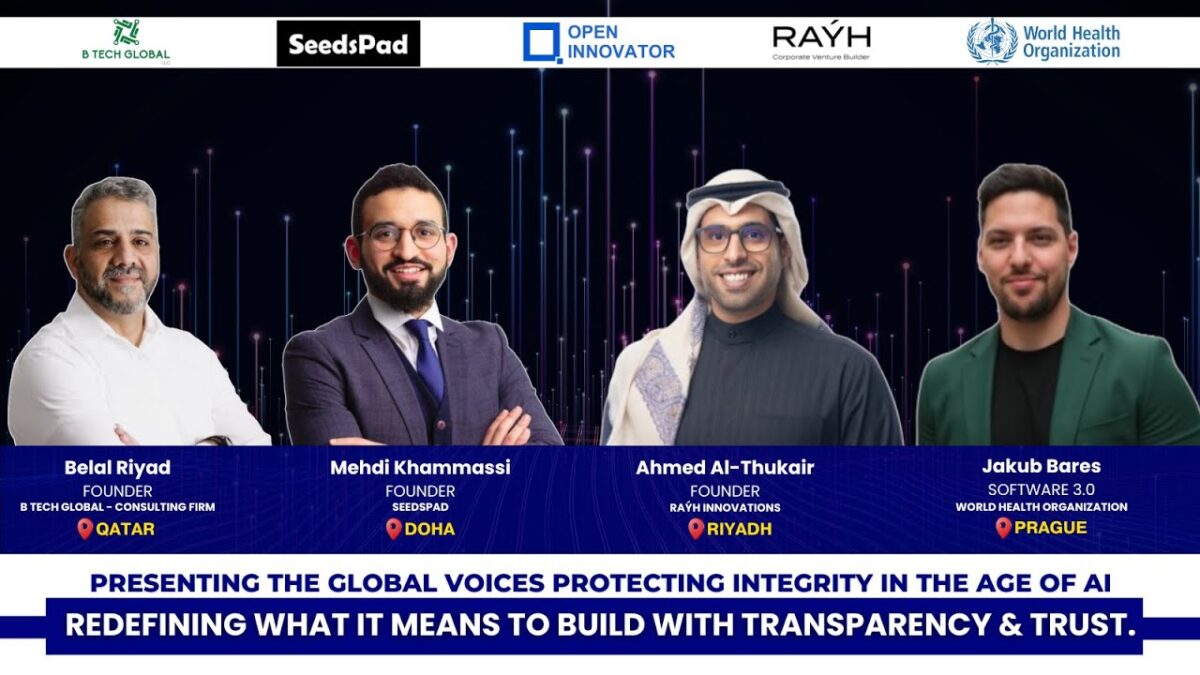
In a world where ChatGPT gained 100 million users in two months—a accomplishment that took the telephone 75 years—the importance of ethical technology has never been more pressing. Open Innovator on November 14th hosted a global panel on “Ethical AI: Ethics by Design,” bringing together experts from four continents for a 60-minute virtual conversation moderated by Naman Kothari of Nasscom. The panelists were Ahmed Al Tuqair from Riyadh, Mehdi Khammassi from Doha, Bilal Riyad from Qatar, Jakob Bares from WHO in Prague, and Apurv from the Bay Area. They discussed how ethics must grow with rapidly advancing AI systems and why shared accountability is now required for meaningful, safe technological advancement.

Ethics: Collective Responsibility in the AI Ecosystem

The discussion quickly established that ethics cannot be attributed to a single group; instead, founders, investors, designers, and policymakers build a collective accountability architecture. Ahmed stressed that ethics by design must start with ideation, not as a late-stage audit. Raya Innovations examines early enterprises based on both market fit and social effect, asking direct questions about bias, damage, and unintended consequences before any code is created. Mehdi developed this into three pillars: human-centricity, openness, and responsibility, stating that technology should remain a benefit for humans rather than a danger. Jakob added the algorithmic layer, which states that values must be testable requirements and architectural patterns. With the WHO implementing multiple AI technologies, identifying the human role in increasingly automated operations has become critical.

Structured Speed: Innovating Responsibly While Maintaining Momentum

Maintaining both speed and responsibility became a common topic. Ahmed proposed “structured speed,” in which quick, repeatable ethical assessments are integrated directly into agile development. These are not bureaucratic restrictions, but rather concise, practical prompts: what is the worst-case situation for misuse? Who might be excluded by the default options? Do partners adhere to key principles? The goal is to incorporate clear, non-negotiable principles into daily workflows rather than forming large committees. As a result, Ahmed claimed, ethics becomes a competitive advantage, allowing businesses to move rapidly and with purpose. Without such guidance, rapid innovation risks becoming disruptive noise. This narrative resonated with the panelists, emphasizing that prudent development can accelerate, rather than delay, long-term growth.

Cultural Contexts and Divergent Ethical Priorities

Mehdi demonstrated how ethics differs between cultural and economic environments. Individual privacy is a priority in Western Europe and North America, as evidenced by comprehensive consent procedures and rigorous regulatory frameworks. In contrast, many African and Asian regions prioritize collective stability and accessibility while functioning under less stringent regulatory control. Emerging markets frequently focus ethical discussions on inclusion and opportunity, whereas industrialized economies prioritize risk minimization. Despite these inequalities, Mehdi pushed for universal ethical principles, claiming that all people, regardless of place, need equal protection. He admitted, however, that inconsistent regulations result in dramatically different reality. This cultural lens highlighted that while ethics is internationally relevant, its local expression—and the issues connected with it—remain intensely context-dependent.

Enterprise Lessons: The High Costs of Ethical Oversights

Bilal highlighted stark lessons from enterprise organizations, where ethical failings have multimillion-dollar consequences. At Microsoft, retrofitting ethics into existing products resulted in enormous disruptions that could have been prevented with early design assessments. He outlined enterprise “tenant frameworks,” in which each feature is subject to sign-offs across privacy, security, accessibility, localization, and geopolitical domains—often with 12 or more reviews. When crises arise, these systems maintain customer trust while also providing legal defenses. Bilal used Google Glass as a cautionary tale: billions were lost because privacy and consent concerns were disregarded. He also mentioned Workday’s legal challenges over alleged employment bias. While established organizations can weather such storms, startups rarely can, making early ethical guardrails a requirement of survival rather than preference.

Public Health AI Designing for Integrity and Human Autonomy

Jakob provided a public-health viewpoint, highlighting how AI design decisions might harm millions. Following significant budget constraints, WHO’s most recent AI systems are aimed at enhancing internal procedures such as reporting and finance. In one donor-reporting tool, the team focused “epistemic integrity,” which ensures outputs are factual while protecting employee autonomy. Jakob warned against Goodhart’s Law, which involves overoptimizing a particular statistic at the detriment of overall value. They put in place protections to prevent surveillance overreach, automation bias, power inequalities, and data exploitation. Maintaining checks and balances across measures guarantees that efficiency gains do not compromise quality or hurt employees. His findings revealed that ethical deployment necessitates continual monitoring rather than one-time judgments, especially when AI replaces duties previously conducted by specialists.

Aurva’s Approach: Security and Observability in the Agentic AI Era

The panel then moved on to practical solutions, with Apurv introducing Aurva, an AI-powered data security copilot inspired by Meta’s post-Cambridge Analytica revisions. Aurva enables enterprises to identify where data is stored, who has access to it, and how it is used—which is crucial in contexts where information is scattered across multiple systems and providers. Its technologies detect misuse, restrict privilege creep, and give users visibility into AI agents, models, and permissions. Apurv contrasted between generative AI, which behaves like a maturing junior engineer, and agentic AI, which operates independently like a senior engineer making multi-step judgments. This autonomy necessitates supervision. Aurva serves 25 customers across different continents, with a strong focus on banking and healthcare, where AI-driven risks and regulatory needs are highest.

Actionable Next Steps and the Imperative for Ethical Mindsets

In conclusion, panelists provided concrete advice: begin with human-impact visibility, undertake early bias and harm evaluations, construct feedback loops, teach teams to acquire a shared ethical understanding, and implement observability tools for AI. Jakob underlined the importance of monitoring, while others stressed that ethics must be integrated into everyday decisions rather than marketing clichés. The virtual event ended with a unifying message: ethical AI is no longer optional. As agentic AI becomes more independent, early, preemptive frameworks protect both consumers and companies’ long-term viability.

Reach out to us at open-innovator@quotients.com or drop us a line to delve into the transformative potential of groundbreaking technologies and participate in our events. We’d love to explore the possibilities with you.