







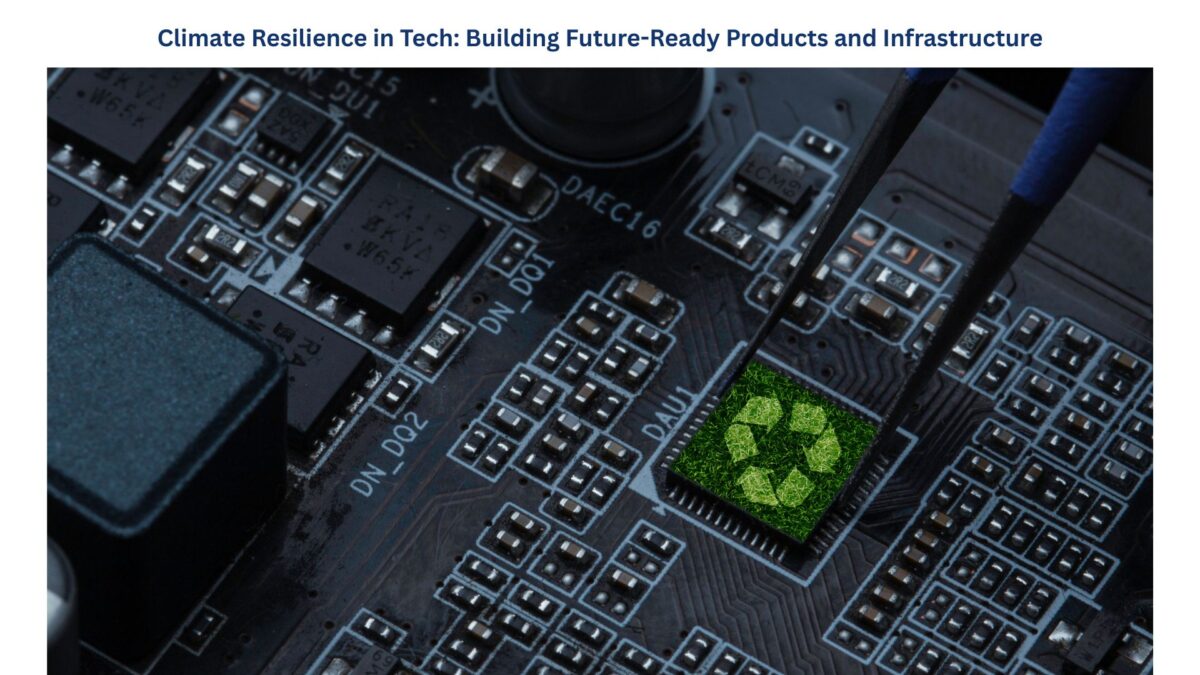
The technological environment is changing due to climate change, which is making businesses reevaluate how they develop, manufacture, and implement products and services.
Climate resilience has gone from being a nice-to-have feature to a business-critical capacity as extreme weather events increase in frequency and environmental rules tighten internationally. The market for climate resilience technologies is expected to grow to $100 billion USD over the next ten years, however financing for these technologies is declining as investors want scalable, tested solutions.
Building infrastructure and products that can endure environmental upheavals while minimizing their own environmental effect is what technology businesses mean by climate resilience. Integration between supply chain management, business strategy, software architecture, and hardware design is necessary for an all-encompassing approach.
Understanding Climate-Resilient Technology Architecture
Multiple layers make up the architecture of contemporary climate-resilient technology, each of which is built to resist and adapt to environmental conditions. This translates to distributed systems architecture at the infrastructure level that can continue to operate even in the face of climate-related disturbances to individual components. While edge computing lessens reliance on centralized data centers susceptible to severe weather, cloud computing platforms are increasingly utilizing regional redundancy particularly to avoid climatic risk zones.
Adaptive algorithms that can react dynamically to shifting environmental variables are included into software design for climate resilience. When the supply of renewable energy varies or when severe weather jeopardizes the stability of infrastructure, these systems automatically adapt resource distribution based on real-time climatic data. Here, artificial intelligence (AI)-driven optimization becomes essential, allowing for anticipatory reactions to climatic events before they affect system efficiency.
In response to rising temperatures, more humidity, and an increase in the frequency of extreme weather occurrences, hardware design has changed. This entails the development of sophisticated cooling systems, the use of materials resistant to corrosion for coastal deployments, and the creation of modular designs that provide quick field repairs in the event that equipment is damaged by climatic events. While modern materials can survive environmental conditions that older components cannot, energy-efficient processors minimize heat emission.
Real-time environmental monitoring is made possible by the integration of Internet of Things (IoT) sensors across infrastructure. This allows systems to automatically modify operations in response to temperature, humidity, air quality, and other climatic conditions. As a result, technological ecosystems become self-adapting and continue to function even when the environment changes.
Navigating Supply Chain Disruptions and Material Sourcing
Critical vulnerabilities in global technology supply chains have been revealed by climate change, especially in rare earth mining that is impacted by extreme weather and semiconductor production that is concentrated in areas that are prone to typhoons. In response, top IT firms are implementing complex supply chain diversification plans that distribute risk among several suppliers and climatic zones.
Resilient supply chains are increasingly based on the concepts of the circular economy. Closed-loop recycling initiatives have been put in place by some businesses which lessen reliance on virgin resources while establishing more stable supply chains. This strategy protects against mining and extraction interruptions brought on by climate change while simultaneously lessening the impact on the environment.
Proactive sourcing decisions are made possible by advanced supply chain analytics that employ climate modeling to forecast disruptions months in advance. To maximize purchase time and location, these systems combine supplier risk assessments, geopolitical climate policy, and weather predictions. To determine which supplier networks are the most robust, machine learning algorithms examine supply chain performance and historical climatic data.
As businesses create more responsive supply chains and cut emissions associated with transportation, local and regional sourcing techniques are becoming more and more popular. By lowering reliance on long-distance transportation that is susceptible to climatic disturbances, this regionalization strategy strengthens supply chain resilience while promoting local economic growth in important markets.
Entire supply networks are made more robust by strategic alliances with suppliers who are committed to climate adaption. This include cooperative development of climate-adaptive materials and components, coordinated climate risk assessments, and combined investments in supplier facility hardening.
Energy Infrastructure and Renewable Integration Strategies
Technology businesses developing climate-resilient operations have both possibilities and problems as a result of the shift to renewable energy sources. Complex energy management systems that may automatically modify usage depending on renewable energy availability and grid conditions are necessary to mitigate grid instability caused by renewable energy intermittency.
The dependability required for vital technological infrastructure is provided by hybrid energy systems that integrate solar, wind, and battery storage with smart grid connections. Businesses are working on 24/7 carbon-free energy projects that employ artificial intelligence (AI) to optimize energy use across a variety of renewable sources and storage systems, allowing operations to continue even in the event that individual renewable sources are unavailable.
Technology systems can automatically lower power usage during periods of peak demand or grid stress situations thanks to demand response integration. During climate-related stress events, advanced algorithms can enhance grid stability and preserve service availability by prioritizing crucial systems while temporarily cutting power to non-essential processes.
Specialized AI chips and quantum computing preparations are examples of energy-efficient computing systems that lower total energy requirements without sacrificing performance. Energy efficiency is a crucial part of designing climate-adaptive technologies because it has the twin advantages of lessening environmental impact and enhancing climate resilience.
Regulatory Compliance and Future-Proofing Strategies
The regulatory environment around technology and climate change is changing quickly, with new standards appearing in several jurisdictions. Technology businesses must manage a complicated compliance environment that includes regulations, and new carbon border adjustments.
While lowering regulatory risk, proactive compliance frameworks that foresee future rules offer competitive benefits. Building modular compliance structures that can quickly adjust to new regulatory needs, taking part in standard-setting procedures, and putting in place sustainability reporting systems that go above and beyond present regulations are all examples of this.
By employing artificial intelligence (AI) to detect regulatory changes across several jurisdictions and automatically update compliance procedures, regulatory technology (RegTech) solutions automate compliance monitoring and reporting. These technologies guarantee accuracy and completeness in regulatory reporting while lowering the administrative load of compliance.
Innovation and Market Leadership in Climate Technology
Maintaining market leadership in climate-resilient technology necessitates ongoing innovation in a variety of technological fields. This includes novel software architectures that naturally take climate concerns into account, sophisticated AI algorithms for environmental optimization, and breakthrough materials research for climate-adaptive hardware.
Access to cutting-edge technologies is made possible by strategic venture investments in climate technology businesses, which also create innovation ecosystems. Businesses that set up extensive climate tech investment plans may promote the wider development of climate solutions while spotting and incorporating innovative technology ahead of rivals.
Rapid integration of external climate technology is made possible by open innovation platforms, which also allow industry partners to share development expenses. Through shared technical advancement, these cooperative techniques foster industry-wide resilience while accelerating innovation.
New capacities for climate monitoring, modeling, and adaptation are made possible by the integration of cutting-edge technologies such as space-based systems, quantum computing, and sophisticated biotechnology. Businesses may quickly incorporate new capabilities when they become economically feasible by preparing their architectures for these technologies.
Reach out to us at open-innovator@quotients.com or drop us a line to delve into the transformative potential of groundbreaking technologies. We’d love to explore the possibilities with you